
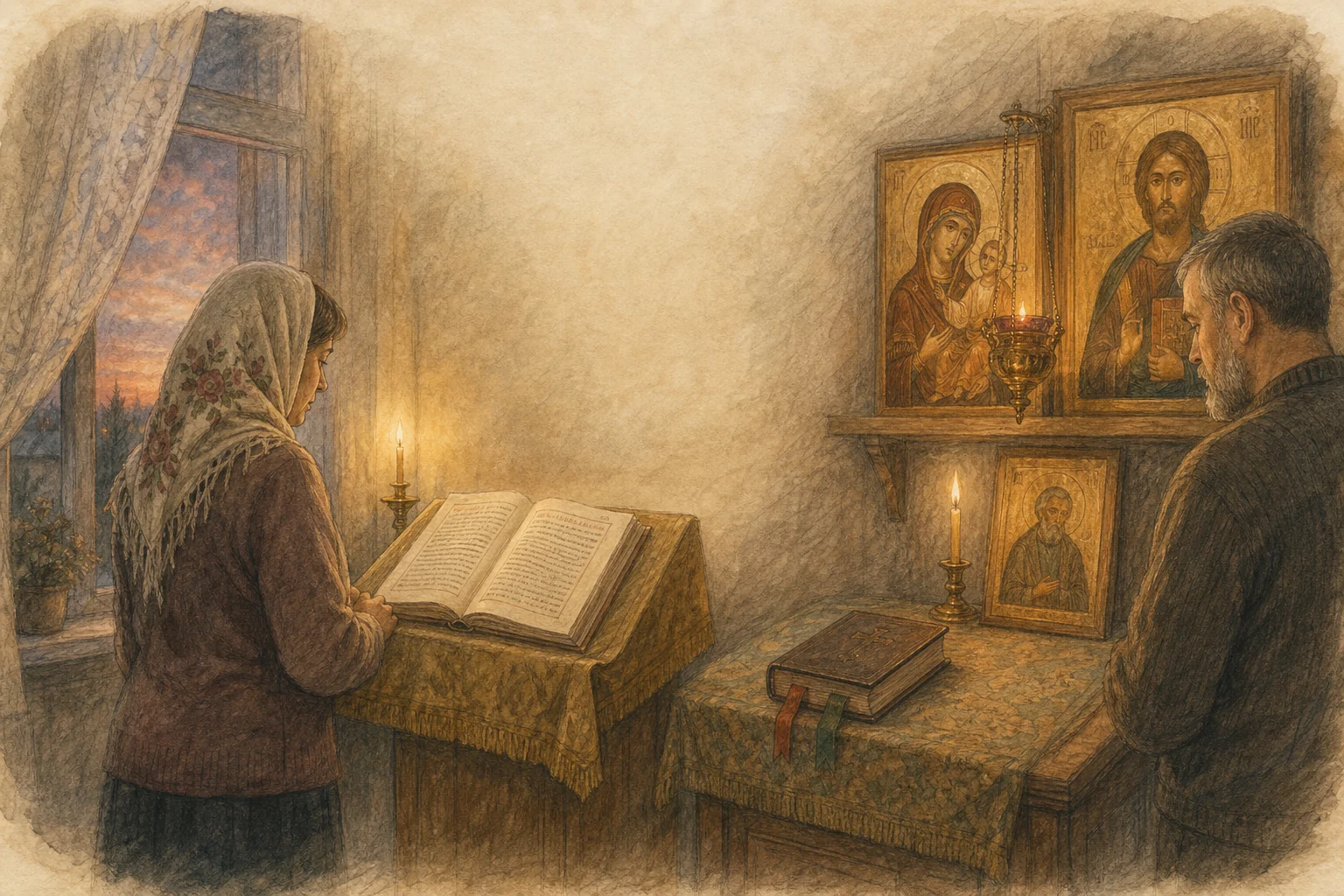
An akathist and a canon are different forms of Orthodox hymnography. An akathist is a solemn hymn of kontakia and ikoi with recurring salutations. A canon is a sequence of odes connected with biblical canticles and built from irmoi and troparia. Both may address Christ, the Mother of God, a feast, or a saint, but they have different structures and liturgical uses.
Neither is spiritually “stronger.” The appropriate choice depends on the Church day, a personal prayer rule, a person’s condition, and pastoral guidance where it is needed.
What is an akathist?
The word literally means “not sitting,” reflecting the custom of standing. The historic model is the Great Akathist to the Mother of God. Many later akathists to the Lord, the Mother of God, angels, and saints follow its form.
A normal structure alternates kontakia and ikoi. A kontakion states the theme briefly and often ends with “Alleluia.” An ikos expands the theme through a series of prayerful salutations. The thirteenth kontakion is normally read three times, followed again by the first ikos and first kontakion.
The rhythmic repetitions are easy to recognize. They can steady attention and hold petition together with praise and thanksgiving.
What is a canon?
A canon is an older and more complex hymnographic form. It has nine odes, each related to a biblical canticle. The second ode is usually omitted outside Great Lent, so worshippers commonly hear eight.
An ode begins with an irmos, linking the canon’s theme to Scripture. Troparia follow—short stanzas about the feast, saint, repentance, or petition. Katavasias, sessional hymns, a kontakion, and an ikos may appear between the odes.
Canons belong to Matins, Compline, preparation for Holy Communion, and other prayer offices. Their language often rewards slower reading and growing familiarity with biblical images.
The principal differences
- Structure: an akathist uses kontakia and ikoi; a canon uses odes, irmoi, and troparia.
- Tone: an akathist is usually festal and laudatory; a canon may be festal, penitential, memorial, or supplicatory.
- Liturgical place: the canon is a regular part of Matins; an akathist has a distinct office or is added on appointed occasions.
- Biblical foundation: a canon’s odes correspond to scriptural canticles; an akathist unfolds through repeated salutations.
- Home use: both are read at home, preferably from a reliable Orthodox prayer book and within a balanced prayer rule.
When is an akathist read in church?
Parishes may serve an akathist after a moleben, in the evening, before a venerated icon, or on a saint’s feast according to their schedule. On the fifth Saturday of Great Lent the Church celebrates a special service of praise to the Mother of God connected with the historic Great Akathist.
Not every text circulating online is used in public worship. Church approval and the rector’s decision matter. If you wish to suggest a particular akathist, speak with the parish first.
Where do we encounter canons?
A canon is heard at nearly every Matins, though a newcomer may not immediately identify its boundaries. The feast’s name and recurring troparia help reveal the theme.
Home prayer books include penitential canons to Christ, canons to the Mother of God and Guardian Angel, and canons in preparation for Holy Communion. Preparation practices vary. Someone who is ill, heavily burdened, or only beginning church life should discuss the length of a rule with a priest.
May an akathist or canon be read at home?
Yes. You do not need to turn a room into a church or wait for a sign. Choose a reliable text, a calm time, and a place before your home icons. Begin with the usual opening prayers when the prayer book gives them and read without haste.
Do not immediately promise forty consecutive days if you are unsure you can continue. A short, honest, stable prayer is healthier than an ambitious effort ending in anger and guilt.
If the text is obscure, pause, look up an unfamiliar word, or read the related passage of Scripture. Prayer does not require mechanical speed.
Must I stand?
The name akathist recalls prayer while standing, and a healthy person normally tries to do so. Illness, age, pregnancy, weakness, and pain permit sitting. The same applies to a canon.
Bodily posture can help attention but must not become a test of another person’s faith. When strength is gone, sit and continue without shame.
How should I choose a text?
Begin not by searching for the “most powerful” akathist but by asking honestly what you are praying about and what the prayer calls you to do. Prayer during illness belongs with responsible medical care; prayer about family conflict belongs with truth, forgiveness, and a willingness to speak; thanksgiving should grow into mercy.
A saint’s life explains why the Church turns to that saint and what Christians learn from the saint’s witness. A saint is not a specialist obliged to fulfill an order. Christian prayer is directed to God, while the saints are asked to pray with us.
If anxiety drives you to switch texts endlessly in search of a guaranteed formula, stop and speak with a priest.
What do these prayers not promise?
No text guarantees healing, the return of another person, a property sale, examination success, or protection from imagined harmful energy. Prayer does not control God or another person’s freedom.
Prayer can change the one who prays: restore attention, give courage to act rightly, sustain uncertainty, and reveal a neighbor’s need. Its fruit cannot be measured as a payment made by a certain number of readings.
How can Church hymns remain connected with the Gospel?
An akathist or canon should not displace Scripture. Their images often grow from biblical events, so reading the Gospel reveals meaning beyond a beautiful rhythm. When a prayer addresses a saint, read a reliable account of that saint’s life.
A healthy beginning can be simple: a short Gospel passage, several minutes of silence, one chosen prayer text, and a brief personal petition. Length changes according to strength and pastoral guidance.
What if prayer produces no feeling?
Prayer does not have to produce warmth, tears, or relief every time. Sometimes a person simply remains faithful and says words whose meaning is accepted even while emotion is silent.
Do not multiply repetitions in an attempt to break through numbness. Notice fatigue, haste, and real pain; shorten the rule and return to the Gospel. A lasting spiritual crisis deserves an honest conversation with a priest, while symptoms of depression may also require professional help.
Frequently asked questions
May I read several akathists in succession?
You may, but volume is not depth. If a long rule damages attention, family life, work, or health, shorten it and seek pastoral guidance.
Is a special fast required?
No special fast is a universal condition for reading at home. The Church’s fasting days and a personal rule belong to the whole Christian life, not to a magical preparation for one text.
May I read a canon on a different weekday?
Many home canons may be read as needed. Liturgical texts follow the calendar; use a reliable calendar if you want your rule to follow it.
What is best for a beginner?
Choose one understandable text of reasonable length and read attentively. When unsure, begin with the Gospel and normal morning or evening prayers, then ask a priest.
May I pray in my own words afterwards?
Yes. The akathist or canon gives the language of the Church, and you may then name your gratitude, pain, and request to God simply.
What should I confirm with the parish?
Check the schedule if you wish to join public prayer and ask through the contacts which akathist or canon will be served. Seek pastoral advice about a long personal rule or preparation for Communion.
The distinction helps prayer become more attentive: an akathist teaches praise and thanksgiving, while a canon leads through biblical images, repentance, and the memory of a feast. Their purpose is not a technique for results but a meeting with God within the prayer of the Church.