In Russian church usage, the word altar often means the whole sanctuary behind the iconostasis. In English, altar may instead mean the Holy Table itself. Keeping these meanings separate makes a church tour much easier to follow: an action at the Holy Table is not simply an action somewhere in the sanctuary.
The central place of the Holy Table
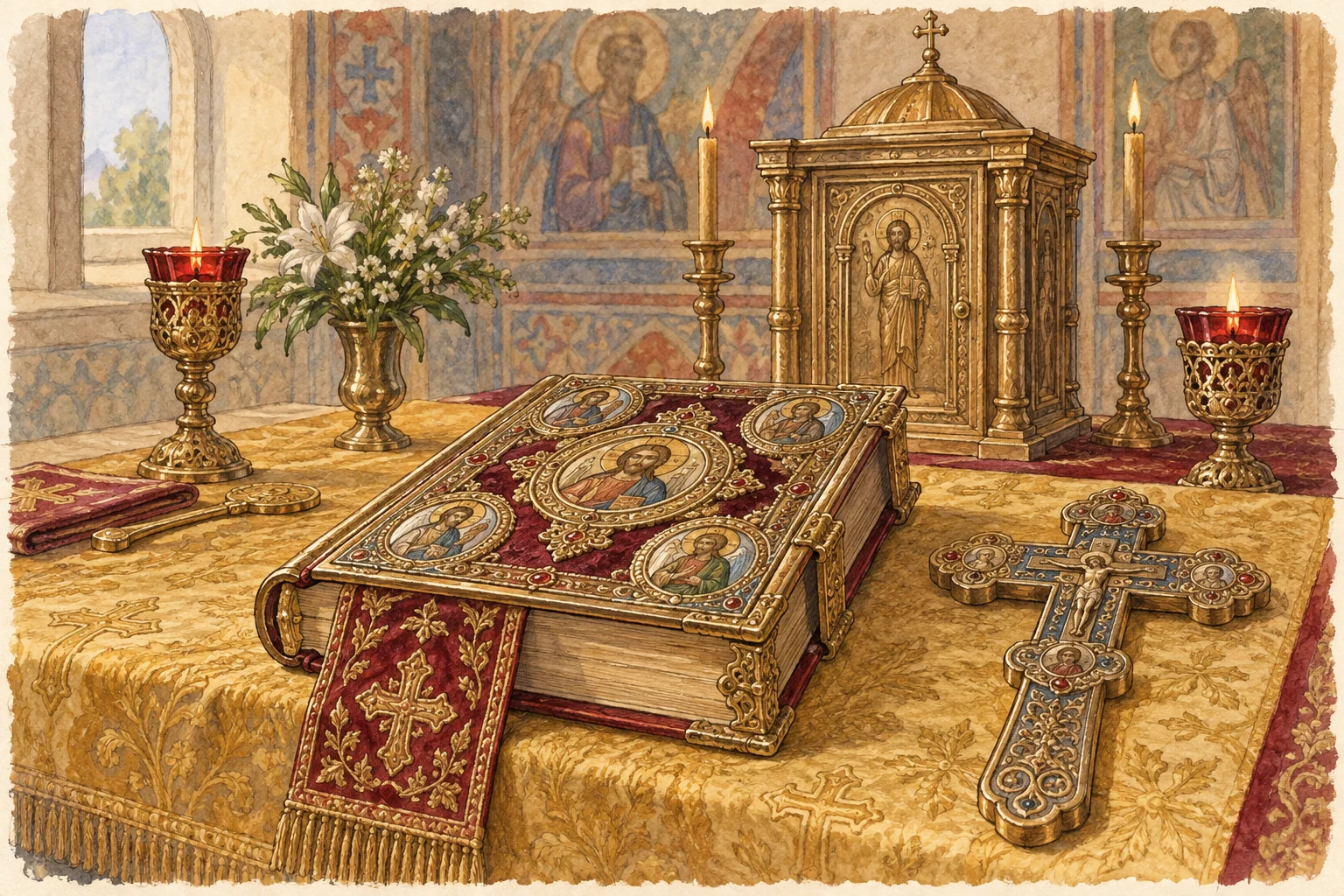
The Holy Table is above all associated with the celebration of the Eucharist. It is covered with liturgical cloths, and the Gospel Book and cross are placed upon it. It is not an ordinary work surface or a pedestal for an icon. Its name and use express Christ's presence; its liturgical meaning also recalls his burial and Resurrection.
Its outward decoration may be modest in a small church and elaborate in a cathedral. Precious metal does not make one Liturgy more real than another. When the doors are open, it is more helpful to notice the focus of the community's worship than to estimate the value of the furnishings.
The table of oblation
The table of oblation, also called the prothesis, is where the bread and wine are prepared for the Liturgy. It is usually in the northern part of the sanctuary. The Holy Table and the table of oblation are therefore not interchangeable objects, even though both belong to the same eucharistic celebration.
The Russian name for this smaller table can sound like a place for a separate bloody sacrifice. That is not its purpose. It is the place of preparation for the Eucharist. The preparation service deserves its own explanation; a detailed inventory of actions should not obscure the larger meaning of thanksgiving to God.
Why access is restricted
The sanctuary is not an open sightseeing area. A visitor should not follow a clergyman through the iconostasis, open a side door for a photograph, or treat a friend's invitation as permission from the priest responsible for the church. Access belongs to particular responsibilities and forms of service, not to personal curiosity.
This boundary does not mean that people standing in the nave matter less to God. The whole community shares in prayer, although its members have different ministries. Explain the distinction to a child as respect for the use of a place, without frightening them with punishment for an accidental mistake. Calmly stop a child who wanders through the wrong doorway and ask a server for help.
Learning without interrupting worship
A useful question after the service is, “Could someone explain what we can see beyond the iconostasis?” A parish may offer a talk or labelled photographs. These allow close observation without interrupting worship. Visitors should not expect doors to be opened or sacred objects brought out merely to satisfy curiosity.
If you are helping for the first time, ask where to leave anything you have brought and who is responsible for receiving it. Carrying a prayer request or flowers does not itself authorize entry. Hand them to the appropriate person. Understanding a church begins with understanding shared service, not acquiring permission to approach every object.
When visiting another church, do not automatically transfer arrangements from your own parish. A service passage or sacristy may be positioned differently. If you are looking for a priest to speak to, wait in the public area after worship. Searching through closed rooms will not make the meeting happen sooner and may interrupt those carrying out necessary duties.
Distinguish an object from a space
A church description may mention the sanctuary, Holy Table, table of oblation and iconostasis in the same paragraph. To keep them distinct, draw a simple relationship diagram rather than a list of impressive names: the sanctuary is a space, the two tables are within it, and the iconostasis marks its boundary with the congregation's gathering area. This explains functions, but it is not a floor plan of every church. Passages and adjoining rooms can be arranged differently.
When moving between Russian and English descriptions, check whether altar means the Holy Table or the sanctuary as a whole. Otherwise a statement about an object may be mistaken for one about an entire room. A photograph caption can say the Holy Table within the sanctuary when that is what is shown. Such precision is especially helpful to children and first-time visitors who cannot yet reconstruct unfamiliar terminology from context.
Preparation and eucharistic celebration
The bread and wine are prepared at the table of oblation. The OCA's description also places the associated vessels and implements there: the diskos, chalice, spear and coverings. Similar decoration therefore does not give the two tables identical functions. For an introduction, distinguish preparation of the Gifts from the central place of eucharistic celebration. There is no need to identify every detail immediately or try to follow each movement from the nave.
A space partly hidden from view does not turn the service into the private activity of the clergy. Someone listening from the nave is not merely a spectator because they cannot see each object. Attend to the choir's responses, the readings and the invitations addressed to the congregation. Afterwards, asking about the meaning of one action you heard is more helpful than searching during worship for a viewpoint covering the entire sanctuary. Gradually, understanding the arrangement connects what you can see with what you hear, without making uninterrupted visual access a condition of participation.