
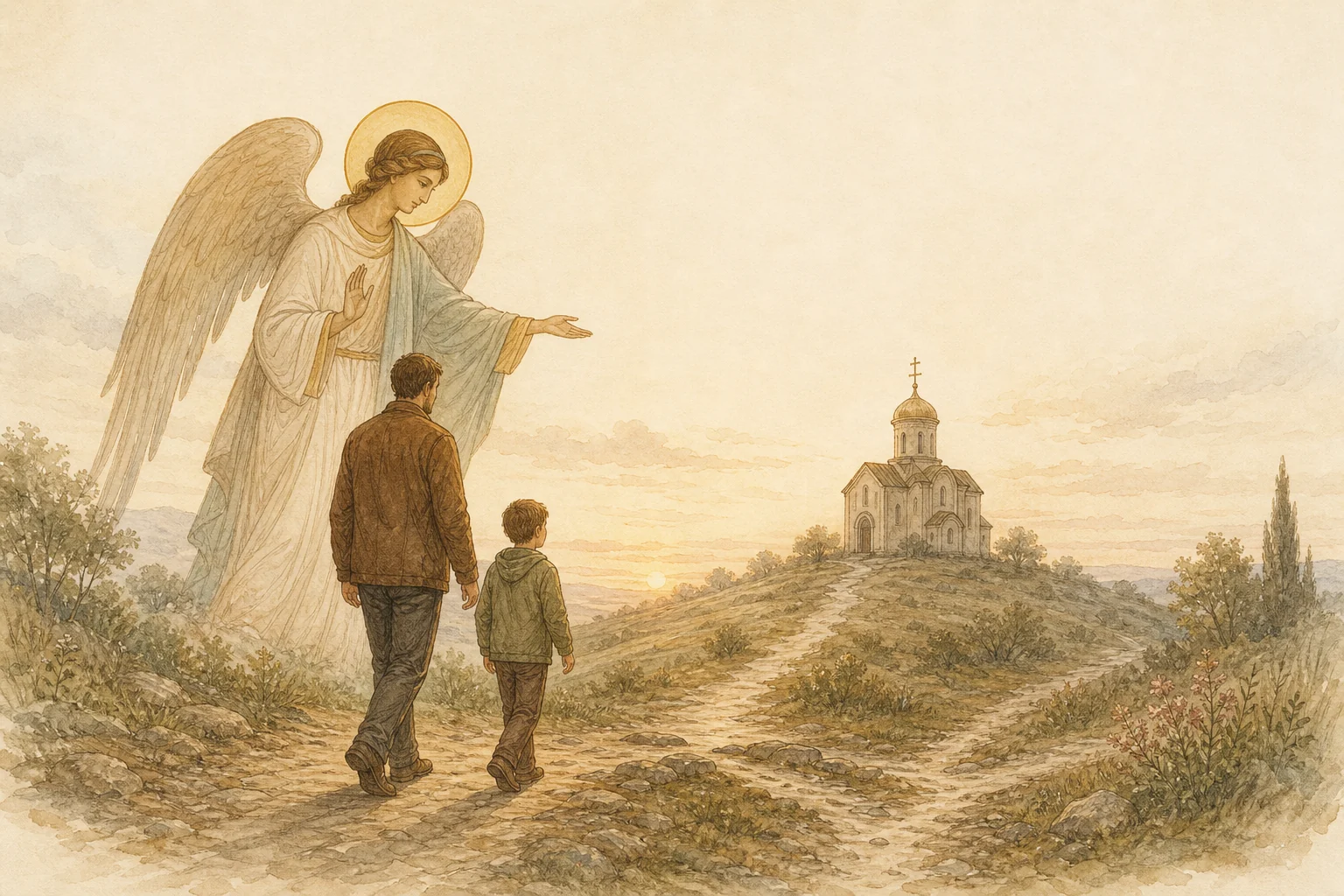
In Orthodox understanding, a Guardian Angel is a bodiless spirit created by God and entrusted with service toward a person's salvation: protecting, guiding toward good, and praying for that person. The angel is not a second god, the soul of a departed relative, a secret inner voice, or a guarantee that nothing painful will ever happen.
Church prayer connects the Guardian Angel's particular care with Baptism. Yet this care does not destroy freedom: a person may receive a call toward good and still choose otherwise.
Who angels are
The word angel means messenger and first describes service rather than bodily appearance. Angels are personal spiritual beings created by God; they are not eternal in themselves and are never equal to the Creator.
Scripture presents angels as servants of God's will, messengers, protectors, and participants in heavenly praise. Orthodox faith does not invite us to construct a fantasy biology around them.
What “Guardian” means
Guardianship includes protection from spiritual evil, a reminder of the good through conscience, prayerful accompaniment, and help on the road toward Christ. It is not a comprehensive insurance policy against every consequence.
The angel serves so that a person may come to God, not so that every human plan will succeed. Angelic help cannot be separated from truth, freedom, and responsibility.
When a Guardian Angel is given
Orthodox parish tradition speaks of particular angelic care being given in Baptism. The rite includes prayers for an angel of light who guards against evil and leads the Christian toward the Kingdom of God.
This must not be used to declare unbaptized people abandoned by God. Divine providence embraces the whole world; the statement concerns a particular gift and responsibility within ecclesial life.
Guardian Angel and patron saint
A patron saint is a human being glorified by God whose name a Christian bears. A Guardian Angel is a bodiless spirit. Saint George and George's Guardian Angel are not the same personal being.
Our guide to name days and baptism anniversaries explains why everyday language sometimes confuses them.
An angel is not a departed relative
A beloved grandfather, mother, or departed child does not turn into an angel after death. Human beings and angels are different kinds of created persons.
We may pray for the departed and keep grateful memory, but we should not appoint that person as a private protecting spirit or search for coded messages. See our guide to remembering the departed at home.
Does the Guardian Angel have a name?
The Church knows the names of certain Archangels from Scripture and Tradition, but does not teach people to guess a private Guardian Angel's name. It cannot be calculated from zodiac signs, birth dates, surname letters, or dreams.
Websites selling the “discovery of an angel's name” mix religious vocabulary with divination. A Christian needs no secret name to say, “Holy Angel of God, my guardian, pray for me.”
How an angel helps
Help may appear as strength for a good thought, restraint before a dangerous step, a timely meeting with someone supportive, or an unexpected opportunity to correct a wrong. We should not confidently attribute every coincidence to an angel.
Thank God for the good without building elaborate theories. Authentic help is known by its fruit: truth, peace, repentance, and love rather than pride or control over another person.
Why accidents and suffering still occur
Having a Guardian Angel does not mean a baptized person will never become ill, experience an accident, or die. The world is wounded by sin, human beings are free, and divine providence cannot be reduced to preventing every pain.
After tragedy, never accuse a victim by saying, “You prayed badly, so the angel left.” That judgment is cruel and presumptuous; the person needs practical care, prayer, and sometimes professional support.
Can the angel “depart”?
Church texts speak of sin grieving the angel and distancing a person from luminous angelic presence. This language describes a moral reality: a persistent choice of evil makes the heart deaf to the good.
It does not describe a temperamental guardian who abandons someone after an accidental mistake. Repentance and return to God remain possible; do not measure an imaginary distance from the angel by your mood.
Human freedom remains
An angel does not operate a person like a puppet or physically block every sin. Divine love calls, warns, and strengthens without eliminating a free response.
Therefore, “my angel told me” cannot exempt a decision from the Gospel, reason, law, and advice from responsible people. It is especially dangerous to justify risk or power over another person this way.
How to pray to the Guardian Angel
One may read morning and evening prayers from an Orthodox prayer book, the canon to the Guardian Angel, or briefly ask for protection from sin and guidance on a wise path. Prayer to the angel remains an appeal to God's servant, never a bypass around God.
A beginner can use a few attentive lines. Our guide to a prayer rule for beginners helps prevent prayer from becoming an impossible quota.
May one use personal words?
Yes: “Angel of God, help me not to fear the truth, restrain me from evil, and pray for my family.” Simple language is appropriate when it does not assign divine authority to the angel.
Do not demand an immediate sign. Prayer may end with an entirely ordinary next step: apologize, call a physician, cancel a dangerous trip, or ask for advice.
An icon of the Guardian Angel
The icon depicts spiritual reality through church symbolism: wings indicate swift service, light clothing purity, and a cross or staff the angel's commission as messenger.
It is not a portrait of the precise appearance of “your” angel. The icon supports prayer but does not automatically protect an apartment or vehicle.
May an image be carried as a charm?
A small icon can recall prayer and Baptism, but it does not act as an amulet. Metal cannot replace seat belts, medical treatment, professional instruction, or ordinary caution.
If the object is lost or broken, that does not predict disaster. Treat it respectfully, ask the parish what to do if necessary, and never pay for someone to “remove the sign.”
Dreams, feathers, and repeated numbers
Orthodoxy does not tell people to search for an angelic message in every feather, 11:11 on a clock, or overheard sentence. Constant interpretation of coincidence easily amplifies anxiety and destroys sobriety.
A dream can reflect memory, fear, and recent impressions. Do not make major medical, financial, or family decisions solely because an image in sleep seemed angelic.
How to teach a child
Say that God gives an angel the service of praying for us and helping us choose good. Do not turn the angel into an invisible police officer who records every mistake and threatens punishment.
Learn one short prayer, remember the guardian before travel, and give thanks after danger. A child must also know that a real threat requires immediate help from a trusted adult, physician, or emergency service.
The angel and practical safety
Faith never requires testing protection through risk. Use seat belts, follow instructions, take prescribed medicine, refuse to go with a stranger, and call emergency services when danger is present.
Asking for angelic protection means cooperating with the good, including the means God provides through human reason, science, and experience.
The angel and mental health
Obsessive fear that the angel has left, commands from a “voice,” or a conviction of a special mission may be symptoms of a condition requiring medical attention. Seeking qualified help is not unbelief.
A pastor can support through prayer while a clinician evaluates health; these forms of care do not compete. If a voice commands harm to oneself or another, obtain emergency assistance immediately.
How to give thanks
Thank God, read a brief prayer, and perform a good action you had previously avoided. The best gratitude becomes a more attentive life.
Do not leave food, coins, or secret notes for the angel. A spiritual servant of God requires no material payment and makes no bargain.
Frequently asked questions
Does every person have a Guardian Angel?
Church tradition especially connects personal guardianship with Baptism while also confessing God's providence over the entire world.
May I learn my angel's name?
The Church offers no method and rejects divination. A secret name is not needed for prayer.
Why did the angel not prevent a tragedy?
Angelic ministry is not a promise of painless life. We do not know the whole of divine providence and must not blame the victim.
May I pray in my own words?
Yes, asking for the angel's prayer, protection from sin, and help on the path toward God.
Is the Guardian Angel my patron saint?
No. A namesake saint was human, while an angel is a bodiless spirit.
The central message
The Guardian Angel serves God and helps a person walk toward Christ but does not replace God, conscience, Church, reason, or responsibility. Angelic presence must not become divination, an amulet, or a guarantee of life without pain.
Pray simply, test decisions by the Gospel and sober counsel, use real means of safety, and return to God after mistakes. Guardianship is revealed not in hunting for signs but in fidelity to the good.