
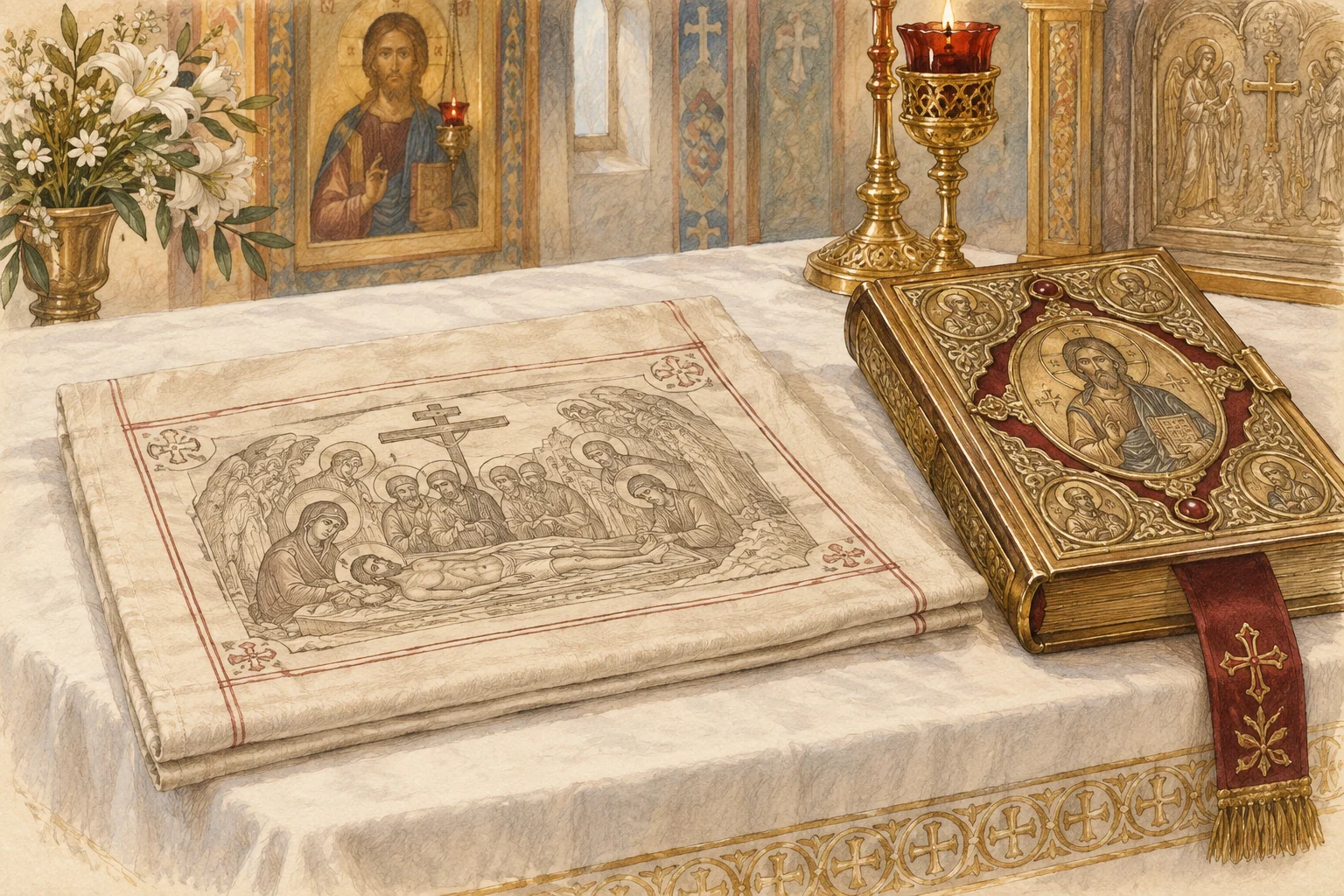
The antimension is a consecrated cloth kept on the Holy Table and used in celebrating the Divine Liturgy. Its name is commonly rendered “instead of the table.” This does not mean that the object replaces a priest, a church community or everything necessary for worship. The short translation explains a term; it is not permission to conduct a service independently.
The image and the inscription
Modern examples usually depict Christ's burial. The bishop's signature is also important, witnessing to ecclesiastical authorization for the celebration of the Eucharist. An antimension is therefore more than a piece of fabric with a religious picture. Its image and inscription express both faith and a particular community's connection with its bishop.
Inscriptions on older examples can preserve historical information. Museums may use them to establish dates and circumstances in church history. Worshippers need not try to decipher a signature from a distance during the Liturgy, however. Published museum photographs or a conversation with the priest afterwards provide better opportunities to learn.
Why the bishop's connection matters
A parish is not an independent religious group free to invent its own eucharistic arrangements. A priest serves in ecclesial communion with his bishop. The antimension gives visible expression to that relationship: the local congregation belongs to the Church, not merely to its building or its favourite parish priest.
Buying a beautiful cloth or finding an antique does not confer authority to use it liturgically. Possession and permission are not the same thing. If such an object appears among inherited belongings, ask a diocese or parish how to handle it respectfully rather than experimenting with its use.
The martyrs and the object's history
In Russian practice, a particle of holy relics is enclosed in the antimension, recalling the eucharistic community's connection with the witness of the martyrs. The object's history is more complex than one unchanging design: dimensions, images and patterns of use have developed. An old example should not be declared incorrect simply because it differs from a modern one.
Distinguish the antimension from the iliton, the cloth in which it is wrapped, and from the burial shroud used in Holy Week, often called the epitaphios or plaschanitsa. A similar image of Christ's burial does not make these textiles interchangeable. Purpose cannot be determined from the image alone.
What a parishioner needs to know
Ordinary participation in the Liturgy does not require tracking every movement involving the antimension or inspecting it closely. It is not an object for unrestricted public veneration or something to be brought out at a visitor's request. Learning its meaning should support common prayer, not distract from it.
When preparing a church description, label a photograph accurately as an antimension rather than simply a covering. Obtain permission before publishing detailed images of a particular liturgical object. For an introductory explanation, three connections are enough: the Eucharist, the remembrance of Christ and the saints, and communion with the bishop. These are more meaningful than technical handling instructions that readers are not meant to reproduce.
In study notes, separate what an antimension is today from how its history developed. The answers require different levels of detail. A short modern definition cannot describe every ancient practice, while a historical exception does not establish present parish arrangements. Keeping these questions separate prevents overly confident conclusions from a single old illustration.
The image and signature answer different questions
When looking at an antimension, distinguish the witness of the image from the information in its inscription. The image directs attention to Christ; the bishop's signature expresses ecclesial connection and authorization. A similarly printed cloth or a reproduction in a textbook does not become an antimension through visual resemblance. Understanding the object involves its consecration and purpose in church life as well as its design and material.
A museum description may name a bishop, place and date. These identify a particular object. They cannot automatically be transferred to a neighbouring exhibit or used to reconstruct a church's entire history from one inscription. For a teaching presentation, keep the image with its catalogue description. Mark an unreadable passage as unresolved instead of supplying a guessed name or year that later readers may repeat as fact. Acknowledging the limit is more useful than giving an apparently complete but unreliable caption.
More than the building itself
The antimension raises a question about what makes a gathering ecclesial. Walls, furnishings and a familiar sequence of movements do not authorize someone to assume priestly ministry independently. The OCA explains the object through the community's relationship with its bishop. For a parishioner, this recalls that a beloved church belongs to a wider church life, even when local memories have long centred on one priest or one family of benefactors.
If an old antimension is found among household belongings, do not test its authenticity by washing it, opening its stitching or extracting anything enclosed in it. Nor should it be assigned a domestic devotional use by analogy with an icon. Describe the find to a responsible parish or diocesan representative and ask how to proceed. Historical importance, careful preservation and possible liturgical use are different questions. Neither the age of the cloth nor the presence of a signature gives its private owner the answer to all three. Keeping these questions separate protects both the object and the meaning of its use.