
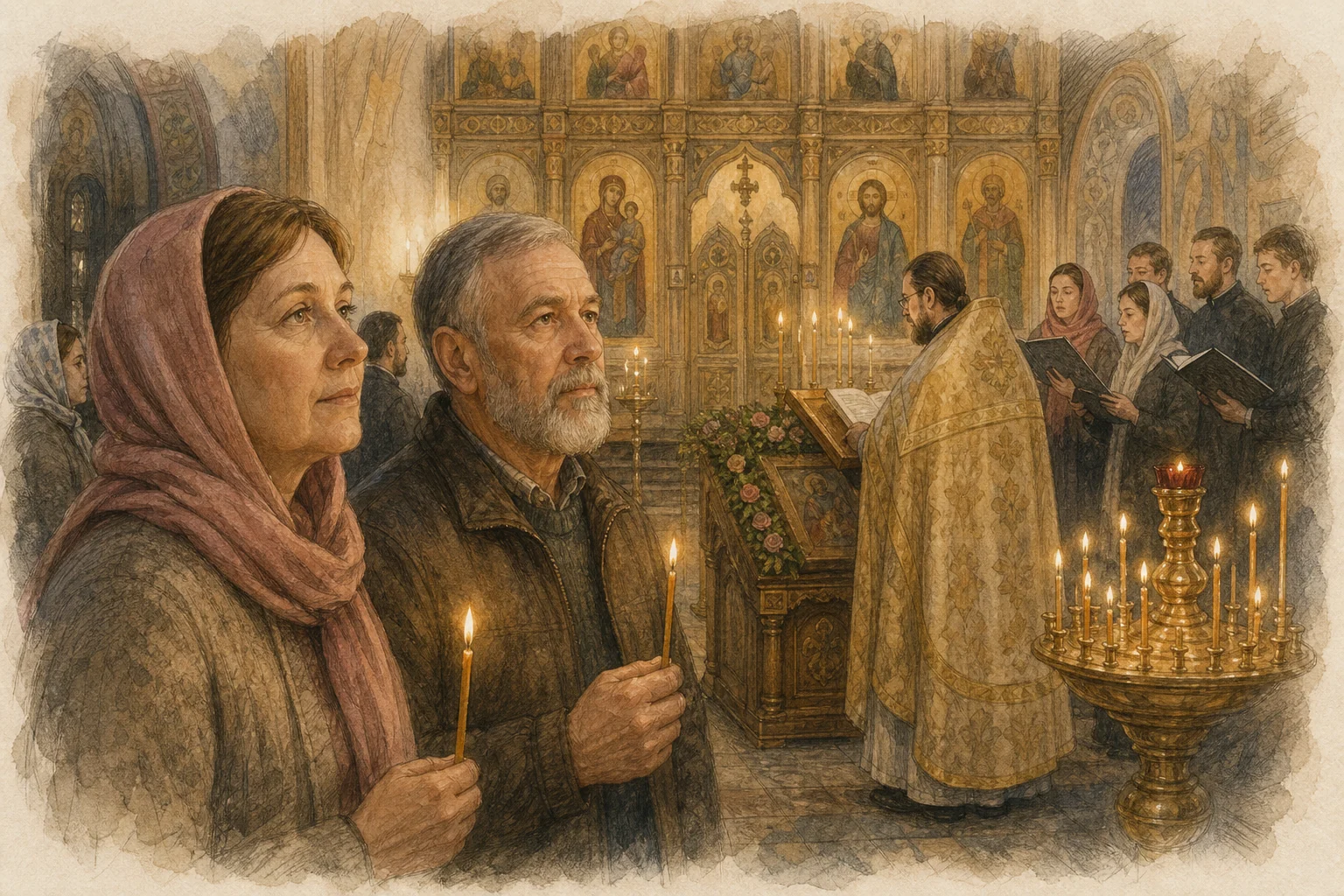
The All-Night Vigil is the solemn evening service celebrated before Sundays and major feasts. In contemporary parish practice it normally brings together Vespers, Matins, and the First Hour. Despite its historic name, it usually lasts not through the whole night but roughly one and a half to three hours. The exact length depends on the feast, the parish’s liturgical practice, the choir, and the order appointed for the day.
If this is your first Vigil, you do not need to understand every action in advance or be afraid that you must stand motionless for several hours. Come without haste, choose a place where you can pray comfortably, listen, and care for your health. This guide explains the shape of the service, but the current practice of a particular parish is best learned from that parish.
Why is it called “All-Night” if it ends in the evening?
The name preserves the memory of an ancient practice in which prayer could continue for much of the night, especially in monasteries and before great feasts. Vespers moved into Matins, the community greeted the dawn in prayer, and the faithful prepared for the Divine Liturgy.
Most parish Vigils today use a form shorter than the full monastic order. “All-Night” therefore describes the solemn character and the joining of several services rather than promising a particular finishing time.
This does not make a parish Vigil less real. The Church preserves the central meaning and images of the service while applying the liturgical order to the life of a particular community.
What are the parts of the Vigil?
A normal Sunday Vigil has three connected parts:
- Vespers, which closes the day in prayer and recalls the story of salvation from creation and humanity’s fall to the expectation of Christ.
- Matins, the longer part, with psalms, hymns, the festal Gospel, and praise of Christ’s Resurrection or of the feast being celebrated.
- The First Hour, a short conclusion asking God to sanctify the coming day.
Particular elements may change or be absent according to the day. The Litiya, Polyeleos, Gospel reading, and anointing with blessed oil all depend on the feast and liturgical order. What you observe at one service should not be turned into a universal rule for every Vigil.
What happens at Vespers?
Vespers begins with praise of God and the reading or singing of psalms. Its great movement is from creation and human loss toward hope in the coming of the Savior. Light and darkness, incense, and the opening and closing of the Royal Doors help express that story not only through words.
At the hymn “O Gladsome Light,” the Church gives thanks to Christ, the Light who has entered the world. It is one of the most recognizable and peaceful moments of Vespers. Litanies, readings, and festal hymns follow according to the day.
When a Litiya is appointed, the clergy move to the narthex or another place in the church, solemn petitions are offered, and bread, wheat, wine, and oil may be blessed. This is not a ritual for good fortune; it is thanksgiving to God and remembrance of His gifts.
What happens at Matins?
Matins unfolds the theme of the coming Sunday or feast. After psalms and prayers, the service gradually becomes brighter and more festal. At a festal Vigil the Polyeleos is sung: psalms of praise with a repeated proclamation of God’s mercy.
At Sunday Matins, one of the Gospel accounts of Christ’s Resurrection is read. The faithful listen standing and may later venerate the Gospel book or the festal icon. In some parishes an anointing with blessed oil follows. If you are unsure when or where people approach, quietly ask a church attendant.
The canon of Matins is a sequence of odes that opens the feast through biblical images and the poetry of the Church. You are not expected to distinguish every part on a first visit. Listen for the recurring theme of the day and carry away one or two prayers that you understood.
Why is the Vigil celebrated before the Divine Liturgy?
In the Church’s liturgical reckoning, the new day begins in the evening. This follows the biblical image, “there was evening and there was morning.” Sunday prayer therefore begins on Saturday evening, and a feast begins liturgically on the preceding evening.
The Vigil prepares us for the Divine Liturgy, not as a mechanical admission requirement but as a spiritual entrance into the day. In the evening the Church listens to the history of salvation, hears the festal Gospel, and learns to wait; in the morning that expectation finds its center in the Eucharist.
Your personal preparation for Holy Communion—including attendance at the evening service, fasting, and confession—should be discussed with the priest of your parish. A general guideline must not be turned into a harsh rule for someone who is ill, caring for a young child, or only beginning to return to church life.
How long does an All-Night Vigil last?
In a parish church the service often lasts around two hours, but it can be shorter or considerably longer. The rank of the feast, the number of readings and hymns, the pace of the choir, a Litiya, anointing, the number of people present, and local practice all affect the length.
The reliable way to plan is to consult the current service schedule and ask when the evening service normally finishes. This is especially important at Pascha, the Nativity, Theophany, and a parish patronal feast, whose services differ from an ordinary Sunday Vigil.
If transport, health, or family responsibilities limit your time, do not build your preparation on guilt. Ask which part of the service it would be reasonable to attend and how you can continue prayer at home.
May I arrive late or leave before the end?
It is best to arrive at the beginning because the service then makes more sense as a whole and your entrance is less distracting. Yet being late does not make entering church pointless. Come in quietly, remain near the back at first, and wait before moving if the Gospel is being read, the clergy are censing, or the church is especially still.
If you have to leave early, do so calmly. There is no need to search anxiously for a superstitiously “safe” minute. Work, travel, illness, or caring for a child are real circumstances and are not the same as contempt for worship.
If leaving early is connected with your preparation for Communion or happens regularly, speak with a priest. A personal conversation will be more helpful than an absolute rule found online.
Must I stand throughout the whole service?
Orthodox worship includes much standing, but no one is required to injure themselves. Age, pregnancy, recovery from surgery, chronic pain, weakness, and other health conditions are entirely sufficient reasons to sit down.
If the church has few benches, choose a place near a wall or a chair. You may alternate standing and resting. Do not judge another person’s faith by how long they stand: attention and honest prayer matter more than a display of endurance.
A separate guide will explain bows and prostrations. On a first visit, there is no need to copy every movement around you in haste.
How should a newcomer take part?
- Arrive ten to fifteen minutes early if you can.
- Silence your phone and choose a place from which you can see and hear comfortably.
- Do not move through the church or light candles during the Gospel reading; ask an attendant for a suitable moment.
- Make the sign of the cross and bow with attention, not from fear of falling behind everyone else.
- If the language is unfamiliar, listen for repeated petitions, the name of the feast, and the Gospel reading.
- If you feel unwell, sit down or step outside and ask for help.
The Russian site’s detailed guides to understanding a service and conduct in church are being prepared in full English form. Until then, a newcomer may always ask a simple practical question through the parish contacts.
How can I prepare at home?
No elaborate preparation is required simply to attend the evening service. You may look up the Sunday Gospel or feast, read a short account of the saint, or read a translation of the principal hymns. Do not postpone visiting until you believe you will understand everything.
Before leaving home, pause and name what you are bringing to church: gratitude, concern for someone you love, or the desire to return to prayer. Worship does not have to produce an intense feeling immediately. Its fruit sometimes appears through stillness, attention, and the willingness to return.
Frequently asked questions
Are an All-Night Vigil and an evening service the same thing?
In everyday speech, people often call the Vigil “the evening service,” but not every evening service is a Vigil. On weekdays, Vespers and Matins may be served in a different form. Read the title in the parish schedule.
Must I attend the Vigil before Sunday Liturgy?
The Vigil offers a fuller entrance into Sunday, but personal circumstances and a rule of preparation for Communion belong in a conversation with your priest. Do not pronounce a harsh verdict on yourself or another person.
May I bring a child?
Yes, while taking the child’s age and experience into account. A family may begin by attending part of the service, stand near an exit, and agree beforehand which adult will step outside when the child becomes tired.
Are blessed bread and anointing offered at every Vigil?
No. These elements depend on the rank of the particular service and local practice. Their absence does not mean that the service was incomplete.
What if I did not have time to light a candle?
You may light it at another quiet moment or after the service. A candle is a sign of prayer, not a condition that makes prayer valid.
What should I confirm with the parish?
Before a first visit, it is helpful to confirm the start and usual finishing time, whether anointing is expected, when prayer notes may be submitted, and how the parish arranges preparation for Holy Communion. Use the official schedule and parish contacts for current information.
Do not try to become an expert in the entire liturgical order in one evening. The Vigil opens gradually: through familiar psalms, the Gospel, common silence, and the choice to return. One calm first visit is already a real beginning.