
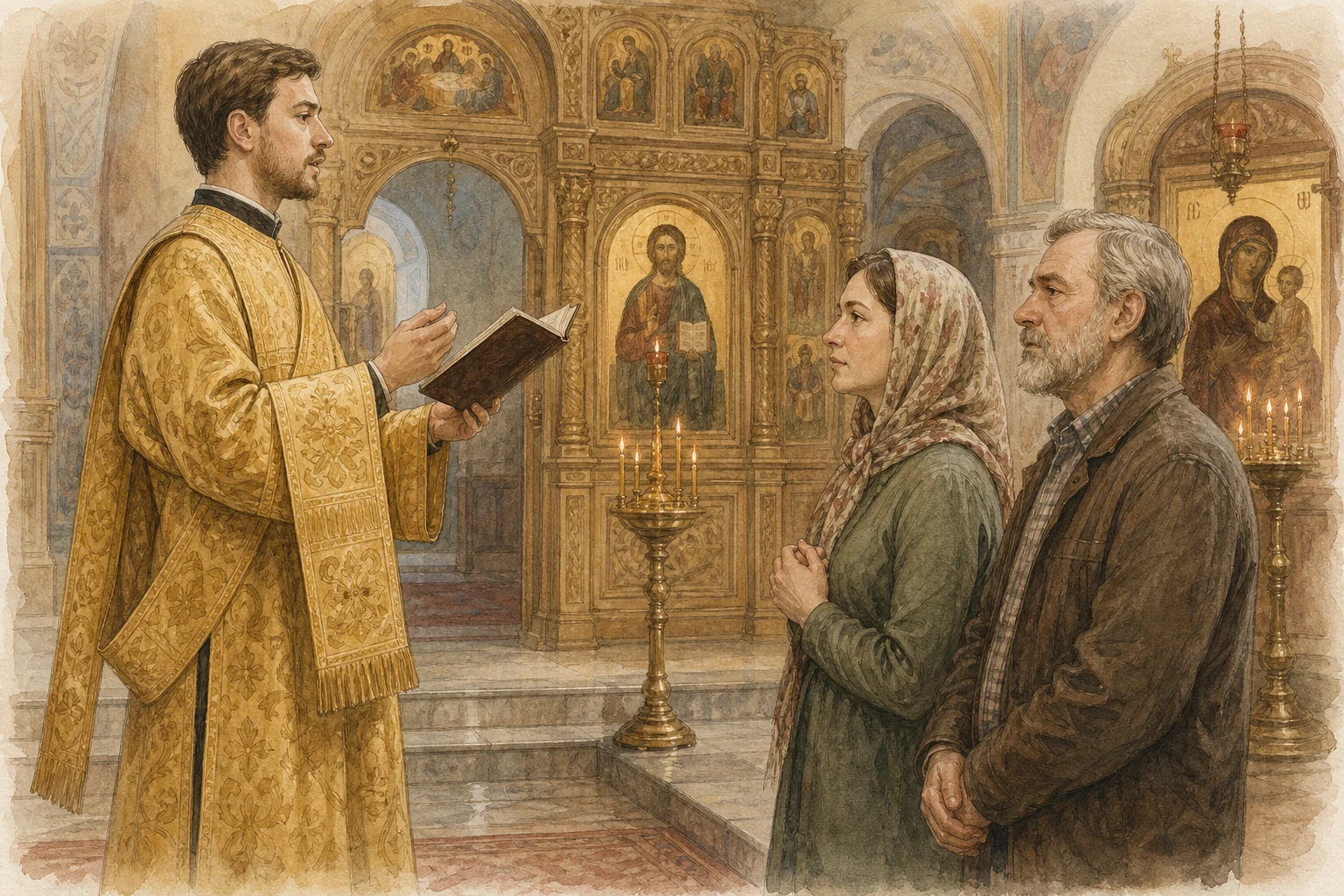
An ektenia, or litany, is a sequence of short petitions proclaimed by a deacon or priest during an Orthodox service. The choir and people respond, “Lord, have mercy,” “Grant this, O Lord,” or “To Thee, O Lord.” It is not a pause between more important parts. It is the Church’s common prayer for peace, people, salvation, and particular needs.
The term may be unfamiliar, but participation is simple: listen to each petition, make it your own, and join the response of the community. There is no need to memorize the names of every litany beforehand.
What does the word ektenia mean?
The term comes from a Greek word connected with earnest and sustained prayer. Each petition briefly names what the community brings before God: peace from above, the welfare of the Church, travelers, the sick, those who suffer, the departed, deliverance from danger, or thanksgiving.
A litany is structured as dialogue. The deacon summons and leads the people in prayer, the choir gives the audible response on behalf of those assembled, and the priest concludes with an exclamation. Worshippers are not spectators; the choir’s answer also expresses their prayerful assent.
Why do we answer “Lord, have mercy”?
Mercy in the Church’s prayer means more than the cancellation of punishment. It is an appeal to God’s loving help, healing, and compassion. We acknowledge that we cannot arrange everything by our own power and entrust ourselves and the world to God.
Repetition is not emptiness. The same response follows different petitions and receives a concrete meaning each time: peace, a sick person, a city, a traveler, or forgiveness. Repetition also gives a distracted mind a place to return.
There is no need to respond more loudly than the choir. You may answer softly or inwardly while preserving the common shape of worship.
The Great Litany: prayer for the whole world
The Great, or Litany of Peace, often stands near the beginning of the Divine Liturgy, Vespers, and Matins. It opens with “In peace let us pray to the Lord.” Peace means both inward peace and the reconciled condition in which a community can turn to God.
The petitions embrace the Church, country and city, the temple, favorable weather and the fruits of the earth, travelers, the sick, captives, deliverance from affliction, and salvation. This order widens personal prayer. We arrive carrying our own pain and learn to remember the needs of others.
At the end, the Church remembers the Mother of God and all the saints and commends ourselves, one another, and all our life to Christ our God.
The Little Litany: a brief return to common prayer
The Little Litany begins, “Again and again in peace let us pray to the Lord.” It is shorter and often concludes a section of psalms or hymns.
Its repetition gathers attention after a long reading. The Church reminds us that what we have heard should become not merely information but a common turning toward God.
The Augmented Litany and earnest petition
The Augmented Litany expresses intensified prayer, and the choir often sings “Lord, have mercy” three times. It may commemorate Church and civil authorities, clergy, parishioners, benefactors, the living, and the departed according to the service and local setting.
“Augmented” means earnest or intensified, not magically more powerful. Repetition does not compel God to obey a demand; it expresses perseverance and the community’s heartfelt participation.
Litanies of supplication and for the departed
In a litany of supplication, the response is “Grant this, O Lord.” The Church asks for a peaceful day or evening, a guardian angel, forgiveness, a good end to life, and a Christian answer before God.
A litany for the departed asks forgiveness, rest, and God’s mercy for those who have died. It is heard at a panikhida, funeral service, and other appointed moments.
Different litanies should not be ranked by supposed strength. They correspond to different moments and needs in the prayer of the Church.
What does the deacon do?
The deacon normally proclaims petitions before the Royal Doors or on the solea, oriented toward both altar and people. His orarion marks his ministry; lifting its end calls the community to attention and prayer.
If no deacon is present, the priest proclaims the litany. The meaning remains: the minister leads the petitions, the community responds, and the concluding exclamation directs the prayer to the Holy Trinity.
How can a worshipper participate?
- Listen to the petition, not only to the choir’s response.
- When the sick, travelers, or departed are mentioned, quietly remember a particular person.
- At “let us commend ourselves and each other… unto Christ our God,” consciously entrust what troubles you to God.
- Respond calmly without competing with the choir.
- If your attention wandered, the next “Lord, have mercy” can be a place of return rather than a reason for self-reproach.
The litany joins personal need to the prayer of the whole Church. It does not forbid prayer in one’s own words; it gives that prayer a wider horizon.
Why are litanies repeated during one service?
Worship has different movements. A litany may conclude one section, open another, or gather what was heard into a prayerful response. Great, Little, Augmented, and Supplicatory Litanies can therefore appear more than once.
A person also changes during the service: arriving distracted, hearing Scripture, giving thanks, and remembering others. The recurring form accompanies that movement and returns the heart to what matters.
How does a litany join common and personal prayer?
We come to church carrying a particular story: a loved one’s illness, family conflict, gratitude, or fear. The litany does not erase that request; it places it beside prayer for peace, travelers, those who suffer, and people we do not know.
Personal pain ceases to be the only center of the world, while the community carries it with us. When the sick are mentioned, the name of someone we love is included even when it is not spoken aloud.
How can a litany help distraction?
Attention inevitably wanders during a long service. Instead of becoming angry with yourself, use the dialogue as a return: hear one petition, understand it in a single sentence, and answer honestly, “Lord, have mercy.”
Do not force a special feeling at every response. Attentive assent may be dry and quiet; it is still real prayer, because a person chooses again to turn toward God and another person’s need.
Frequently asked questions
Must I make the sign of the cross after every “Lord, have mercy”?
There is no universal requirement to cross yourself after every response. Follow the parish’s calm practice and make the sign of the cross attentively rather than mechanically copying every movement nearby.
May I answer aloud?
Yes, softly and in the common rhythm. The choir offers the established response on behalf of the people; an individual voice should not cover it or distract others.
Why is the response sometimes sung three times?
The triple response expresses earnest prayer and belongs to the order of a particular litany. It is not a numerical formula guaranteeing an outcome.
Are names from prayer notes read during a litany?
Names may be commemorated at appointed moments, but the order depends on the kind of note and parish practice. Commemoration at Proskomedia and the general petitions of a litany are related but not identical.
What if I did not hear a petition?
Do not worry. Join the response and continue listening. The meaning of worship is not destroyed by one missed word.
What should I ask the parish?
No special preparation is required for a litany. If you want to understand a particular commemoration, prayer note, or unfamiliar petition, ask after the service through the parish contacts.
The litany reveals that Christian prayer does not close around a private wish. In a few short responses, a person learns to pray for peace, neighbors, strangers, and all of life—and to entrust it again to God.