
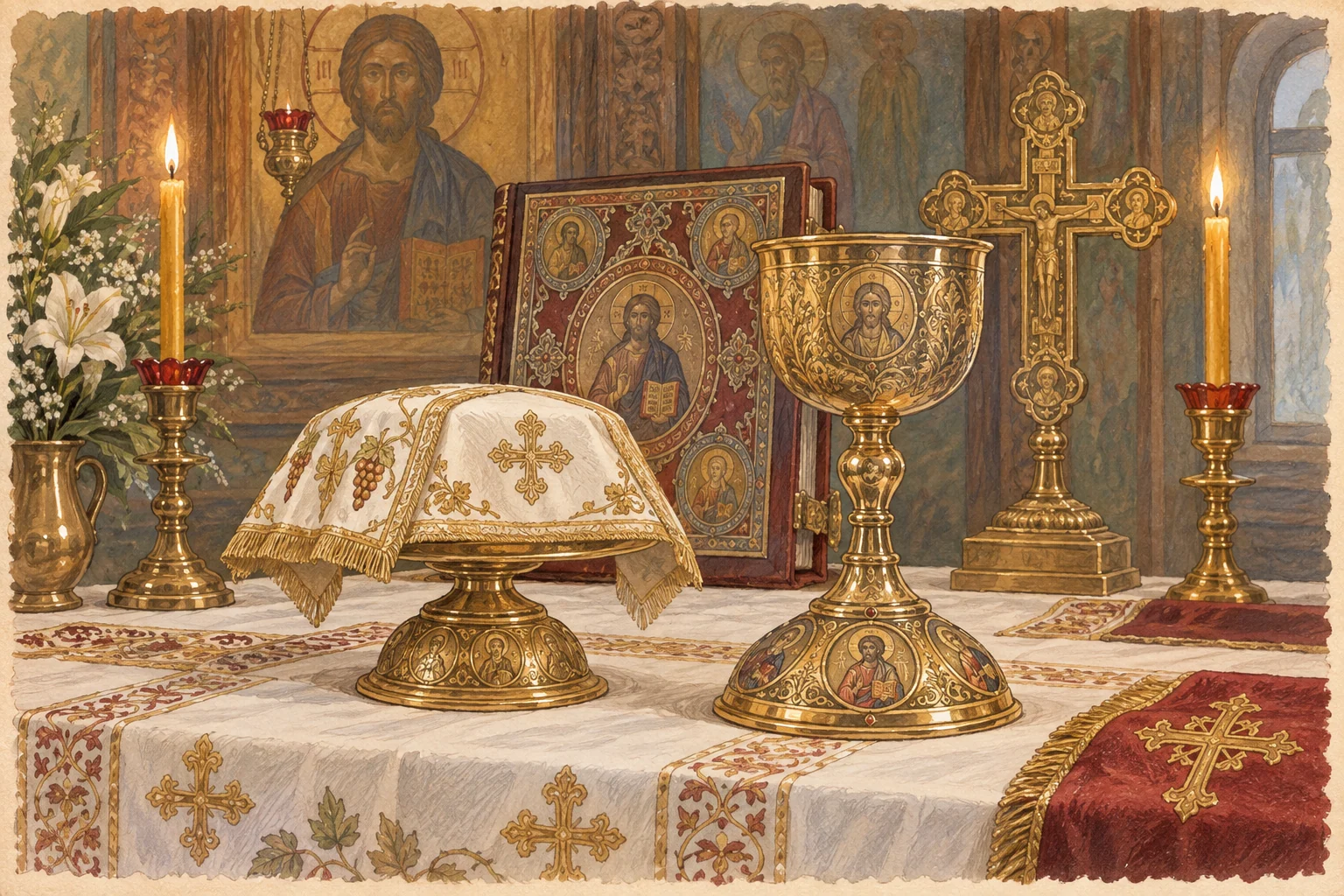
The Eucharistic canon, or anaphora, is the central prayer of a full Divine Liturgy. The Church gives thanks to the Father, remembers Christ's saving work, and invokes the Holy Spirit. Here “canon” does not mean a devotional canon such as one found in a prayer book. The same term is used for different liturgical forms.
Thanksgiving and the Congregation's Response
Calls to attention and to lift up our hearts lead into the anaphora. Priest and people are not conducting independent conversations: the choir's responses express the assembly's assent. Even where some prayers are spoken quietly, worshippers are not spectators at a private clerical act.
The opening gives thanks for existence, salvation, and God's care, including blessings we do not recognize. Thanksgiving does not require us to describe suffering as something good. It turns toward God as the source of life and hope. Saint Basil's anaphora develops this theme at particular length.
Remembrance Reaches Beyond the Past
The singing of “Holy, Holy, Holy” joins the Church's prayer to the biblical vision of heavenly praise. The prayer then recalls the Last Supper and Christ's words concerning his Body and Blood. It does not stop with that meal, but remembers the Cross, burial, Resurrection, Ascension, and the awaited Second Coming.
This remembrance is called anamnesis. It is neither a theatrical re-enactment nor an attempt to repeat the sacrifice of Calvary. The Church gives thanks for Christ's unique saving work and participates in the life he gives. Mentioning his future coming shows that this prayer looks toward the fulfilment of God's promises as well as toward events already accomplished.
The Invocation of the Holy Spirit
Epiclesis means invocation. In the Eucharistic prayer, the Church asks for the Holy Spirit to descend upon the assembly and the offered Gifts. This expresses faith in God's action, not confidence in a human technique that consecrates bread and wine through precisely managed words.
It is therefore unhelpful to search for one exceptionally powerful second and treat everything else as waiting. The anaphora is a connected prayer of thanksgiving, remembrance, and consecration. Outward gestures support reverence but do not operate independently of the service's meaning. If your health prevents a bow or prostration, you can remain still and attentive.
Why We Remember Other People
After the consecration, the prayer embraces the saints, the living and departed, the Church, and the needs of the world. We ask for more than personal well-being. Communion with Christ cannot be separated from love for other people. Remembering the sick and those in trouble also recalls responsibilities that continue after we leave church.
Read the entire anaphora at home in a language you understand, noticing the transitions between its sections. At the service, recognizing those transitions and joining the responses is enough for a beginning. Do not try to analyse every detail, take explanatory notes, and pray all at once. Understanding grows gradually; attention remains directed toward God, to whom the Church offers thanksgiving, rather than toward the mechanics of the rite alone.
Distinguish the prayer's text from the musical arrangement of responses. Extended choral singing may accompany priestly words you cannot hear from your place; the anaphora has not paused. When reading at home, notice indications of who speaks. If a moment remains unclear, remember the hymn's name and ask afterwards, when the text can be opened without interrupting worship.
Terms that serve understanding
“Anaphora,” “anamnesis,” and “epiclesis” help distinguish aspects of the prayer, but knowing Greek terms does not make participation more valid. Begin with the plain-language landmarks: thanksgiving, remembrance, and invocation. If an explanation becomes crowded with terminology, return to the text and ask who is being addressed and what is requested. A technical name should help you read the prayer rather than take its place or turn worship into a vocabulary examination.
Responding with Amen
The assembly's response expresses assent to the prayer, not a judgement on how beautifully the priest delivered the exclamation. Read a few lines before and after a familiar response in advance. The short word will then be more than an audible marker at the end of extended singing. Do not make your own pronunciation a test of anyone else's participation: someone may listen silently, have difficulty hearing, or follow a translation. The volume of a person's voice cannot disclose the quality of their attention.
Thanksgiving and unnoticed gifts
Our everyday gratitude often depends on receiving a desired outcome. The anaphora invites a wider view. Someone disappointed by a working week might still recognize a friend's support, an opportunity to put a mistake right, or a relationship preserved through difficulty. Such observations do not establish that hardship is good in itself. They help prevent one failure from becoming the whole account of a life. With that attention, shared thanksgiving becomes possible without pretending that everything is already well.
Not a separate ceremony within the Liturgy
Studying the central prayer should not detach it from the readings, confession of faith, preparation for Communion, and subsequent thanksgiving. Avoid planning attendance only around the guessed starting time of the “most important part.” The service has a connected movement. If circumstances limit your time, discuss them with the parish without turning a personal limitation into a rule for everyone. When studying at home, read the section after the anaphora as well. Notice where the Eucharistic prayer leads and how the request for sanctification relates to the faithful receiving Communion. This wider setting prevents detailed analysis of one passage from obscuring the purpose of the whole celebration.