
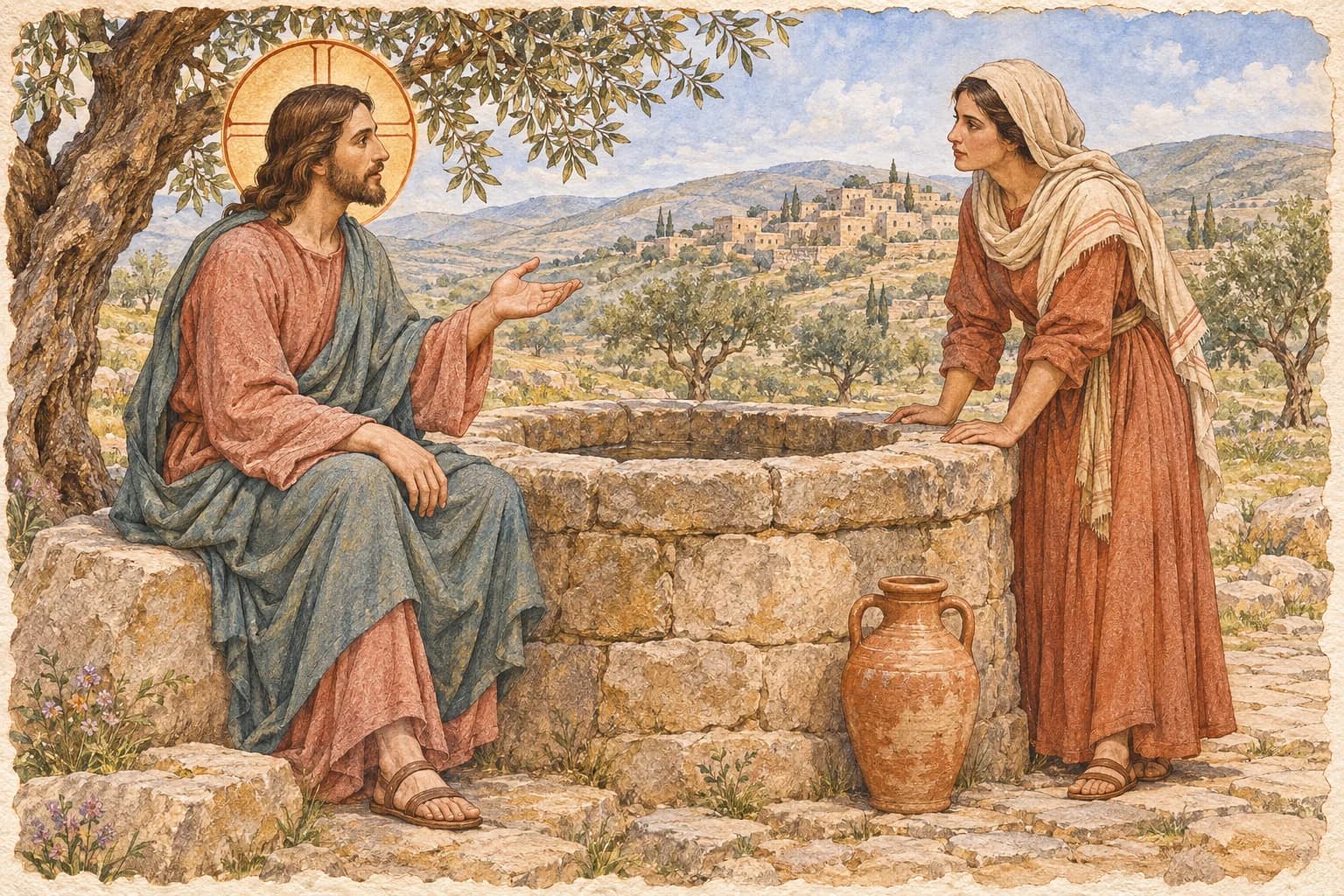
Church tradition honours the Samaritan woman who spoke with Christ at the well as Saint Photini. John chapter four does not itself give her name. Distinguishing the Gospel account from later tradition avoids attributing details to a source that does not contain them.
The conversation begins with water and moves to life, faith and worship. The woman is not a silent backdrop: she asks, responds and tells others about the encounter. The Gospel shows the possibility of change rather than defining someone solely by past mistakes.
The episode should not be used to humiliate women or expose another person’s private life. Christ addresses a particular person. Identifying a patron for the modern Russian name Svetlana requires church guidance rather than a simple resemblance between translations.
Read the whole conversation, noticing the woman’s questions and Christ’s responses. If seeking your patron, check your baptismal name. A personal connection with the story begins in attentive reading rather than guessing a suitable image.
What happens at Jacob’s well
The account begins in Samaria at the well associated with Jacob. Christ asks a woman who has come there to give him water. Her surprise matters: a Jewish man addresses a Samaritan woman despite strained relations between their communities. The Gospel does not erase that historical difference; it describes an encounter that moves beyond habitual estrangement.
The conversation gradually passes from ordinary thirst to living water, and from an everyday need to life with God. At first the woman understands literally and asks about water that would spare her repeated journeys to the well. This does not make her foolish. The narrative shows understanding unfolding through questions. Readers can follow that movement too, without expecting themselves to possess every theological concept at the outset. The concrete setting remains important: a profound conversation begins with an ordinary request.
Her personal history and dignity
Christ speaks about the woman’s life, and she recognises him as a prophet. Retellings sometimes narrow the entire account to the number of her marriages. Yet the text also contains her questions, religious expectation and capacity to bring other people to encounter Christ. Her biography does not exhaust her identity or close off her future.
The evangelist does not explain the circumstances of every change in her family life. Readers should therefore not supply an accusatory psychological biography or confidently explain events about which the source is silent. Attentive reading preserves both elements: Christ does not conceal the truth, and he continues to address her as a responsible person capable of listening and responding. This balance is lost when the episode becomes only a lesson about somebody else’s presumed moral failures.
Worship in spirit and truth
The woman raises the question of the place of worship: the Samaritan mountain or Jerusalem. This is a specific religious dispute, not an arbitrary change of subject. Christ’s reply leads towards worship of the Father in spirit and truth. It cannot simply be reduced to the slogan that churches are unnecessary: the conversation concerns the coming of the Messiah and a new disclosure of humanity’s relationship with God.
Orthodox interpretation does not set interior life against the Church’s worship. Entering a building is not a substitute for faith, but private feeling is not made the sole measure of truth either. Read the conversation to its conclusion, noticing the explicit discussion of the Messiah. The words about worship then remain part of encountering Christ instead of becoming support for whichever position a reader already finds convenient.
From a personal encounter to witness in the town
The Samaritan woman leaves her water jar and goes to the townspeople. She does not deliver a fully developed lecture; she invites them to come and consider the encounter themselves. They then approach Christ and listen to him. The narrative distinguishes her testimony from the experience of those who respond. Her role matters, but she does not take the Saviour’s place.
This offers a useful way to understand Christian witness today. You can explain what led you towards faith, suggest reading the Gospel together or invite someone to a service. The other person should still be able to ask questions and investigate the source personally. A witness need not know everything and should not obtain agreement through pressure. The task is to point honestly towards an encounter that has affected one’s own life, allowing others to listen for themselves.
The name Photini and subsequent church tradition
The name Photini, her subsequent preaching and her martyrdom belong to the church’s life of the Samaritan woman. When reading these details, identify the source: John chapter four contains the meeting at the well, while the later life is conveyed through tradition. This prevents the impression that every episode of the hagiography can be found in that same Gospel passage.
In Russian church practice, the name Svetlana is often associated with Photini, but there are other saints with related names. Establishing a name day requires the actual baptismal record or clarification from the parish. Icons may show the Samaritan woman beside Christ at the well or separately as a martyr. The full inscription helps connect the image with the appropriate life and prevents different saints from being merged because their names sound alike.
A question for reflection
Which of the woman’s questions helps you express your own question about faith?