The iconostasis separates the sanctuary from the nave while presenting images of Christ, the Mother of God and the saints to the congregation. It is best approached as a connected composition, not a decorated wall. Nor does every Orthodox church have a tall screen with five tiers: a smaller screen can fulfil the same basic purpose.
Begin with the local tier
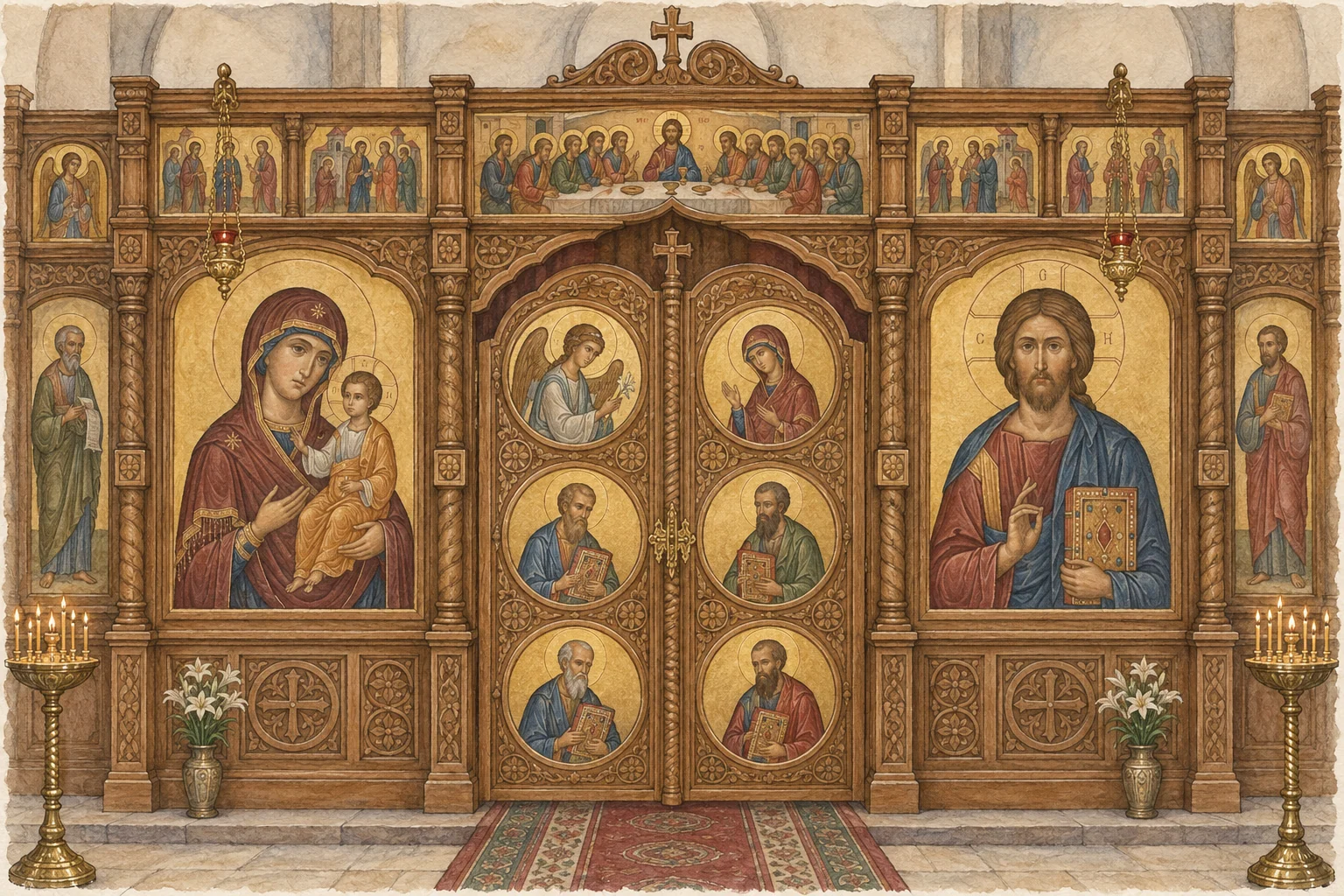
Looking towards the sanctuary from the nave, Christ's icon is usually on the right of the central Holy Doors and the icon of the Mother of God on the left. This lowest, or local, tier also includes especially venerated images and the patronal icon. The latter identifies the saint or feast to which the church is dedicated; size alone will not reliably identify it.
The side doors may show archangels or holy deacons. The Annunciation and the evangelists often appear on the Holy Doors. These are useful landmarks, not a guarantee that every detail will be identical everywhere. For an unfamiliar arrangement, read the inscriptions or ask someone who knows the history of that particular screen.
The Deesis: prayer before Christ
Deesis means supplication. Christ stands at the centre of this composition, with the Mother of God, John the Baptist and other saints turned towards him. Its meaning is not that Christ is inaccessible and must be persuaded to care. It expresses the prayerful unity of the Church before the Lord.
Find the centre first, then follow the direction of faces and gestures. This is more helpful than trying to memorize every name immediately. An iconostasis is not an examination in church history. Note an unfamiliar name and read about it later, when you can give it proper attention.
Feasts, prophets and forefathers
The festal tier depicts events in the history of salvation. A prophetic tier points towards the Old Testament expectation of the Saviour, while a forefathers' tier recalls the righteous of ancient times. In a developed Russian iconostasis these form an extensive theological composition, although their arrangement, contents and number can vary.
Do not assume that every upper image is a portrait of one saint: it may depict an event involving many people. Look at the scene before reading its title. If details are too distant to distinguish, an authorized photograph or published description is more useful than moving forward during the Gospel reading.
Looking without interrupting prayer
For a first visit, choose one tier and one image. After the service, ask who is represented, what event is shown, and how the image relates to the church's dedication. You need not identify everything while the congregation is praying. Attention to the service matters more than completing an artistic survey.
Do not arrange the icons mentally into a hierarchy of stronger and weaker sources of help. Their height, age or costly coverings do not determine God's willingness to hear prayer. The opening of doors during worship is a separate topic: a photograph of closed doors cannot tell you what was happening at that moment. Begin instead with the person or event depicted and its place in the Church's witness to Christ.
In an old church, some original icons may have been lost or replaced. Questions about the artist and date of each tier belong to the history of that particular building. A parish or museum description can help. The general arrangement explains a theological purpose but cannot establish an icon's date or authenticity from its appearance alone.
Why different periods appear together
An iconostasis may place the Mother of God with the Child, Gospel events and saints from different centuries within one composition. This is not a chronological mistake or an attempt to portray a single historical meeting. The OCA's account explains the screen as a witness to the Church's unity with Christ and the saints. Asking whether everyone could have met in one room therefore misses its purpose: this is a liturgical expression of communion, not a group portrait of eyewitnesses.
The same approach helps explain the image of the Mystical Supper often placed above the central doors. It connects with the eucharistic gathering rather than merely filling a decorative space. Nevertheless, check the actual screen before claiming that a particular image occupies a particular position. A general explanation describes a familiar arrangement; it does not require mentally adding an absent icon or declaring a smaller church incomplete.
Preparing a short explanation for someone else
Three questions are enough to begin: who is depicted, what event is shown, and how does this image relate to its neighbours? Do not start by naming every tier if your listener cannot yet distinguish the central and side doors. Identify a visible landmark, then add one connection. An evangelist's image, for example, can be linked with the book from which the Gospel was read, without immediately introducing a detailed history of painting.
In your notes, distinguish observation from explanation. Seeing figures turned towards the centre is not the same as knowing every saint's name. Leave an illegible inscription as a question. If using a photograph, retain its caption naming the church and its source: another cathedral may have a different arrangement. This will not amount to a complete art-historical survey, but it gives a newcomer dependable orientation without filling gaps with invented details. It also leaves space for a later, more informed visit when the individual images can receive proper attention.