
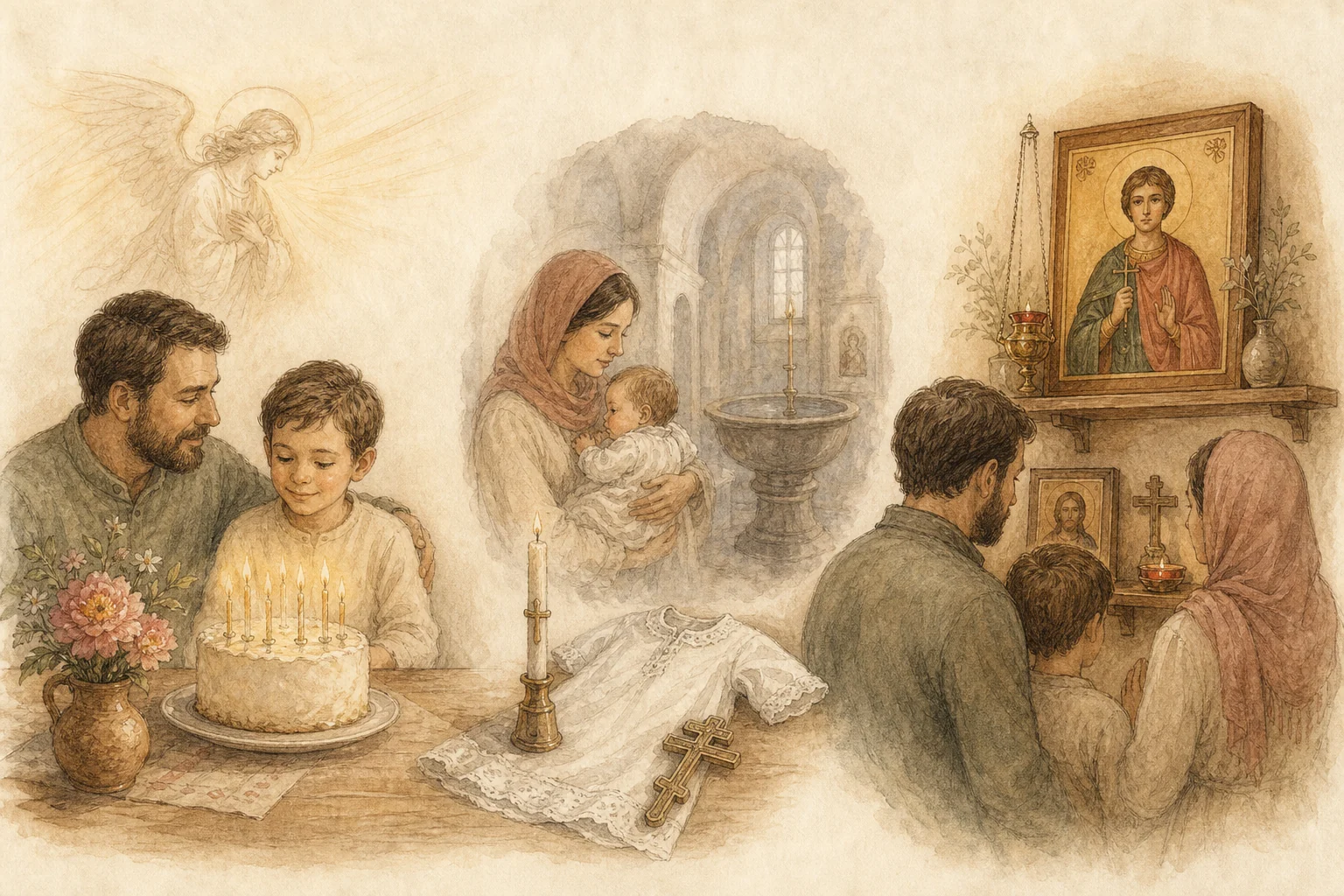
A name day is the Church's commemoration of the saint whose name a Christian bears and honors as a heavenly patron; a birthday marks natural birth, while a baptism anniversary remembers entry into the life of the Church. The expression “Angel Day” is used in two ways: colloquially it often means the name day, while stricter explanations also apply it to the date of Baptism.
A patron saint and a Guardian Angel are not the same person. The saint was a human being glorified by God; an angel is a created bodiless spirit. Both serve and pray according to God's will, but they should not be confused.
What a name day means
A name day, or feast of one's namesake, is connected with the liturgical memory of a particular saint. A Christian thanks God for the patron, learns the saint's life, asks for intercession, and tries to imitate that person's fidelity.
It is not merely a second birthday requiring a party. Its ecclesial meaning appears through prayer, worship, Confession and Communion with preparation, mercy, and reconciliation.
Who a patron saint is
This is the saint in whose honor a person received a Christian name at Baptism. Patronage is not a magical contract: the saint prays for the Christian, and the Christian learns from the saint's life.
When a baptism certificate, parish note, icon inscription, or clear memory of parents and sponsors survives, that information matters more than a random calendar algorithm.
What people call Angel Day
In ordinary speech, “Angel Day” very often means the name day. The usage has a long history because a heavenly patron could be called an angel in the broad sense of messenger and protector of a namesake.
Church reference works may also call the date of Baptism Angel Day, because the baptized Christian receives the prayerful care of a Guardian Angel. It is therefore wise to ask which date a speaker means.
A patron saint is not a Guardian Angel
Saint Nicholas, Great Martyr George, and Blessed Xenia were human beings. A Guardian Angel belongs to the angelic world and does not acquire the name of a human saint simply because the baptized person bears it.
Do not search for “your angel's name” through numerology, a birth date, or divination. Our separate guide explains the Guardian Angel in Orthodox teaching.
Name day and birthday
A birthday concerns natural life, family, gratitude, and the completion of another year. A name day concerns a saint's church commemoration and asks what that person's fidelity can teach us now.
One feast does not cancel the other. An Orthodox Christian may celebrate a birthday warmly without considering it spiritually inferior and also observe the patron's memorial.
Why remember the baptism anniversary?
Baptism is not only an event from infancy or an archive formality. It is the beginning of life in Christ and in the ecclesial community; its anniversary invites thanksgiving and renewal of baptismal commitments.
When the date is known, mark it with prayer, the Liturgy, and a work of mercy. When it has been lost, do not panic: a valid Baptism does not disappear because a record is missing.
How to identify your patron
Begin by learning whom you were named for at Baptism. Ask parents and sponsors, inspect a certificate, look for an inscription on a baptismal icon, and contact the former parish when possible. Sometimes the saint was explicitly chosen during catechesis.
When reliable information cannot be found, speak with a priest. He can help identify a patron among saints with the same name according to baptismal date, family memory, and stable church practice.
The nearest-feast rule
A popular calendar rule chooses the first commemoration of a namesake saint after one's birthday. It is a common guide, especially when older information has been lost.
Yet software cannot replace a patron already known or effectively rename a baptized person for another saint. The nearest date is an aid in uncertainty, not a universal decision machine.
When several saints share the name
The calendar may contain many Alexanders, Johns, Marys, Georges, and Annas. The Church honors them all, but one particular saint normally becomes the personal patron.
Learn the full title—for example, Great Martyr George the Victory-Bearer rather than only “Saint George.” This helps locate the correct life, icon, and feast.
When the civil name is absent from the calendar
A person may receive a similar or different Christian name at Baptism. It need not legally replace the civil name; church prayer lists use the baptismal name.
Do not choose it independently from an online table at the last moment. The question belongs to preparation with the priest and the adult candidate or the child's parents.
May a patron saint be changed?
A baptismal name and patron are not changed because another saint appears “stronger” or seems to offer more relevant help. That logic turns saints into a catalog of services.
A Christian may and should honor many saints, pray for their intercession, and study their lives. Special love for another saint does not erase the original relationship formed around Baptism and the name.
Finding a child's name day
The best time is before Baptism: ask exactly which saint will be honored and when that saint's feast occurs. Record the information beside the baptismal date and parish in the family's documents.
If the sacrament has already taken place, ask the sponsors and parish. Do not announce a new date whenever an internet search produces another saint with the same name.
How to observe a name day
Check the schedule and attend the Liturgy when possible. If you plan to receive Communion, prepare according to pastoral guidance and parish practice rather than treating the sacrament as a ceremonial birthday benefit.
Read the patron's life, thank God, ask for intercession, and perform a work of mercy. A family meal and guests are appropriate when they preserve peace and do not displace the meaning of the day.
Are Confession and Communion required?
Participation in the sacraments is the natural center of church life, but Confession is not a box checked for a name day. A person brings real repentance and prepares for Communion according to spiritual condition and local practice.
When attending church that day is impossible, pray at home and choose a nearby service. God does not turn a calendar conflict into guilt.
What to give for a name day
A book about the saint, a well-made icon, a prayer book, flowers, something related to a hobby, or an ordinary personal gift can all be suitable. A religious object is not required when it has been chosen without knowing the recipient.
An icon should not become a cheap formal souvenir or charm. Discover whether the person already has the image and would welcome this particular gift.
When the feast falls during a fast
If a name day falls within a fasting season or on Wednesday or Friday, the meal follows church discipline and the person's circumstances. Joy does not require excess or a deliberate rejection of the fast.
Children, pregnant people, patients, and those taking medicine need a sensible measure. Our guide to fasting during illness and treatment explains the principle.
May the family meal be moved?
Yes. Keep the liturgical remembrance and personal prayer on the feast, while arranging the gathering on a practical weekend. Moving the meal neither moves the church calendar nor offends the saint.
Tell relatives clearly and do not turn the date into a conflict. Gratitude and communion are the purpose, not a test of everyone's calendar discipline.
How to offer a greeting
Wish the person God's help, the patron's intercession, fidelity to Christ, peace, and strength for good work. Name the saint when you are certain whom the person honors.
Do not send an unsolicited sermon or promise that the patron will automatically solve every problem. One warm personal sentence is better than a generic image forwarded to everyone.
George's name day in our parish
For a person baptized in honor of Great Martyr George the Victory-Bearer, May 6 is the principal name day. It is also the patronal feast of our church.
Our article on Saint George's life and witness explains the feast. Check the parish schedule before visiting.
When the date is unknown and nobody can be asked
Gather what remains: approximate year and parish of Baptism, civil and possible baptismal names, an old icon, and family correspondence. Then discuss the evidence calmly with a priest.
Uncertainty does not leave a Christian “without a patron.” God knows the complete history; the family's task is not to guess a magical number but to recover memory as honestly as possible.
Frequently asked questions
Are name day and Angel Day the same?
They often are in everyday speech. More precisely, the name day is a saint's feast, while Angel Day may also mean the baptism anniversary.
Which date applies when there are several feasts?
The feast connected with the patron chosen at Baptism; when records are lost, seek pastoral help instead of repeatedly guessing.
May an Orthodox Christian celebrate a birthday?
Yes. Gratitude for life and family joy do not contradict the ecclesial observance of a name day.
Does the Guardian Angel bear my name?
There is no basis for assuming this. A namesake saint and a Guardian Angel are distinct spiritual persons.
Must the gift be an icon?
No. A gift should be respectful and useful rather than a formal performance of a religious theme.
The central message
A birthday remembers the gift of earthly life, a baptism anniversary the beginning of life in Christ, and a name day the patron saint and a call to imitate faithful witness. These dates need not compete.
Do not trust a random calculator more than the real history of your Baptism. Learn the saint's name, read the life, pray, join worship, and perform a good work; then a calendar date becomes living Christian memory.