
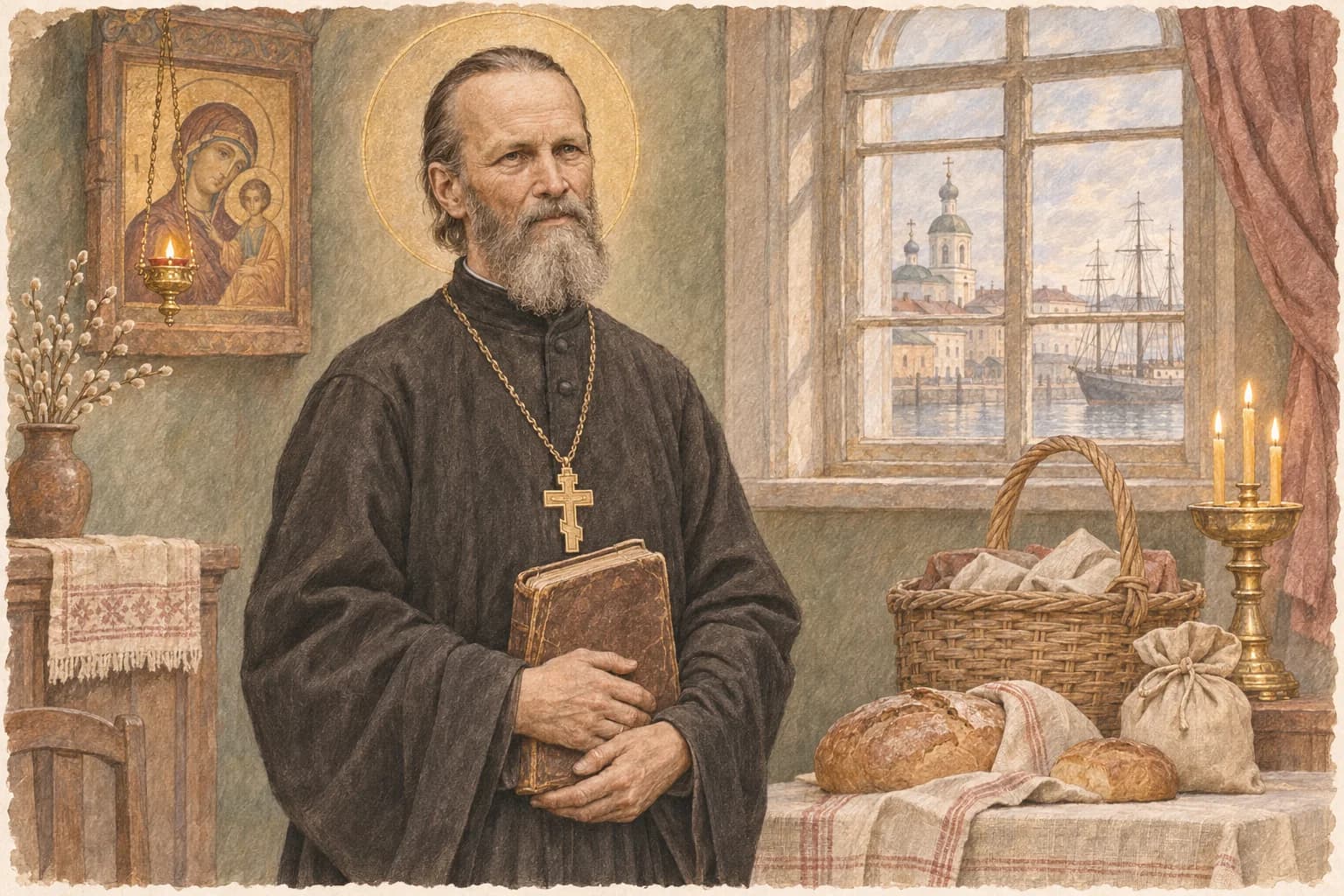
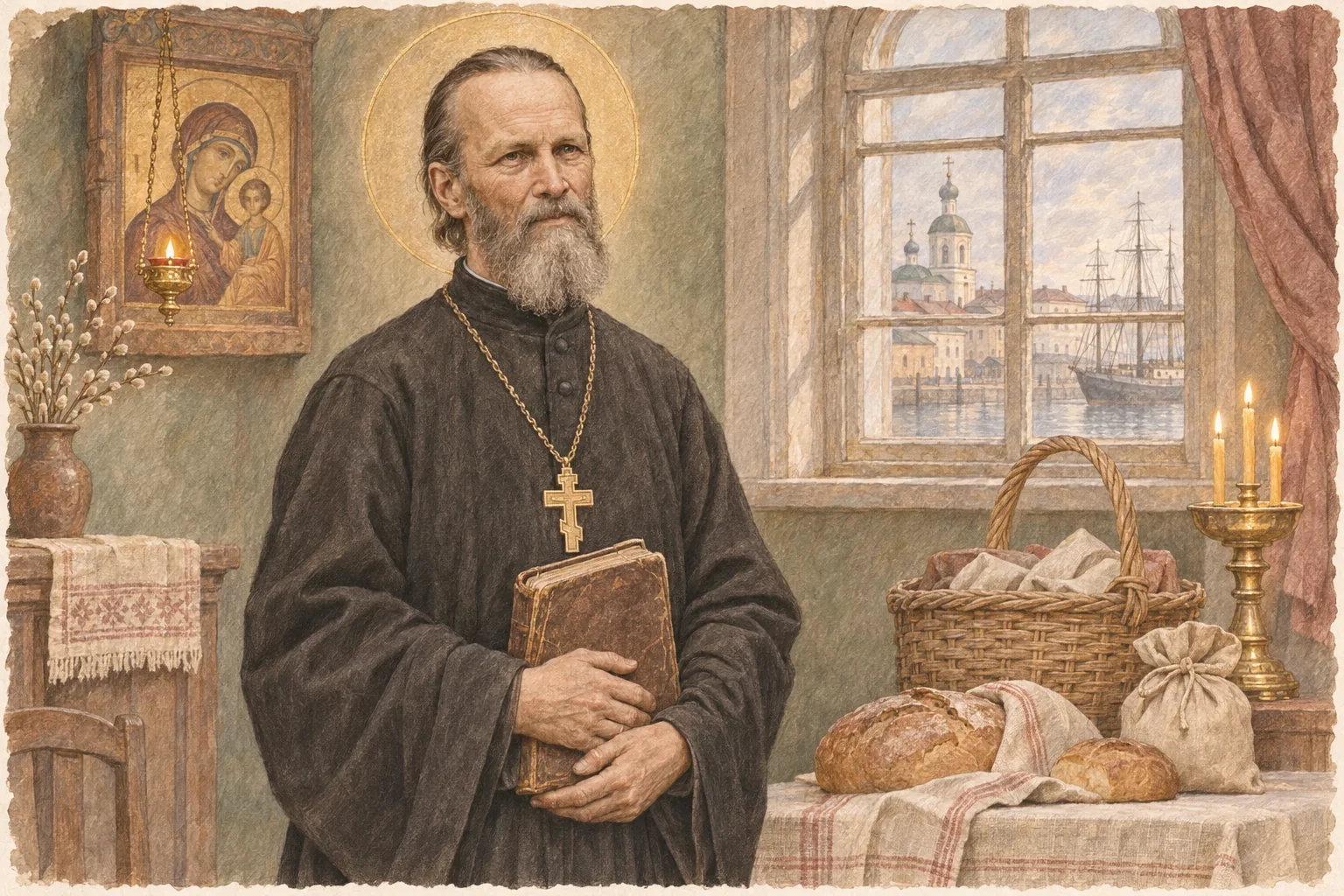
Saint John of Kronstadt was a Russian priest known for pastoral ministry in Kronstadt and help for people in need. His life connects worship with care for others. Veneration should not be reduced to searching for accounts of extraordinary healings.
Liturgy, confession and charitable work had a central place in his ministry. The House of Industry was an important initiative. Assistance sought to address actual human need rather than offer visitors only a brief consoling phrase.
Read the saint’s personal journals with attention to their genre and circumstances. Not every quotation circulating online has verified authorship. An isolated statement cannot automatically become a compulsory rule for every contemporary household.
Choose a reliable edition and a short passage to read attentively. Consider who nearby needs help you can actually provide. Following an example of mercy begins with a concrete action, not a promise to reproduce a famous pastor’s entire ministry.
From a northern village to ministry in Kronstadt
The future pastor was born in 1829 in Sura, in the Arkhangelsk region, into a church servant’s family. His surname was Sergiev; Kronstadt identifies the place of his long ministry. After ecclesiastical schooling he graduated from the Saint Petersburg Theological Academy and became a priest at Saint Andrew’s Cathedral in Kronstadt. He should therefore not be imagined as a hermit whose life unfolded far from urban concerns.
Kronstadt was a naval town marked by sharp social contrasts. Alongside military and harbour activity were poverty, unemployment and overcrowded dwellings. Pastoral ministry in that setting could not be confined to preaching sermons. His life gives an important place to visiting struggling families, offering personal assistance and being willing to speak with people. Faith became visible in the availability of a priest in circumstances where a person might otherwise encounter only rejection.
Why the Liturgy stood at the centre of his life
John of Kronstadt is known for an intense life of prayer and frequent celebration of the Liturgy. For him, the Eucharist was not an isolated duty followed by the supposedly real work of social service. Worship and assistance to people belonged to one pastoral ministry. His diary repeatedly brings together reflection on prayer, repentance, relationships with others and Communion.
Nevertheless, every feature of his ministry cannot simply be transferred to any contemporary parish. Large crowds and particular forms of pastoral encounter belonged to specific historical circumstances. A biography does not authorise readers to redesign confession or prescribe Communion arrangements for other people. Its more fruitful lesson is the underlying relationship: participation in the sacraments should affect the treatment of others, while care for those in need does not make prayer unnecessary. These dimensions of Christian life support rather than displace one another.
The House of Industry: assistance beyond a single gift
John of Kronstadt is associated with the House of Industry, an undertaking that combined assistance to poor people with opportunities for work and learning. This addressed a difficulty that a single cash gift cannot always resolve: someone may need income, skills, accommodation and dependable relationships. Assistance sought to engage the causes of hardship rather than only its most visible symptom.
That does not mean every poor person is responsible for their situation or must first prove economic usefulness. Illness, age and family circumstances can limit the ability to work. The significant principle is attentive, organised care. In a contemporary parish, it might involve supporting a family over time, collecting specifically needed goods, cooperating with professionals and accounting transparently for donations. Following the saint’s example does not require literally reproducing a nineteenth-century institution or treating its historical arrangements as a universal social policy.
How to read My Life in Christ
This book grew out of spiritual diary entries. It should not be read as a sequential textbook in which every sentence advances a single argument from the preceding chapter. The author returns to prayer, the heart’s condition, mercy and struggle with sin from different directions. A short passage read carefully can be more helpful than a large quantity skimmed merely to finish a reading target.
Distinguish personal observation, an address to God and a general reflection on Christian life. If a line appears unusually severe or unclear, read the neighbouring entries and check the edition. Online quotation images often remove context and omit the source. For an initial reading, choose one question, such as attentiveness in prayer, and observe how the author relates it to everyday treatment of others. This preserves the book’s character as testimony to inner work rather than reducing it to a collection of slogans.
Veneration and the reader’s responsibility
John of Kronstadt died on 20 December 1908 in the Julian calendar, corresponding to 2 January 1909 in the Gregorian calendar, and was glorified by the Russian Orthodox Church in 1990. His ecclesiastical designation is righteous, rather than venerable in the specific monastic sense: his path involved priestly ministry in the world, not monastic tonsure. Icons commonly identify him through priestly vestments and an inscription. His surname, place of ministry and category of sainthood help distinguish him from other saints named John.
Accounts of healing belong to the Church’s remembrance of his prayerful intercession. They cannot become a promise of the same outcome for every patient. Attention to suffering includes support for medical care and practical needs. Someone wishing to honour the saint through action can join prayer to a concrete step: visit an isolated person, assist a charitable effort supporting families, or read part of his diary attentively and put one clearly understood insight into practice.
A question for reflection
What manageable action could connect your prayer with care for another person?