
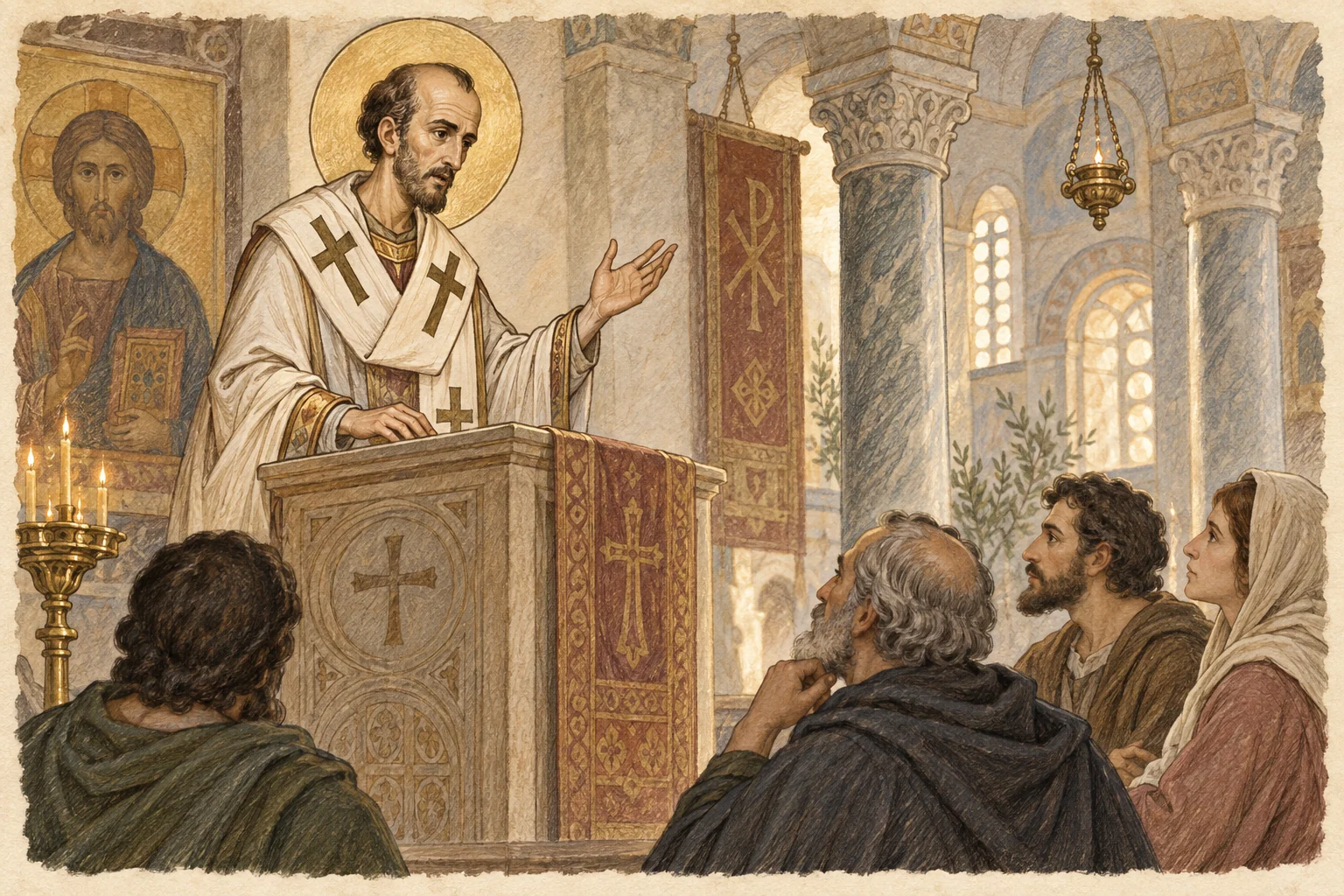
John is called Chrysostom, meaning golden-mouthed, for his gift of preaching, but eloquence was not an end in itself. He sought to connect the Gospel with his listeners' treatment of poor people, use of possessions, domestic habits and participation in the Church. Reading him merely as a source of attractive sayings misses that purpose.
From Antioch to Constantinople
John grew up in Antioch, received an education, undertook an ascetic life and became a priest in 386. Much of his preaching belongs to his Antiochian ministry. Later he became Archbishop of Constantinople, where pastoral responsibility was accompanied by severe conflict.
His criticism of abuses and advocacy for people in need did not always bring gratitude. He was deposed and exiled, and died in 407. His biography challenges the idea that faithfulness to God necessarily produces public success. The Church's veneration is not retrospective approval of an untroubled career.
Preaching as a reading of Scripture
John left extensive commentaries on biblical books. He explains the movement of a Gospel passage and then addresses the listener's moral choices. Read the relevant passage of Scripture before the homily. Otherwise an objection the preacher is examining might be mistaken for his own final conclusion.
Check an unfamiliar online quotation against the title of a work and its homily number. A name beneath a picture is not enough. Older translations may need a glossary; clarify an unfamiliar term rather than inventing a convenient meaning. One complete argument read attentively is a good beginning.
Two passages about mercy
In Homily 50 on Matthew, John discusses adorning the church's sacred table and helping poor people. Alongside offerings, and “even before them,” he urges almsgiving. This does not prohibit every form of care for a church building: it identifies the moral priority of a living person.
In the same argument, he says that “Christ is hungry,” referring to encountering Christ in someone in need. These short phrases are translated here from the Russian text linked below. Their meaning becomes clearer when reading continues beyond the striking expression: John demands consistency between reverence inside the church and conduct outside its doors.
Commemoration and putting teaching into practice
In Russian practice, the principal November commemoration is civil November 26 during the twentieth and twenty-first centuries, corresponding to November 13 Old Style. John is also commemorated with the Three Hierarchs. The Liturgy bearing his name deserves a separate explanation and does not exhaust his written legacy.
After reading, choose something concrete: answer an acquaintance whose request for help has gone unanswered, assist without a humiliating interrogation, or reconsider an unnecessary purchase. The severity of an ancient preacher's language is not permission to insult people today. His demands address the reader first. This approach keeps together the word, prayer and action that mattered to Chrysostom. Rather than collecting a sentence to win an argument, return to the biblical passage and ask what responsibility it places upon you in the circumstances you actually face.
Keep two notes alongside each other: what the text actually says and what personal action you draw from it. The second should not be presented as the saint's exact instruction. Choosing to help a particular family is your responsible application. This honesty respects the source without using an ancient name to settle every dispute about a private decision.
From a Gospel Event to a Personal Question
Homily 50 begins with Matthew 14:23–36, not immediately with church donations. John considers Christ's prayer, the disciples' fear at sea, and their encounter with the Saviour. Readers arriving through a famous quotation about poverty should notice this setting. The moral conclusion belongs within a sustained discussion of the Gospel rather than functioning as an isolated slogan.
Mark the transitions as you read. Where does the account of the event end? Which question is the preacher answering? When does he turn to his listeners' conduct? This distinguishes the biblical passage, its interpretation, and your own application today. There is no need to master the whole homily at once. Understanding one transition from Scripture to the reader's responsibility can be more fruitful than collecting ten sentences with no connection between them.
Hearing a Challenge Without Becoming Cruel
A teaching about mercy can easily become a way to criticise other people's spending while ignoring our own. A discussion of an expensive church furnishing might turn into condemnation of its donor while a request for assistance remains unanswered. First ask what action lies within your responsibility. This does not forbid discussion of a shared budget, but it does require attention to verified circumstances and actual needs rather than imagined faults in other participants.
For group reading, consider a specific situation: a community has both premises expenses and an urgent request for help. Participants can identify the questions that need answering without presenting their proposed budget as a direct command from Chrysostom. Ancient preaching then prompts responsible deliberation instead of becoming a weapon against disagreement. Its seriousness is preserved when readers are willing to alter their own conduct, not merely find a forceful sentence to use against someone else.