
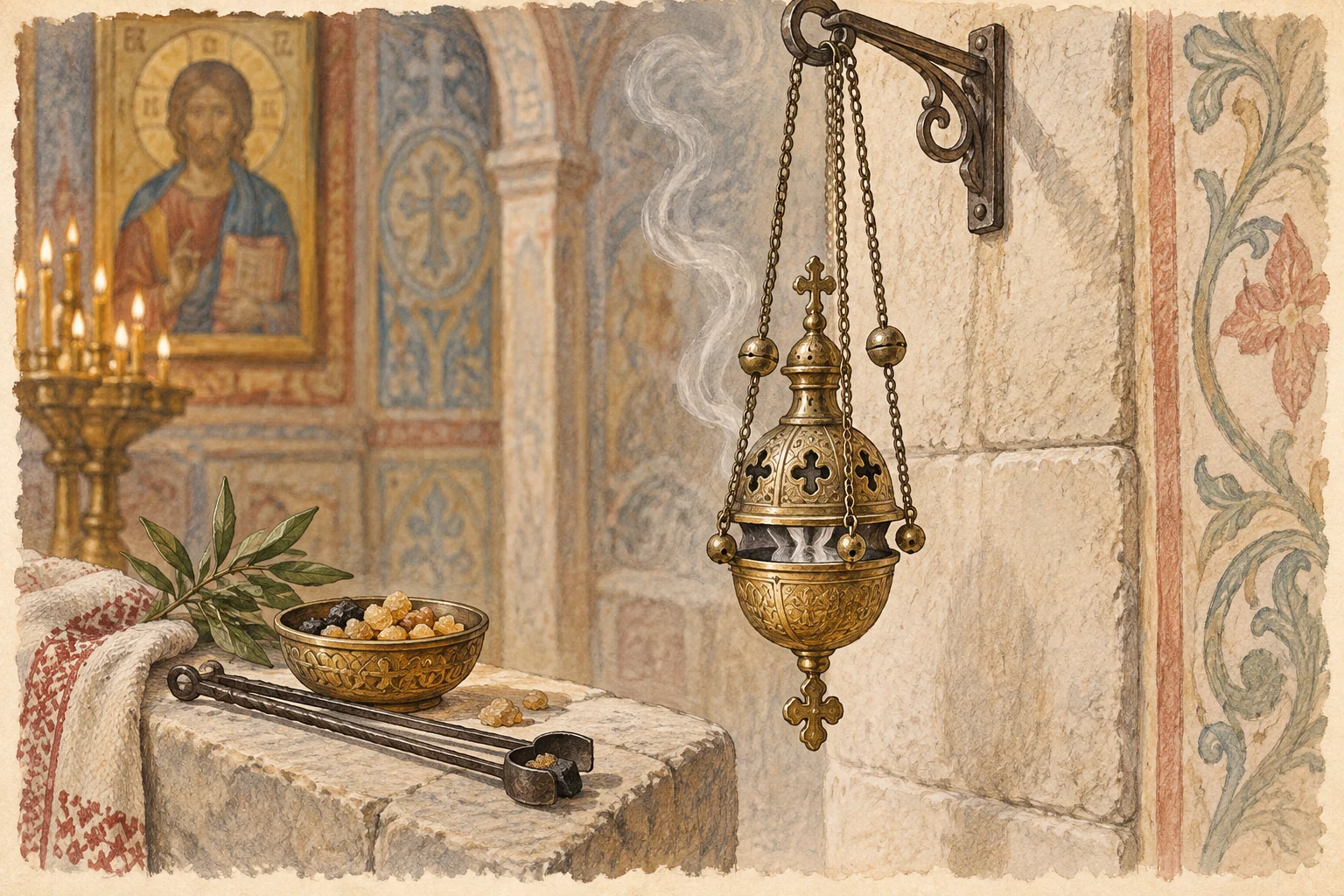
A censer is a metal vessel used to burn incense: aromatic resin is placed on hot charcoal, producing fragrant smoke. A suspended censer on chains is common in church. The object, the aromatic substance and the liturgical action have different names: censer, incense and censing. Keeping them distinct helps explain how a material object serves prayer.
What censing expresses
The biblical image of rising incense is associated with prayer to God. It appears in Psalm 140 in Orthodox numbering, Psalm 141 in many English Bibles, and in Revelation 8. In worship, physical action is not opposed to inward attention. A person prays as a whole person: hearing, seeing, standing before an icon and sensing fragrance.
Smoke is not a substance that automatically improves character or removes difficulties. Its meaning belongs to the prayer it accompanies. Focusing entirely on the smell can obscure the service itself, which is the reason for the action. The sensory experience supports worship; it does not replace understanding or attention.
Why people are censed as well as icons
Censing honours sacred things and the people gathered for worship. Reverence towards a person recognizes the dignity of the image of God. It is not a reward for the most devout worshippers or an inspection of their clothing. When the censer is directed towards you, there is no reason to interpret it as a personal prediction.
A slight bow is the customary response. You do not need to turn your whole body as the censer moves, walk around your neighbours or seek a larger amount of smoke. A quiet, respectful movement is sufficient, followed by continued attention to prayer. Missing the moment for a bow does not require a hurried correction.
Leaving space for movement
During a full censing, the clergyman may walk around the church. Keep narrow passages clear, hold a small child's hand and move bags out of the way. The censer is hot: do not catch it, touch its chains or try to assist without being asked. Practical care matters more than precisely imitating other people's gestures.
Explain to children beforehand that the swinging vessel is not a toy. They can watch from a little distance. If you need to leave during censing, move calmly and avoid suddenly crossing the clergyman's path. Respect includes attention to the safety of people sharing the space.
When smoke is difficult to tolerate
No one has to remain in concentrated smoke to prove their faith. Move nearer an exit, step outside briefly, or ask the parish about a more suitable place. If you have a medical condition or known sensitivity, follow your clinician's advice. A church article cannot assess someone's individual response to a substance.
Coughing, a headache or the wish to move away must not be treated as evidence of a person's spiritual condition. Incense is not a treatment, a diagnostic test or a guarantee of disinfection. Prayer at home does not require recreating a church full of smoke. When using a domestic incense burner, observe ordinary fire precautions: prayer does not remove responsibility for hot charcoal, ventilation or children's safety.
Do not bring a homemade aromatic mixture and expect it to be used during worship. Those organizing the service are responsible for its supplies. Before donating incense, ask whether it is needed and what is normally used. This allows generosity to meet an actual need without creating extra work or overlooking circumstances you may not know about.
Censer, chandelier and domestic incense burner
Similar-sounding Russian names can be misleading. A panikadilo is a large church chandelier, not an oversized incense vessel. A hand-held censer shaped like a small pan is called a katsia. The reference article on censers distinguishes these objects. When studying a photograph, first establish the purpose of a suspended object: is it providing light or being used for censing? Hanging from chains does not by itself answer that question.
A domestic incense burner need not reproduce the form of the church's suspended censer. More importantly, buying an object does not create a prayer rule. There is no need to acquire a complete set of equipment to make a room feel exactly like church. First consider whether you will actually use it and whether suitable safe conditions are available. Ordinary prayer at home depends on attention to the words, not on reproducing every sensory experience of a service.
Notice meaning as well as movement
While observing censing, ask what prayer is being heard and towards whom the action is directed. This connects what you see with the service. Counting swings or seeking a private message in the direction of the smoke quickly displaces the common meaning. You need not track every movement if doing so makes it harder to hear the reading or singing. Recognizing the action should help you return to prayer, not create another task to monitor anxiously or complete without a mistake.
When explaining it to a child, distinguish respect from fear. A hot object needs space, but missing a bow does not mean being rejected. If a child is distracted by sound or smoke, name the object briefly and return to the service. A fuller explanation can wait until later, rather than accompanying each movement with whispered commentary. Someone who finds the smoke difficult can participate from a more suitable position. Moving does not change the common prayer into a different or lesser one, and other worshippers need not turn that practical adjustment into a judgement about faith.