
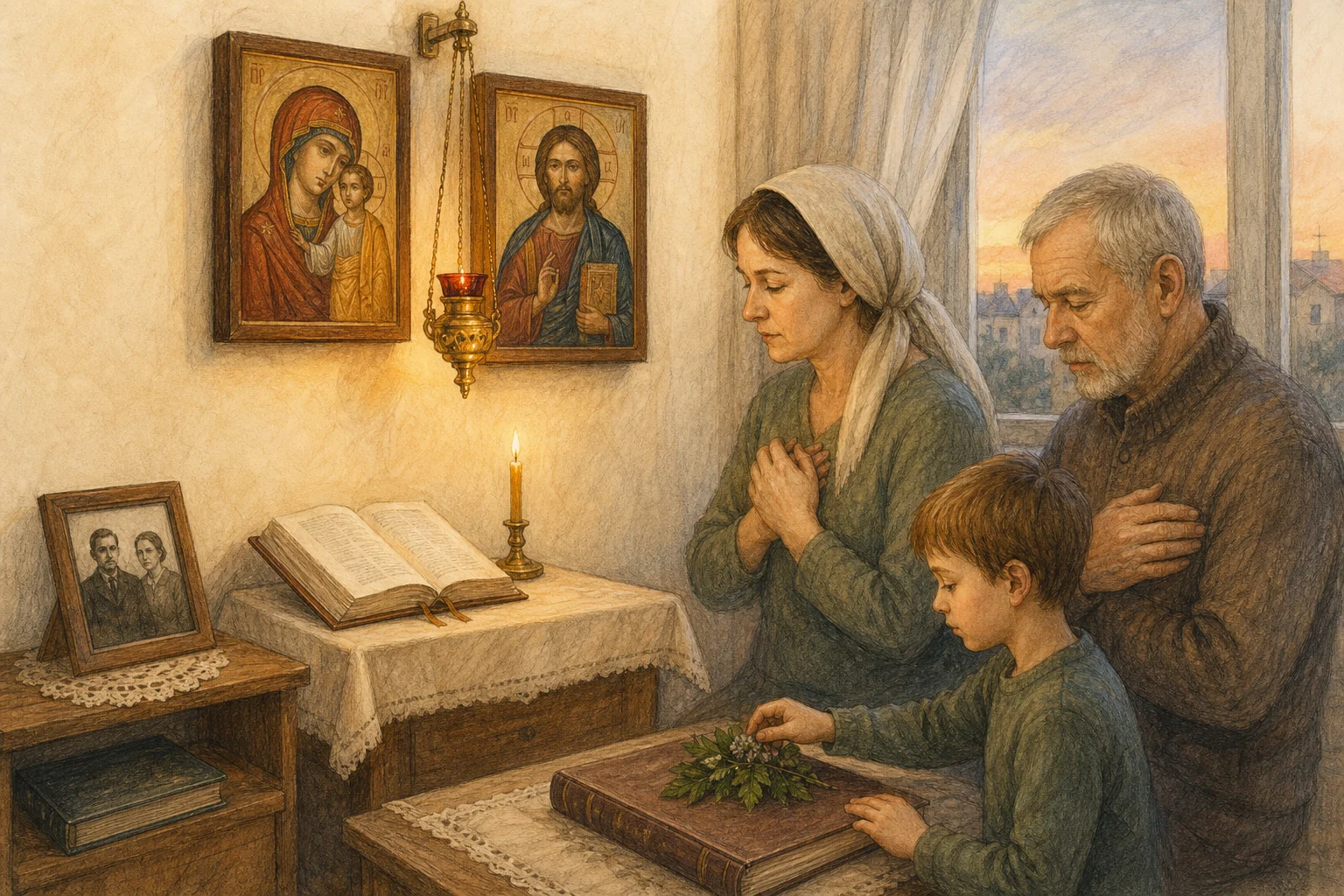
A departed person may be remembered at home through a short prayer in one's own words, memorial prayers from an Orthodox prayer book, and the reading of the Psalter. No special food, glass of water, covered mirrors, or continuously burning candle is required.
Prayer at home does not compete with commemoration in church. When possible, the name of a baptized Orthodox Christian is submitted for the Divine Liturgy, while personal and family remembrance continues at home.
How to begin prayer at home
Stand before the icons, or sit if health makes standing difficult. Put the phone aside, breathe quietly several times, and name the departed person before God.
You may simply ask the Lord to grant rest, forgive sins, and receive the person into the Kingdom. Attention and trust matter more than perfect pronunciation.
Must long texts be memorized?
No. A short honest prayer is better than an incomprehensible rule read in panic. Familiar texts from a prayer book can be added gradually.
It is all right to stop, weep, or repeat one request. God hears a person whose thoughts cannot yet be gathered.
Which prayers are suitable?
Orthodox prayer books include a short prayer for the departed, a lay litiya, and longer memorial orders. Use an edition carrying church approval or a text recommended by the parish.
Do not copy anonymous spells or “secret prayers” from random websites. Old religious vocabulary by itself does not prove that a text is Orthodox.
May I pray in my own words?
Yes. Tell God about love, gratitude, pain, anger, and fear, and ask for mercy toward the person who died. Personal words do not cancel the common prayer of the Church.
Never promise a dangerous act or impossible vow in exchange for a result. Prayer is a relationship of trust, not a bargain.
How to read the Psalter
Begin with one kathisma or even several psalms. Do not race; pause and commemorate the name at the appointed points according to the prayer book you use.
If the liturgical translation is difficult, a parallel modern translation can help understanding. Regular attention is more useful than trying to finish the entire Psalter in one night.
Must the Psalter be read for forty days?
Forty days of reading is a venerable custom, not a condition without which the departed cannot be saved. Relatives may divide the kathismata among themselves or choose a sustainable rhythm.
Do not pay an unknown person because you fear that one missed night will harm the soul. Honest prayer without anxious dependency is better.
When people pray especially at home
Common occasions include the first days after death, the third, ninth, and fortieth days, anniversaries, Memorial Saturdays, and Radonitsa. Prayer is also appropriate whenever the person comes to mind.
The first dates and the church order are explained in our guide to the third, ninth, and fortieth days.
What “newly departed” means
This expression commonly describes a person during the first forty days after death. It acknowledges that the loss is recent and the family is in an intense season of grief.
Prayer does not stop after the fortieth day. The name is simply offered without that description.
Preparing a place for prayer
A clean quiet corner with icons and a prayer book is sufficient. A photograph may be present as a memory, but it should be clearly distinguished from the icons.
A photograph does not become a sacred image, and the departed person is not worshipped. There is no need to build a domestic altar from many personal belongings.
Is a candle or lamp required?
No. Prayer is possible without flame. A candle can focus attention and symbolize turning toward Christ, but it is not a channel of communication with the soul.
Use a stable holder away from fabric, children, and animals. Never leave the flame burning through the night or when leaving the room.
Should water and bread be placed nearby?
No. Water, bread, salt, sweets, and a separate plate “for the deceased” are not part of Orthodox prayer. A soul does not consume physical food.
Give food to a living person in need. In this way remembrance becomes an act of mercy.
Should mirrors be covered and clocks stopped?
No. These actions come from family and folk customs, not the teaching of the Church. A mirror cannot trap a soul, and a clock does not determine its journey.
If an elderly relative insists, the first hours of grief may not be the time for an argument. Explain the distinction calmly later without feeding fear.
May a layperson read the panikhida?
A layperson may read a specifically prepared lay order without priestly exclamations or actions. Obtain the text from the parish or ask for guidance when making it a regular practice.
Do not wear vestments, imitate priestly censing, or pronounce prayers reserved to an ordained minister. Prayer at home has its own dignity.
May a priest be invited to the home?
Yes. By arrangement, a priest may celebrate a litiya or another suitable memorial prayer. Call the parish, describe the situation, and ask what is possible.
Do not order a “home funeral by photograph” from an anonymous person. Verify the actual parish to which a clergyman belongs.
Why the Divine Liturgy matters
At the proskomedia, the priest takes particles from the prosphora while commemorating baptized Orthodox living and departed people. This is the prayer of the whole Church united to the Eucharist.
The order is explained in our article on commemoration at the Divine Liturgy. Reading at home should not become a reason never to enter the parish.
When church attendance is impossible
Illness, disability, care for an infant, distance, and dangerous weather are serious circumstances. Pray at home and send the name through a trusted person or an official parish service.
Verify the website and never buy a promise of the “strongest prayer” through an urgent transfer to a stranger's personal account.
How to pray as a family
Choose a short time, name the departed, and read one psalm or prayer. Allow everyone to participate according to strength and do not assess the volume of a person's voice.
Afterward, family members may share one grateful memory. Do not turn prayer into a trial of the departed person's biography or a dispute about inheritance.
When relatives follow another faith or none
Do not force them to read an Orthodox text or accuse them of lacking love. Invite them to remain silent, offer a grateful memory, or help someone who is living.
An Orthodox family member may pray separately. Respect for freedom preserves peace and does not weaken faith.
How to pray for an unbaptized person
Personal prayer for God's mercy is possible, but the name of an unbaptized person is not normally submitted for the proskomedia or a common church panikhida. Do not conceal the absence of Baptism.
Pastoral distinctions, including the loss of a child before Baptism, are discussed in our article on prayer lists for the unbaptized.
Good works in memory
Help a particular person in need, support a verified charity, plant a tree where permitted, donate blood if eligible, or continue a useful work begun by the departed.
A good deed does not purchase salvation and need not be public. Do not give away what your household needs because of guilt.
What to do with personal belongings
The Church sets no deadline after which possessions must be discarded or distributed. A family may keep meaningful items, give useful things away, and make decisions gradually.
Do not allow outsiders to hurry you, and do not preserve everything from fear that the soul will be offended. Respect documents, inheritance law, and the needs of other relatives.
Dreams about the departed
Vivid dreams are common in grief and may reflect memory, anxiety, and an unfinished conversation. They are not reliable instructions from the world beyond death.
Pray, but do not make financial, medical, or family decisions from a dream alone. Persistent terror calls for psychological and pastoral support.
A sense of presence and supposed signs
A person may expect familiar footsteps, recognize a scent, or notice coincidences. These experiences should not be declared proof that the departed is physically present in the room.
People who offer paid contact with a soul are especially dangerous. Spiritualism and divination are incompatible with Christian prayer and exploit the vulnerability of grief.
When there is guilt toward the person
Name the guilt before God and discuss your own Confession with a priest. Correct what remains possible: repay a debt, support someone harmed, or stop a destructive habit.
Do not assume responsibility for everything. After suicide or sudden death, relatives particularly need professional help against destructive self-blame.
When memory includes abuse
Prayer does not require idealizing the departed or returning to unsafe relationships with living relatives. Forgiveness does not mean denying harm.
Choose a short prayer for mercy and freedom from hatred. Therapy and safe boundaries do not contradict faith.
How to speak with a child
Say: the person died, we remember that person, and we ask God to care for them. Do not claim that the departed became an angel or watches every action.
Let the child choose whether to stand nearby, name the person, draw a memory, or leave. Never force a long reading of words the child cannot understand.
How long should prayer last?
Begin with two to five minutes and increase the time if helpful. Exhausted mechanical reading is not better than brief attention.
If a regular rule supports you, keep it. If it produces panic and obsessive guilt, discuss a healthier measure with a priest.
A simple daily sequence
Make the sign of the Cross, pray the Lord's Prayer, name the person, ask God to grant rest, give thanks for the good in that life, and finish with the sign of the Cross.
Add a psalm or kathisma when strength permits. The sequence is a support for attention, not a magical formula.
Frequently asked questions
May I pray without a candle?
Yes. A candle is a helpful symbol but not a condition of prayer.
May I use a photograph?
Yes, as a memory clearly distinct from an icon and without placing food before it.
Must the Psalter be read for forty days?
No. It is a pious custom carried according to strength.
May I pray at night?
Yes, if health and sleep are not harmed; there is no specially powerful hour.
What if I can only weep?
Remain before God, say a few words, and care for yourself. Tears are not failure.
The central message
Remembrance at home is not a complex ceremony but a faithful prayer of love. Icons, the Psalter, and a candle can focus attention, but God does not depend on objects or the exact length of a rule.
Name the person before God, bring the name to the Divine Liturgy, perform a good work, and care for the living. Refuse food for the soul, spiritualism, and fear of a missed ritual.