
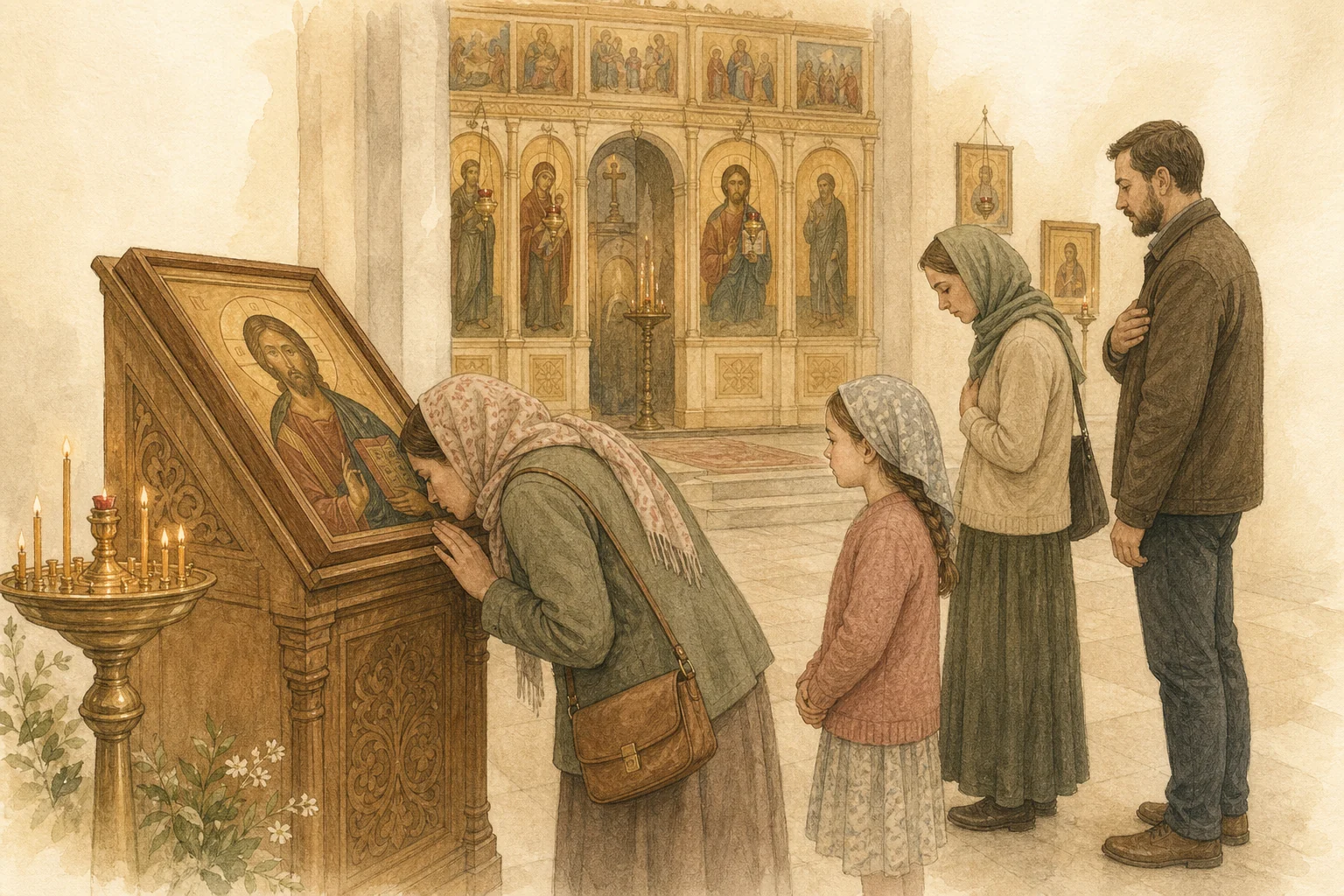
To venerate an icon in church, calmly make the sign of the cross, bow according to your ability, pray briefly, and, if you wish and it is safe, kiss the edge, garment, hand, or feet of the person depicted—normally not the face. Then cross yourself or bow once more and step aside without delaying the line.
Kissing is not a condition for prayer to be heard. Illness, infection precautions, anxiety, or limited mobility may make it wiser simply to stand before the icon, make the sign of the cross, and bow.
Why Orthodox Christians venerate icons
An icon witnesses that the Son of God truly became human and can be depicted in human form. It brings the worshipper into prayerful remembrance of Christ, the Mother of God, angels, and saints.
The Seventh Ecumenical Council affirmed the distinction between veneration of an image and worship, which belongs to God alone. Honor shown to the image passes to the prototype.
An icon is neither an idol nor a magical object
A Christian does not call wood, glass, and pigment divine. The prayer addresses the person depicted: Christ as God, and the Mother of God or a saint with a request for intercession.
The material produces no automatic result. Our article on why Christians pray with the saints explains why veneration never replaces prayer to God.
Must every icon be visited?
No. A church may contain many images, and a visitor is not required to complete a circuit. Attentive prayer before one or two icons is better than rushing around to finish a ritual.
During worship, do not walk unnecessarily in front of praying people or cross the space before clergy. Choose a time before or after the service, or a moment when movement does not disturb common prayer.
A simple sequence
Approach without haste and leave space for the person ahead. A common custom is to cross oneself twice with bows, venerate the image, and then cross and bow once more.
This is a pious pattern, not an examination with one valid sequence. If you made one bow or lost count, continue praying rather than beginning again in fear.
How to make the sign of the cross
Join the thumb, index, and middle fingers of the right hand while folding the other two toward the palm. Touch the forehead, lower chest or abdomen, right shoulder, and then left shoulder.
Move attentively rather than waving the hand. Our detailed guide explains how Orthodox Christians make the sign of the cross and the meaning of the gesture.
Where to kiss an icon
The face is normally avoided. On an icon of Christ, kiss the feet, hand, edge of the garment, or lower panel; on an image of the Theotokos, the hand or garment; on an icon of a saint, the hand, feet, or edge.
If the icon is behind glass and the appropriate area is high, do not stretch across a candle stand or place your weight on the analogion. A respectful kiss of the lower frame or a simple bow is sufficient.
Why the face is normally not kissed
The face is the center of personal presence in the icon, so pious custom avoids kissing it as an expression of reverence. This is not fear that God will punish a technical mistake.
An accidental kiss does not desecrate the icon and requires no special cleansing of the person. Adjust the gesture next time without panic.
An icon of Christ
Before the Savior, the Christian addresses the Lord directly in thanksgiving, repentance, and petition. One may say the Jesus Prayer or name a need in ordinary words.
Do not assign secret levels of strength to different images of Christ. Iconographic types differ, but the Lord is one.
An icon of the Mother of God
Before an image of the Theotokos, Christians ask for her maternal intercession before Christ. Her hand in a Hodegetria, such as the Tikhvin icon, points precisely toward her Son.
Our article tells the story of the Tikhvin icon. Do not turn different Marian icons into competing specialties.
An icon of a saint
Name the saint and ask, “Pray to God for me.” Not knowing the life is no barrier; afterward you may learn why the Church honors this person.
A saint does not perform a spell or act independently of God. Veneration becomes meaningful when the Christian tries to imitate the saint's faith, mercy, and courage.
When a line has formed
Prepare a short prayer before reaching the icon, do not push, and avoid holding bags or phones in front of the shrine. Allow an older or disabled person to move at a safe pace while preserving personal space.
A longer prayer may continue a few steps to the side. God does not hear only at the exact point directly in front of the glass.
During a service
It is normally best to remain in place during the Gospel reading, Cherubic Hymn, Eucharistic prayer, and other concentrated moments. Local parish practice can identify suitable times.
If you arrive late, do not cross the center of church to obtain a compulsory kiss. Stand quietly, enter the prayer, and venerate after the service.
Lipstick, marks, and care for the icon
Remove bright lipstick before kissing so it does not mark glass, a metal cover, or painted surface. Never scrub a mark yourself with a tissue and certainly not with a chemical cleaner.
Tell a candle-desk worker or another parish employee. People who know the material and conservation rules are responsible for caring for icons.
Infection and sensible precautions
If you have a respiratory infection, a sore on the lips, or are living through a period of increased health risk, do not kiss a shared surface. A bow and prayer retain the full meaning of veneration.
Judge neither those who kiss nor those who abstain. A parish may temporarily establish a particular order, and visitors should follow it calmly.
When bending is difficult
A person with back pain, dizziness, disability, pregnancy, or age-related limits need not prove devotion through a deep bow. Incline the head, cross yourself while seated, or simply pray.
Do not grasp an unstable stand. Ask for assistance in a narrow passage; the safety of a person matters more than external precision.
Helping a child
Demonstrate once and say simply, “We greet the saint shown here and ask for prayer.” Never push a child's head against the glass or shame a refusal.
A small child may cross, bow, or even wave from a distance. Voluntary reverence grows through the peaceful example of adults.
May one touch the forehead to the shrine?
In some places, people briefly touch the frame or reliquary with the forehead after a kiss. This is a local devotional gesture, not a required part of Orthodox practice.
Do not lean on a painted surface, press the glass, or copy everything you see when the movement would be unsafe.
Icons and relics are different
An icon is a sacred image; relics are the remains or portions of the remains of a saint, venerated in hope of resurrection. Both call for reverence, but they are different sacred objects.
Read our guide to what holy relics are. Follow signs and instructions from parish workers, especially around a small shrine.
If an icon is bumped or dropped
Tell a worker immediately, do not conceal damage, and do not attempt to lift a heavy icon alone. When nobody has been injured, the accident is not a prophecy of future harm.
An apology and practical help are appropriate; a paid “atonement” or search for omens is not. God does not create a trap from an awkward movement.
A candle before the icon
A candle expresses prayer and an offering, but is not required in order to address a saint. Use an available stand, protect hair and clothing, and do not rearrange another person's candles without reason.
If no place remains, leave a donation separately if desired and pray without a candle. God does not measure attention by the amount of flame.
After making a mistake
If you crossed in the wrong direction, forgot a bow, or did not know where to kiss, do not restart from fear. Say a short prayer and continue participating in worship.
The church is a place of healing and learning, not a public examination for beginners. A practical question can be asked quietly after the service.
Frequently asked questions
Must an icon be kissed?
No. A bow and prayer are a complete expression of veneration.
May one kiss the glass?
Yes, according to custom when it is safe, while health considerations can make abstaining the better choice.
How many times should one cross?
Two before and one after is a common pattern, but losing count does not invalidate prayer.
May one venerate during a service?
Choose a moment when movement does not disturb common prayer; remain in place during the most concentrated parts.
What if I do not know the saint?
Briefly ask for the saint's prayer and later read a reliable account of the life.
The central message
Approach calmly: sign of the cross, bow, short prayer, an optional kiss of the edge or hand, and space for the next person. Never turn the sequence into a magical code.
An icon leads toward personal encounter in prayer, not anxiety about technique. God receives the honest appeal of someone who is learning, ill, unable to bow, or simply chooses to stand in silence.