
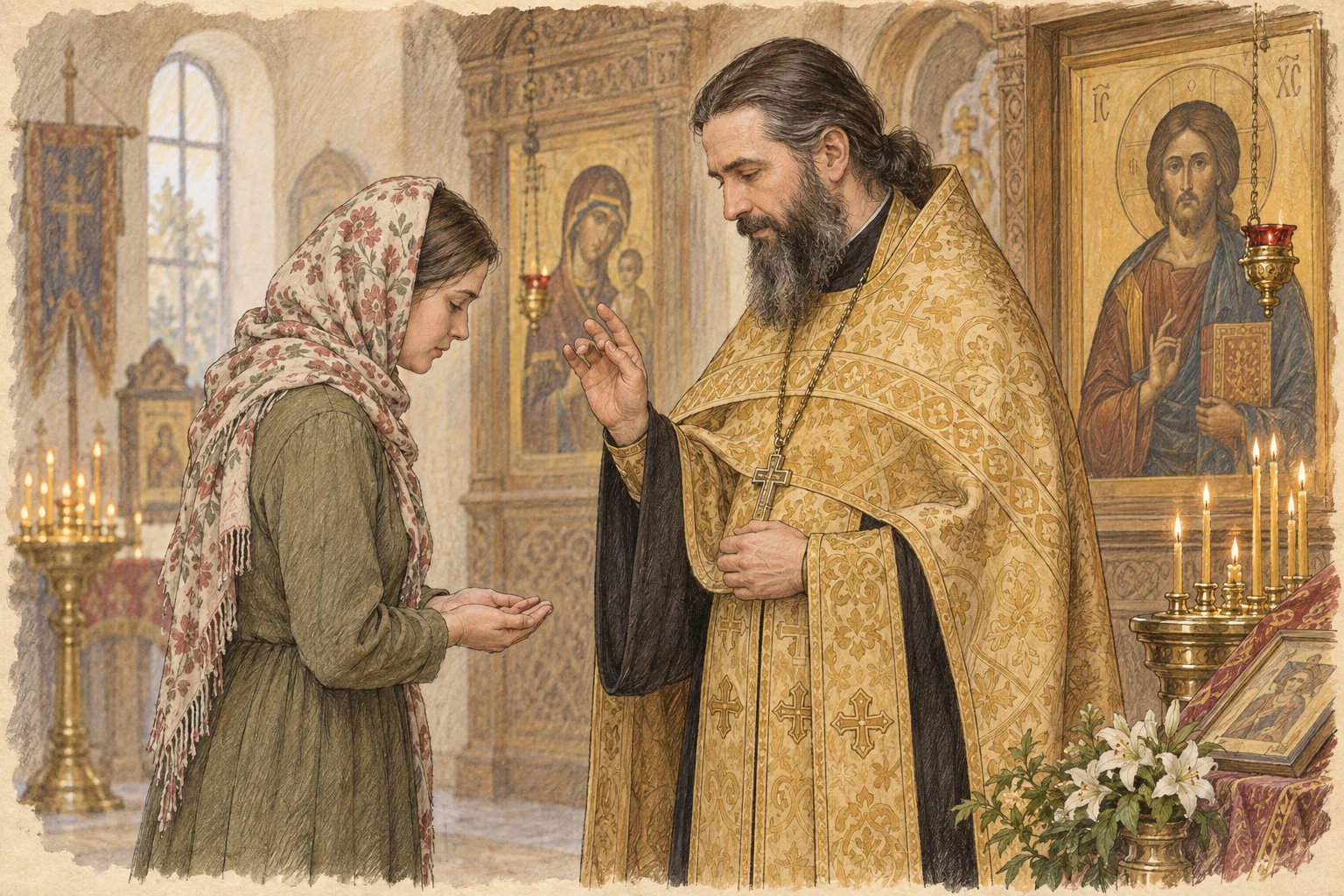
Asking a priest for a blessing is an appeal to God through priestly ministry, not an examination in church gestures. If this is your first time, say so and ask for guidance. Uncertain hands or unfamiliarity with forms of address do not invalidate an honest request.
How to Approach and What to Say
Choose a moment when the priest is not celebrating a sacrament, reading a prayer, or speaking privately with someone. You can say, “Father, bless.” In common Russian practice, hold your palms upwards with the right hand over the left. The priest makes the sign of the cross over you; the person receiving the blessing customarily kisses his right hand.
The gesture honours priestly ministry rather than declaring the priest personally incapable of error. If you become confused, do not grab his hand or rush through a sequence. Wait for guidance. If health or mobility makes the usual movement difficult, explain this. An appeal to God does not depend on your physical ability to perform the customary gesture.
Why Ask for a Blessing?
A blessing asks for God's help and the sanctification of life. It may be requested when meeting a priest, before travel, or before beginning a good undertaking. It is not a charm guaranteeing freedom from difficulty. A travel blessing does not remove the need for care on the journey; a blessing on work does not replace preparation, skill, and keeping commitments.
Do not turn daily life into endless waiting for permission for every action. Ordinary responsibility remains yours. A morally complicated decision may need a substantive conversation rather than a brief gesture. Explain that you need advice and ask when the priest can hear the circumstances properly.
A Blessing and Advice Are Not Always Identical
Asking for a blessing on a project may mean asking for prayer, but it may also conceal a desire for approval of a questionable decision. Avoid misunderstanding by explaining the intended action, whom it affects, and what concerns you. Do not omit essential information and later cite the priest as though he approved everything.
If an answer is unclear, ask whether it concerns a moral prohibition, personal advice, or a practical suggestion. Priesthood does not make someone an expert in every medical, technical, and legal field. Do not turn a general remark into an instruction to stop treatment, breach an agreement, or deprive another person of their rights. Such decisions require appropriate expertise and full information.
During Worship and When Time Is Short
A general blessing during worship is addressed to the congregation. You do not need to approach the priest or interrupt the service to receive it. Leave an individual request for a suitable moment. If a large queue follows the service, ask briefly for a blessing and arrange a separate meeting for a complex family question. This respects both the priest and those waiting.
If you are not baptised or are only beginning to explore Orthodoxy, explain that and ask what is appropriate. There is no need to pretend to be an experienced parishioner. An ordinary greeting and request for help are enough to begin. Church customs become familiar gradually; the precise position of your hands must not obscure prayer, trust in God, and responsibility for your own conduct.
Make the Request Unambiguous
Before approaching, distinguish two intentions: are you asking for prayer for an undertaking, or do you need to discuss whether to begin it? Before a move, for example, a brief request for God's help on the journey is understandable. Whether it is right to leave a dependent relative without care requires a separate conversation. Using the same word, blessing, does not make these situations identical. A brief response to a greeting cannot later be treated as approval of details nobody discussed.
If the priest answered hurriedly, do not complete his meaning on his behalf. At another meeting, check whether you understood correctly. This matters especially when a decision affects others: a spouse, colleague, or relative need not treat your brief conversation as an instruction addressed to them. Report the actual question and answer accurately, without strengthening them into an unconditional obligation the speaker did not establish.
A First Visit With a Child or Companion
Tell a child beforehand that you want to ask the priest for prayer and a blessing. Do not push them forward or shame them for feeling uncertain with an unfamiliar adult. Approach together, let them observe your calm greeting, and leave room for questions later. The purpose is not an immaculate performance of an adult sequence in front of onlookers, but an introduction to church relationships without fear. Familiarity can develop through repeated, unhurried encounters rather than a single successful performance.
If accompanying someone with limited mobility, ask whether they want help approaching or explaining a difficulty. Do not pull their hands into position or speak about them as though they were absent. If you do not know who someone is or how to address them, an ordinary respectful greeting is a sufficient beginning. Asking their name and whether this is a suitable moment is simpler than guessing from clothing and then worrying about a possible mistake. Considerate attention to the person matters throughout.