
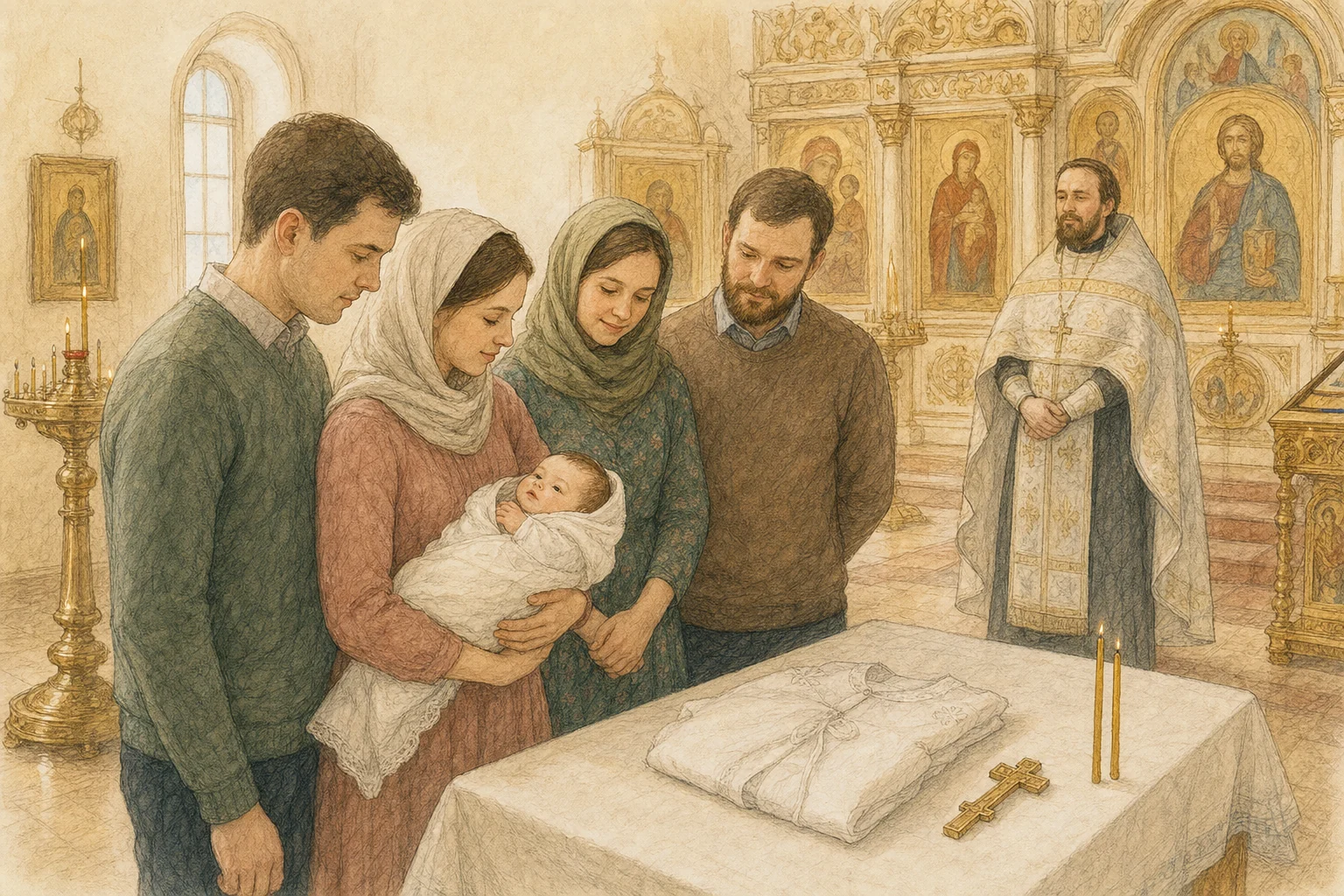
When a family begins to think about Baptism, many questions arise at once: must we know everything first, whom should we ask to become godparents, and what happens on the day? These questions should not make the first step impossible. Baptism is not an examination for parents. It is the beginning of a child’s life in the Church.
The most helpful first step is a calm conversation with the parish. This guide offers orientation, while the priest and parish can explain the current local preparation and practical arrangements.
What Baptism means
In Baptism a person enters the life of the Church. A child is brought in the faith of parents and godparents, who promise to help the child grow in prayer and church life. The meaning is therefore greater than one beautiful family day.
Where to begin
Contact the parish or come after a service and say simply that you would like to ask about a child’s Baptism. You do not need perfect church vocabulary. Ask how preparation is arranged, how to choose a date, what to bring and whom to contact on the day.
Do parents have to be “perfectly churchgoing”?
Some parents postpone Baptism because they themselves are only beginning to learn about faith. That is not a reason to hide from the conversation. Preparation can become a sincere beginning for the whole family. Honesty and willingness to take the next step matter more than pretended certainty.
Choosing godparents
Godparents are not merely guests. They pray for the child and help the child discover faith. Think not about social convenience, but about someone ready to remain close, learn and care. Speak openly with a prospective godparent; a respectful refusal is better than a formal agreement.
Preparation talk
The preparation talk is not a test. It is a chance to understand the Sacrament, ask practical questions and discuss your own circumstances. Ask about dates, arrival time, family attendance, photographs and any concern that feels personal or simple.
Prayer and preparation
Do not turn preparation into an anxious race to memorise everything. If the parish suggests prayers or texts, approach them attentively and without panic. The purpose is to understand why the family comes to the Sacrament.
Choosing a date and what to bring
Confirm the date directly with the parish. Local practice and the church calendar can affect arrangements. The exact list of items should also come from the church where Baptism will take place; there is no need to buy everything in advance out of fear.
The day of Baptism
Leave enough time, arrive without haste and follow the guidance given in church. You do not need to remember every action. The heart of the day is the Church’s prayer and your attentive presence.
After Baptism
Baptism begins a path rather than ending a task. Families can start with small, lasting things: pray briefly for the child, come to church from time to time, answer questions as the child grows and learn gradually together.
The child's baptismal name
Ask the parish how the child's name will be recorded in church. If the civil name does not have an obvious church form, do not choose one from an anonymous list without guidance.
The baptismal name is not a secret charm. It belongs to the child's life in the Church and is used in prayer and the Sacraments.
What happens during the service?
The rite includes prayers, the renunciation of evil, the confession of faith, Baptism in water, Chrismation and the child's entrance into the worshipping life of the Church.
The priest will guide the parents and godparents. You do not need to memorise every movement, but it helps to understand that each action belongs to one whole beginning of Christian life.
Baptism and Chrismation are connected but distinct. The anointing after Baptism is not a decorative addition; it is part of the child's reception into the Church.
If the child cries or becomes tired
A baby may cry, need feeding, become frightened or fall asleep. This does not spoil the Sacrament and does not mean that the family has done something wrong.
Tell the parish in advance about health needs, feeding, sensory sensitivity or any circumstance that may require a pause or a more accessible arrangement.
Adults can help by remaining calm. A child does not need to perform quietness for guests or photographs.
Clothing, towel and baptismal cross
Parishes may give different practical instructions about a towel, baptismal clothing, a cross and a change of clothes. Confirm the list before buying anything.
Choose simple, safe clothing appropriate for the child's age and the season. Expensive decoration does not make the Baptism more complete.
If the child has a medical device, skin condition or restricted movement, explain this before the service so the priest can plan a safe and respectful approach.
Relatives, guests and photographs
Ask how many people may attend and whether photography is allowed. A church is a place of prayer, so the photographer should follow parish guidance and avoid interrupting the rite.
Relatives help most when they support the parents and preserve peace. The day does not need to become a large production in order to be meaningful.
Baptism is not magical protection
The Sacrament is not a charm against every illness, accident or difficulty. A baptised child still needs medical care, safety, patient parenting and the ordinary protection of adults.
Baptism gives the child life in Christ and the Church. Its meaning unfolds through prayer, Communion, love and a growing relationship with God, not through fear of what might happen without a ritual.
The child's first Communion
Ask the parish when and how the newly baptised child may receive Holy Communion. The practical order may depend on the time of Baptism and the parish schedule.
Parents should receive clear guidance rather than applying fasting rules intended for adults to a baby or young child.
Growing in church life after Baptism
Keep the baptismal date as a day of gratitude. A simple family prayer, a visit to church or a conversation about the child's patron saint can give it living meaning.
Do not leave all church life to the godparents. Parents, godparents and the parish support one another, while the child gradually learns through the example of nearby adults.
Begin with small practices that can last: brief prayer, occasional attendance and honest answers as the child's questions grow.
If the family situation is complicated
Separation, conflict between relatives, one parent's absence or different attitudes toward faith require a personal conversation, not shame or concealment.
Explain the situation calmly to the priest. The purpose is to care for the child and prepare honestly, not to force every family into one idealised picture.
Additional practical questions
Must both parents attend the preparation?
Parish practice and family circumstances differ. Explain who can attend and ask how preparation should be arranged.
Can Baptism be arranged urgently because of illness?
Contact the parish immediately and describe the child's condition. Do not rely only on an online form in an urgent medical situation.
What if we have already bought different items?
Bring the list to the parish and ask what is actually useful. A mistaken purchase does not create a spiritual problem.
Questions to ask the parish
Confirm preparation, current dates, practical arrangements and the presence of relatives directly with the church. If you are unsure about godparents or your family circumstances, bring that question openly to the priest.
Next step
Contact the parish with your first simple question. You can also read about sacraments and parish requests before your conversation.