
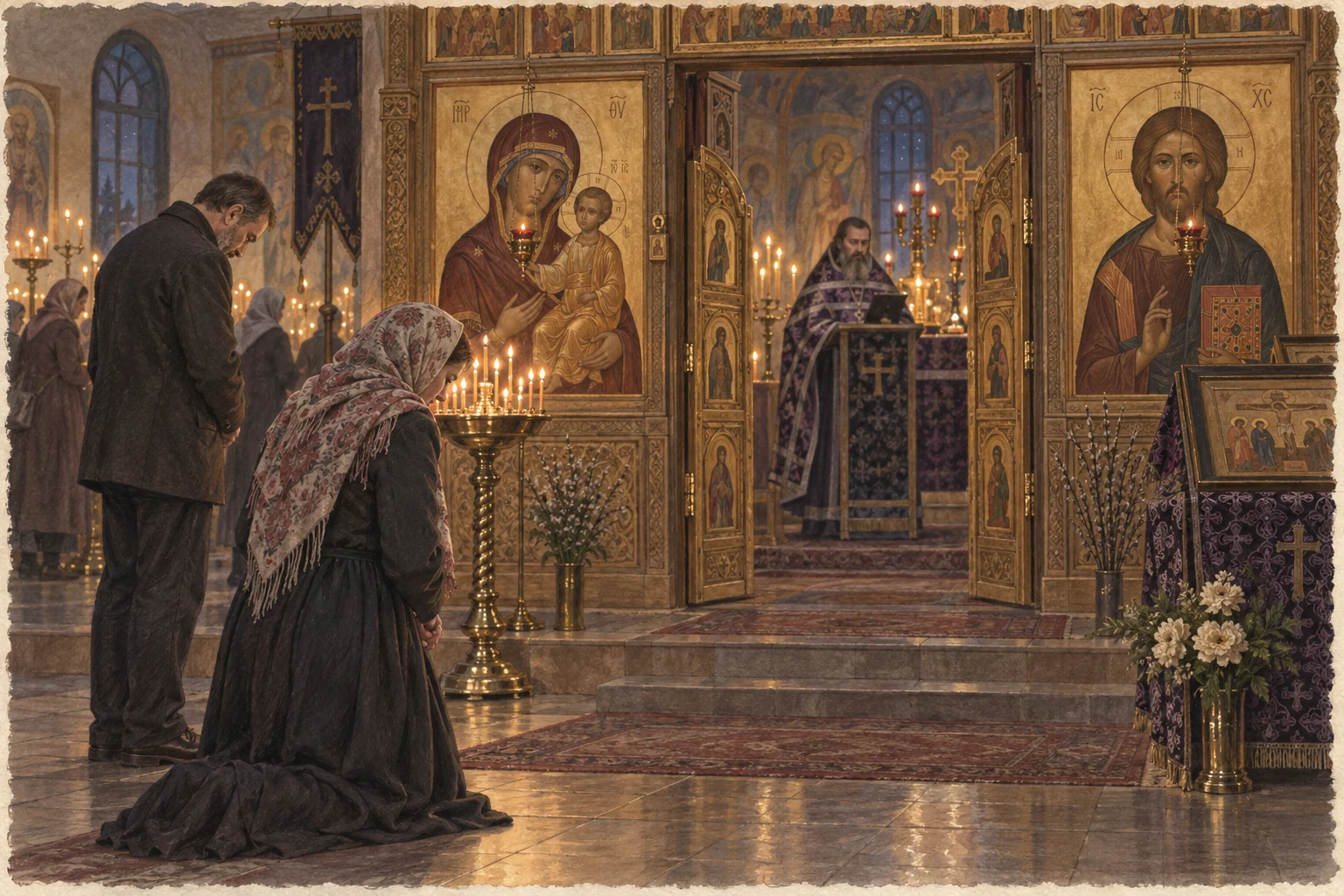
“Presanctified” means that the Holy Gifts were consecrated beforehand at a full Divine Liturgy. At this service the faithful receive those already consecrated Gifts. There is no new Eucharistic prayer consecrating bread and wine. This is neither an abbreviated Sunday Liturgy nor simply evening prayer: it has its own structure and a particular place in Lent.
Why It Belongs to Lent
The weekday services of Great Lent emphasize repentance, while the full celebration of the Eucharist has a festive character. The Presanctified Liturgy joins weekday Lenten prayer with Communion. Fasting is not separation from Christ but preparation to meet him with renewed attention.
Parish schedules commonly list it on Wednesdays and Fridays. The liturgical rule also provides other occasions, including the first three days of Holy Week. These general patterns do not establish a particular parish's timetable. Check its actual announcement; not every weekday Lenten service is a Presanctified Liturgy.
What You Will Hear
The first part follows Vespers, with psalms, petitions, and Old Testament readings. On ordinary weekdays of the Forty Days, the readings come from Genesis and Proverbs. They invite a different kind of attention from a familiar Sunday Gospel narrative: stories of human choices stand beside the instruction of biblical wisdom.
The singing of “Let my prayer arise” connects prayer with the offering of incense. The service then moves toward the transfer of the Holy Gifts and Communion. “Now the Powers of Heaven” replaces the usual Cherubic Hymn. During this transfer the Gifts are already consecrated, unlike the bread and wine carried at the Great Entrance of a full Liturgy.
Preparing to Participate
If you intend to receive Communion, ask the priest beforehand about confession, preparation, and the Eucharistic fast in relation to the service time. Although its structure includes Vespers, the service may take place in the morning. Do not automatically apply a morning fasting timetable to an evening celebration or adopt an unusually strict rule from an online comment.
Illness, pregnancy, medication, and feeding a child call for a practicable arrangement. Do not discontinue prescribed medicine on your own for a service. If a young child cannot yet receive a particle of the Holy Gifts, ask specifically about Communion at this Liturgy: the parish's practice needs explanation from its priest.
Following an Unfamiliar Service
Begin with a few landmarks: the readings, “Let my prayer arise,” the transfer of the Gifts, and the prayer before Communion. You need not follow every printed line while also watching every movement. Returning quietly to the petition you can hear is more helpful than worrying about a lost page.
Make bows or prostrations as your health permits. Being unable to kneel does not exclude you from prayer. On a first visit, choose a place where you can sit if necessary without blocking a passage. You may attend without receiving Communion, simply to pray and become familiar with the service. Its music is significant, but the service is more than a rare musical occasion: its movement is toward communion with Christ.
If the schedule combines the Hours, Typika, and Vespers with the Presanctified Liturgy, ask when the congregation gathers. Arriving only for Communion misses the preparation integral to this service. When work prevents full attendance, discuss the circumstances beforehand rather than concealing the difficulty or abandoning church participation throughout Lent.
Two entrances and different readings
For a first visit, distinguish the entrance belonging to Vespers from the later transfer of the Gifts. Not every appearance of clergy from the sanctuary means Communion is about to begin. The published OCA outline identifies an entrance with the censer and provides for the Gospel and additional readings on certain feasts. A service sheet prepared for one day may therefore differ from the order on another. Check its date and occasion rather than assuming that your memory of a previous visit supplies the complete pattern.
Listening to the Old Testament
Read the appointed passage as a whole beforehand, rather than looking only for familiar phrases. In a narrative, notice the people involved, their decisions, and the consequences. In a passage of instruction, ask what kind of conduct it encourages. A reflection on honesty, for example, can raise a question about a promise you have made or the way you conduct an argument. This is not a search for a coded prediction of tomorrow. When the meaning remains unclear, keep the question for discussion instead of replacing the text with your first impression.
During worship you do not need to recall every point from that preparation. Simply listen and recognize the passage you have read. If some words are inaudible, avoid pushing through the congregation or playing a recording on your phone. You can return to the passage afterwards. Preparation serves shared listening; it should not turn the church into a setting for a private lesson running over everyone else's prayer.
After the service
Separate two questions: what you still do not understand about the order, and what the prayer asks of your own day. Take the first to the priest or parish catechist. The second may call for a small action: keeping a promise, finishing a difficult conversation calmly, or making time for someone you remembered in prayer. Do not judge participation only by a powerful impression of a dimly lit church or unfamiliar music. When those impressions fade, Communion and the call to repentance have not lost their meaning. A quieter response can still lead to a more attentive and responsible life outside the church.