
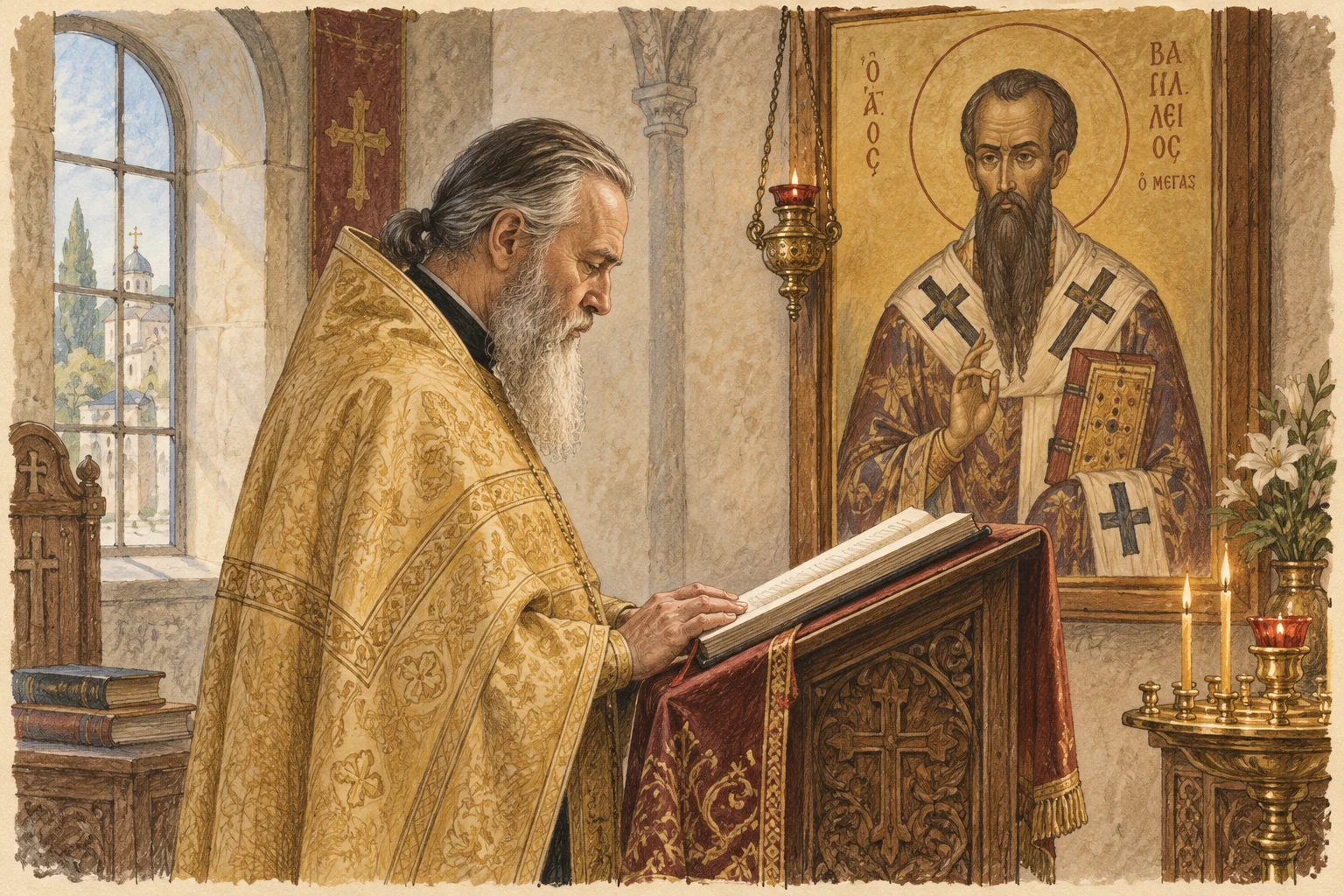
The Liturgies of Saint Basil the Great and Saint John Chrysostom celebrate the same mystery of the Eucharist. Communion is not more powerful or more gracious in one than the other. They are two liturgical forms with a shared structure but different priestly prayers, especially the central Eucharistic prayer, or anaphora.
Its Distinctive Prayer
Saint Basil's anaphora speaks at length about the creation of humanity, its falling away, God's care, and salvation in Christ. Its movement connects biblical history with what the assembled Church is doing now. Thanksgiving embraces the whole work of salvation, rather than only particular benefits received.
The intercessions after the consecration bring concrete human needs before God. Travellers, sick people, prisoners, and people facing difficult circumstances are remembered. These petitions are not an optional appendix to the “real” prayer. They show that the Eucharistic community does not close itself around those present. Listening can also help us remember people who need practical help.
When It Is Celebrated
In the normal annual cycle this Liturgy is appointed ten times: the first five Sundays of Great Lent, Holy Thursday, Holy Saturday, Saint Basil's feast, and in connection with Christmas and Theophany. For the last two feasts, the calendar determines whether it is celebrated on the eve or on the feast itself.
When the eve of Christmas or Theophany falls on Saturday or Sunday, Saint Basil's Liturgy is celebrated on the feast. Otherwise it is joined to Vespers on the eve. In parishes following the Julian calendar, Saint Basil's feast falls on January 14 in the civil calendar; in new-calendar parishes it is January 1. These represent the same liturgical commemoration, not two separate feasts.
What a Worshipper Notices
The readings, entrances, Creed, and preparation for Communion remain broadly recognizable. Some choral responses last longer because the priestly prayers are more extensive. “All of creation rejoices in you” normally takes the place of “It is truly meet”; the service appointed for a particular feast may include further variations.
There is no reliable number of extra minutes to add. Vespers, additional readings, the pace of singing, and the number of communicants all affect the length. If you need to arrange medication, transport, or care for someone else, ask the parish for an approximate finishing time. Remaining on your feet for a particular duration is not a measure of personal faithfulness.
Preparing to Listen
Read the anaphora beforehand in small units: thanksgiving, salvation history, the remembrance of the Last Supper, the invocation of the Holy Spirit, and the intercessions. Ask a simple question of each paragraph: what are we thanking God for, or what are we asking? This makes a long prayer easier to follow as a connected whole.
During the service you do not need to race ahead through a book. Recognizing the part of the common prayer is enough. Preparation for Communion deserves the same care as at another Liturgy; these ten celebrations do not offer an “enhanced” sacrament. Their distinctive prayers can, however, deepen our understanding of every Eucharist.
When comparing the two forms at home, place their texts side by side and identify shared transitions. Read one prayer that differs without deciding which saint expressed the faith better. Their names identify received liturgical traditions, not a claim that every element of the present service was written by one person at one moment and never developed.
A long prayer and personal attention
The extended anaphora can be difficult to follow if you expect an uninterrupted list of requests. Notice first the account of God's faithfulness and then the Church's response. This changes the way you listen: each sentence need not be tested for its immediate relevance to today's private difficulty. Your life matters within a larger story, but it is not the only subject of the prayer. Understanding even one section can change how you hear the whole without requiring instant mastery of its vocabulary.
For study at home, mark the addresses to God and the words describing his actions. Then find the requests concerning people. Use your own sheet rather than writing in a borrowed service book. The exercise distinguishes thanksgiving for what has been given from petitions for help now. It does not turn the prayer into independent pieces to select according to mood. They belong together as one act of prayer by the Church, and their relationship matters as much as any individual phrase.
Intercession and practical care
The naming of human needs can prompt thoughtful help without hasty promises. Remembering an isolated relative may lead you to ask what they need rather than deciding for them. Prayer for travellers might recall someone who needs meeting or assistance with a journey. Such actions are not extra conditions for the sacrament to be valid, nor ways of earning grace. They help prevent the concerns voiced at worship from being left inside the church building when the congregation goes home.
An unfamiliar description in the schedule
A listing of Vespers with Saint Basil's Liturgy describes the structure of the service, not merely a familiar Sunday Liturgy beginning later. Ask about the published starting time and the complete sequence when planning your visit. If accompanying someone who finds a long service difficult, agree beforehand where they can sit and how to contact one another if necessary. Caring for them is compatible with reverence; you do not need to test their endurance. Nor is attendance at different forms of the Liturgy a collection of personal spiritual achievements. The practical aim is to make room for prayer and participation within the circumstances you actually have.