
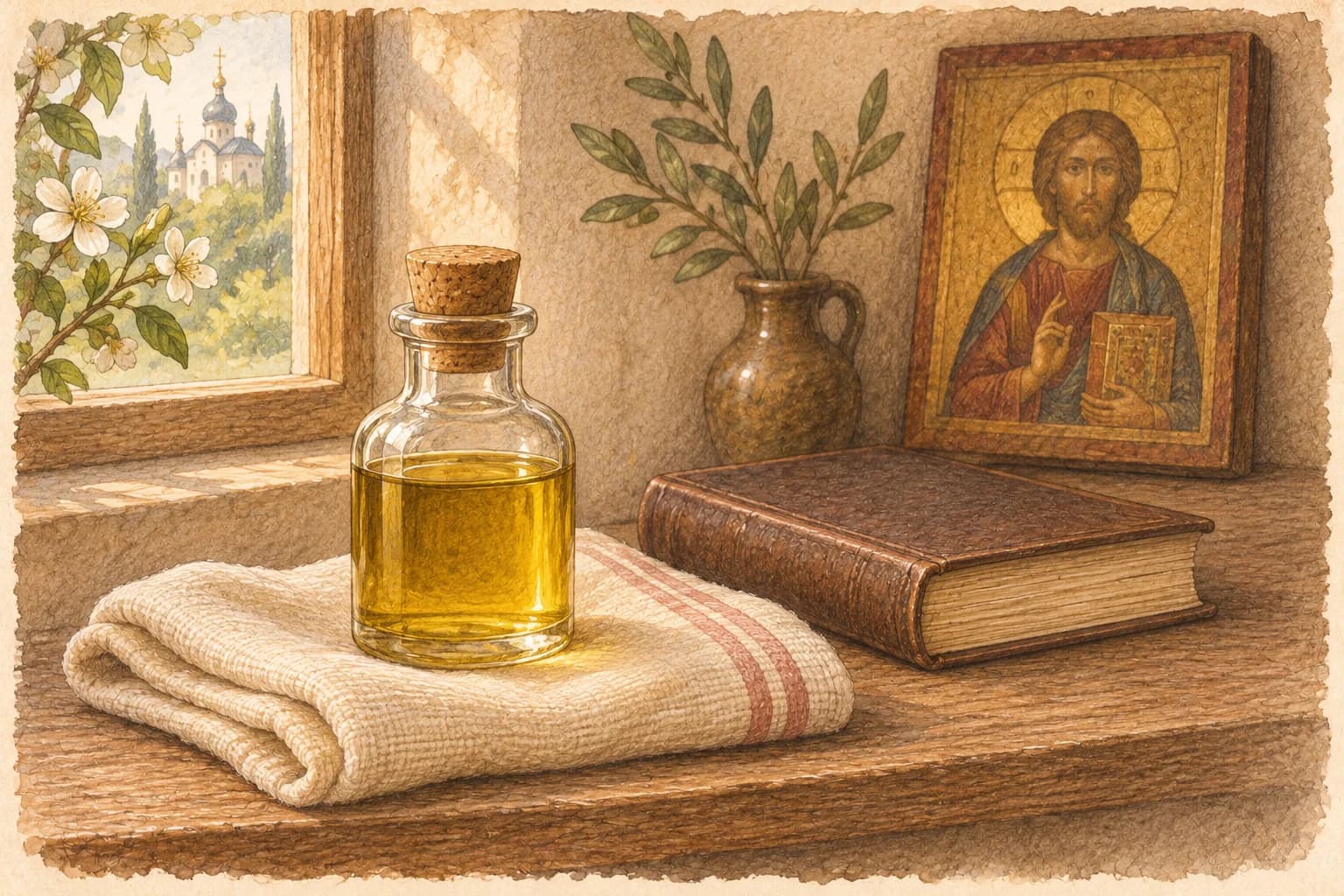
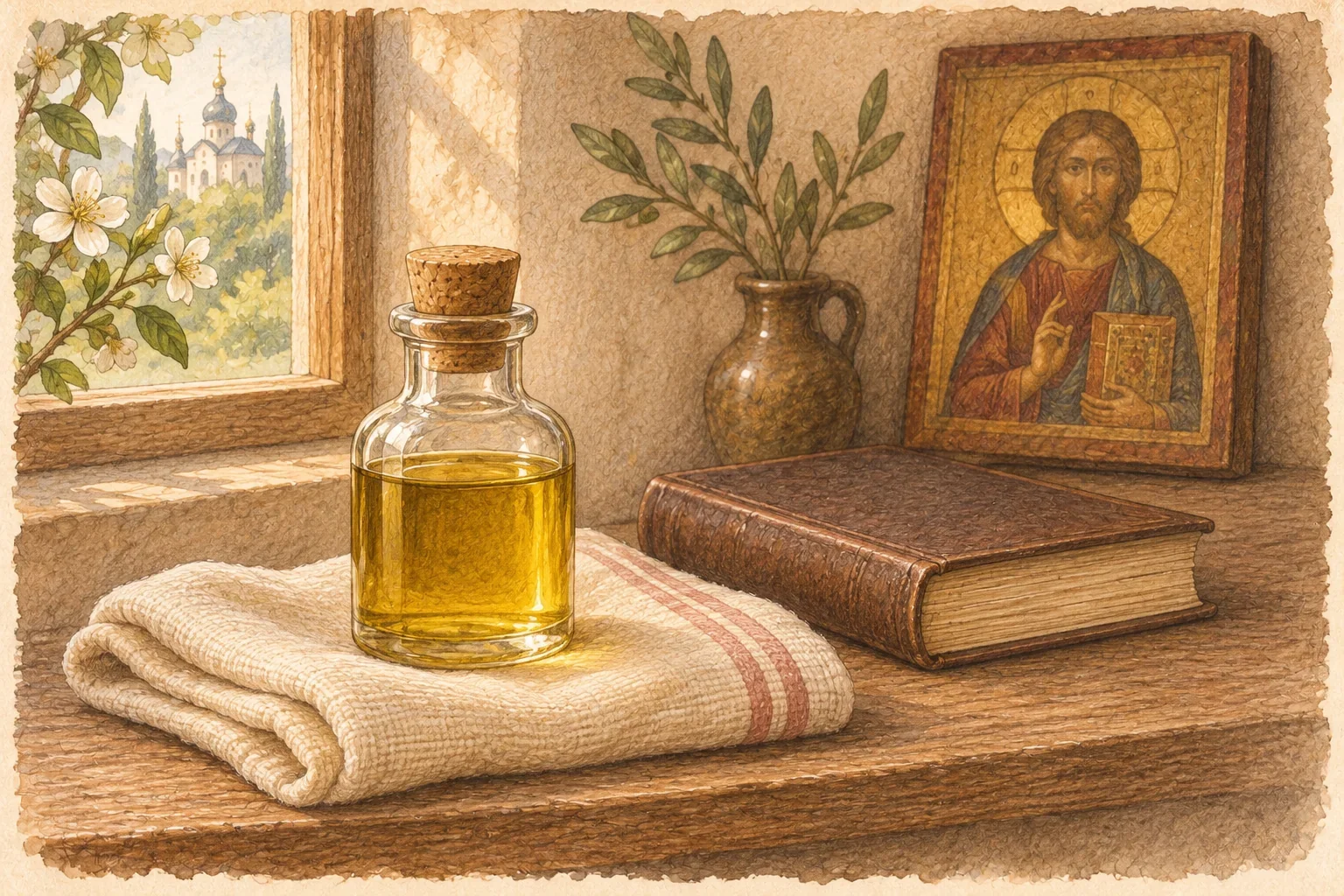
If your parish offers blessed oil after Holy Unction, ask the priest how it should be used at home. Receiving oil to take away is not a condition for participation in the sacrament. Distribution practices can differ between parishes.
The oil is associated with the Church’s prayer for healing and forgiveness. Reverent use at home does not repeat the sacrament or make someone its celebrant. Do not independently reproduce the rite over a relative from an online recording.
Blessing does not turn oil into a universal medicine. Do not stop treatment, put it in the eyes or use it as a medical intervention without medical advice. Dietary limitations and allergies still matter; online comments cannot replace clinical assessment.
Keep a small quantity in a suitable labelled container away from household products. If it has spoiled or you are unsure what to do, ask the parish how to handle it. There is no need to accumulate supplies for fear that lacking oil will deprive you of God’s help.
How the oil relates to the sacrament
The name Holy Unction refers to oil being blessed within the Church’s prayerful rite. The service includes readings and prayers for healing and forgiveness, and participants are anointed with blessed oil. Its meaning cannot be reduced to obtaining a substance that subsequently works independently of prayer, repentance and a person’s relationship with God. Oil belongs within the ecclesiastical sacramental action, but does not replace the whole life of faith.
Taking a bottle home after the service and participating in the sacrament are consequently different things. Someone who does not receive oil to take away has not undergone an incomplete Unction. A relative to whom oil is later given does not automatically become a participant in the rite celebrated at the church. This distinction helps people approach parish distribution customs calmly, without seeking a compulsory material object as proof that the sacrament took place.
Lamp oil, Unction oil and holy chrism
Church life involves several kinds of blessed oil or oil associated with a holy place. Oil from a lamp before a venerated image, oil after Unction and holy chrism are not interchangeable names for one object. Holy chrism is used in particular ecclesiastical rites, especially Chrismation; it should not be confused with the ordinary distribution of oil to parishioners.
If several unlabelled containers are kept at home, establish the origin of each first. There is no reason to call everything chrism simply because it came from a church. A label recording the place and date of receipt helps prevent confusion. Household members should understand what the container holds, so that it is not mistaken for a cosmetic or food product without regard to its origin. Reverent handling begins with the ordinary practical task of knowing what you are keeping.
Home use without inventing a rite
If a priest has blessed anointing at home, ask for the simple arrangements appropriate to the oil you received. There is no need to assemble your own service from fragments of a video. A layperson does not become the celebrant of a sacrament by repeating similar words or copying the priest’s movement. Prayer at home has its place, but should not be represented as another celebration of Unction.
Do not invent a compulsory number of drops, days or repetitions when no such instructions were given. Online advice can turn an ordinary custom into a promise of guaranteed healing: perform an action exactly so many times or it will not work. That changes the meaning of ecclesial prayer. If instructions cause anxiety or seem unnecessarily elaborate, ask the person who supplied the oil to explain their purpose. Simplicity and understanding are more helpful than fear of making a mistake within an invented system.
Storage, usability and oil that has deteriorated
Blessing does not cancel oil’s physical properties: it can oxidise, develop an altered smell or become contaminated through careless storage. Use a clean suitable container, keep it closed and place it away from household chemicals and from where a small child might accidentally drink it. Avoid packaging that makes it easy to confuse with another substance. A large supply is usually unnecessary if you use it only occasionally.
If the oil has deteriorated, do not use it merely from fear that disposal would be disrespectful. Ask the parish how remaining oil should be handled; advice intended for special monastery facilities cannot automatically be transferred to every apartment. Do not burn it at home in unsuitable vessels or pour it where it creates pollution. The question can be resolved calmly and practically, preserving reverence without performing a hazardous action.
When someone requests oil for an ill relative
First establish what the patient wants and whether they need a priest’s visit. Giving oil may express care, but it does not replace a visit, confession or another sacrament when that is what the person is requesting. Do not secretly add oil to the food of a relative who has not consented to a religious action or has medical restrictions. Care involves respecting the person’s wishes and understanding the actual conditions of treatment.
Do not promise recovery within a certain time or attribute a lack of improvement to insufficient faith. Support can include prayer, presence, practical assistance and arranging pastoral contact. Where treatment has been prescribed, use of a church blessing is not a reason to stop it independently. In this way relatives’ involvement remains help for the person, rather than another test in which they must prove their faith through the outcome of treatment.
A question for reflection
Did the priest provide instructions when you received the oil?