
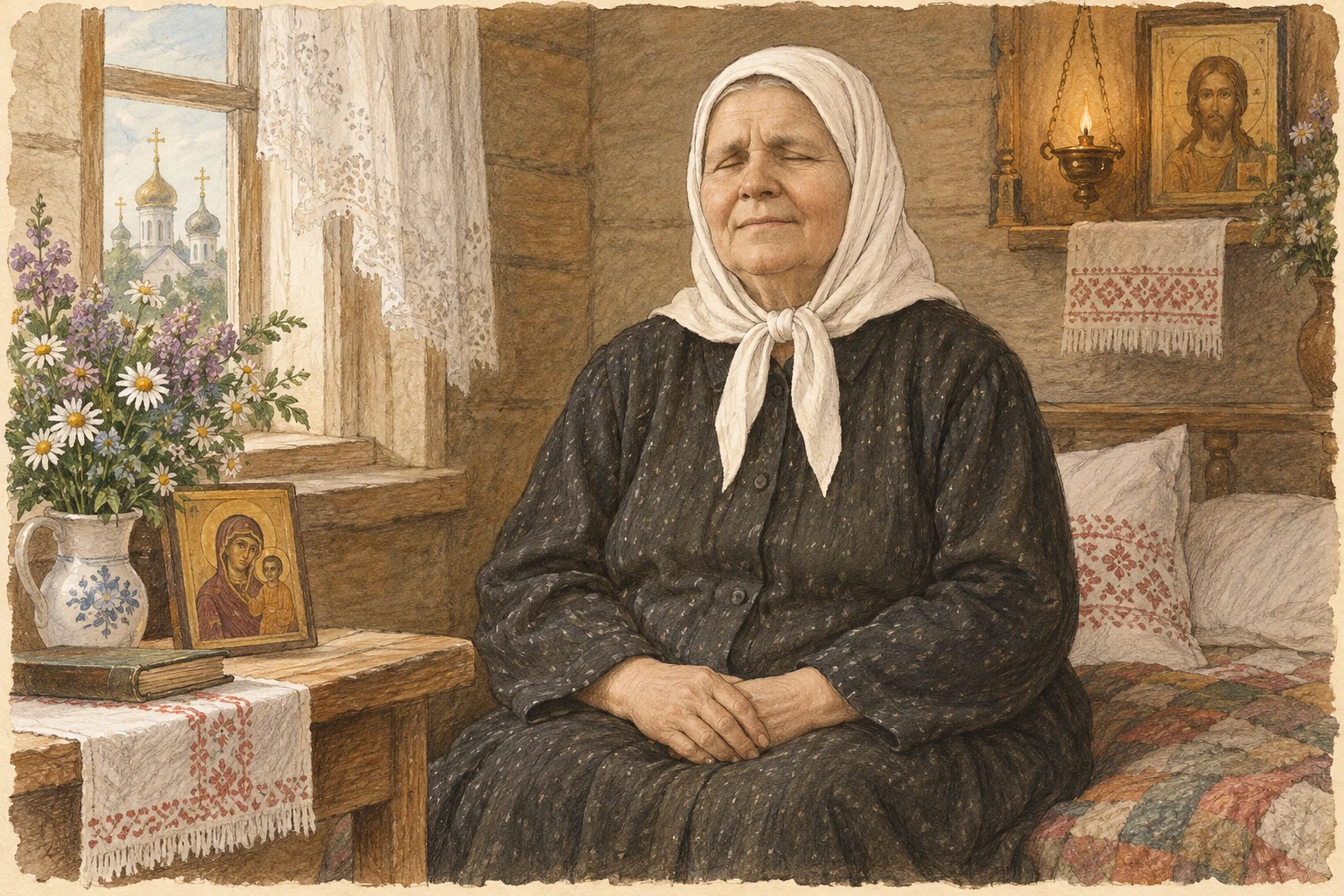
Matrona of Moscow is remembered as an Orthodox laywoman whom people approached for prayer and spiritual support. Her veneration does not rest on an office, academic qualification or monastic rank. It is important to encounter a particular person and her church life, rather than a collection of predictions easily circulated online.
Sebino and life with disability
Matrona Dimitrievna Nikonova was born in Sebino in the Tula region in the late nineteenth century. The Life published by the Intercession Convent gives 1881; historical discussions contain other datings, so this detail should not be presented as undisputed. According to her Life she was blind from birth and later lost the ability to walk.
Church memory describes the prayerful help she offered visitors. Physical disability, however, is neither proof of holiness nor evidence of spiritual deficiency. Matrona's example must not be used to demand exceptional patience, refusal of support or unusual spiritual abilities from another disabled person.
The Moscow years
The convent's account dates her move to Moscow to 1925. She lived in difficult circumstances, staying in the homes of people who sheltered her, receiving visitors and praying. She died on May 2, 1952. Her memory remained alive among those who had known her and those visiting her grave.
Mutual assistance deserves attention in this biography. Someone sought out for consolation also needed accommodation, personal care and companionship. Spiritual life does not remove our dependence on other people's kindness. Asking for help is not shameful, and being able to support someone does not grant control over their choices.
Church veneration and online legends
Matrona's local canonization took place at the Intercession Convent on May 2, 1999. This documented event should be distinguished from every story later attached to her name. A forwarded message labelled “Matrona's prophecy” is not thereby an authenticated statement or an account supported by an ecclesiastical source.
Check whether a witness is named, where the record came from, and whether its context can be read. Be especially cautious with precise predictions of disasters, political forecasts or instructions to refuse medical treatment. Declining to circulate an unverified saying does not disrespect a saint. It helps prevent another person's fears or interests from replacing her actual memory.
Asking for prayer
You may ask Matrona to pray to God for family, health or help in difficult circumstances. There is no need to seek a required flower colour, a fixed number of visits or a formula supposedly incapable of remaining unfulfilled. Gifts at a shrine are voluntary expressions of love, not payment for a result.
Being unable to visit the relics does not close the way to prayer. Turning to God at home, sharing parish life and supporting someone in need remain possible forms of veneration. When asking about illness, continue appropriate medical care; when asking about a family decision, respect the other person's freedom. Failure to obtain a desired outcome does not prove that someone lacked faith or performed a ritual incorrectly.
Take particular care when sharing testimonies of help. A diagnosis, family conflict or bereavement does not become public information because someone prayed to a saint. Ask permission before retelling the story and omit unnecessary personal details. Gratitude to God does not require publishing information that could leave the person or their relatives vulnerable.
Receiving Care and Offering It
Matrona's story raises a question that is easily overlooked: can we see someone needing assistance as more than a recipient? A person may depend on help with travel while also listening carefully, offering encouragement, or preserving family memories. This is not a demand to earn care by being useful. Dignity needs no such qualification. Yet making every decision for someone can also deprive them of opportunities to participate in shared life.
When arranging a visit to church, ask the person whether they want to go, what time suits them, and what assistance they need. Do not discuss their circumstances only with a companion if they can answer for themselves. Unexpected touch or an attempt to guide someone without warning may be unwelcome. Such questions help prevent the veneration of a blind saint from becoming a conversation in which a living blind person is never heard.
Reading Accounts of Personal Encounters
A testimony about Matrona may contain several layers: an eyewitness memory, the explanation supplied by a compiler, and a later retelling. If a passage gives advice to a particular visitor, ask whether the circumstances are known. A private conversation cannot simply become an instruction for every household. Acknowledge uncertainty about a source rather than filling the gap with invented direct speech.
This matters especially when someone invokes the saint in an argument about marriage, relocation, or treatment. Respect for church remembrance is compatible with asking to see a complete publication. A sentence that cannot be located in its alleged source should not determine another person's future. For reading at home, choose a consecutive Life and note questions about particular stories separately. This allows an encounter with Matrona's memory without turning it into a search for a secret answer to every decision or surrendering personal responsibility to an unverifiable message.