
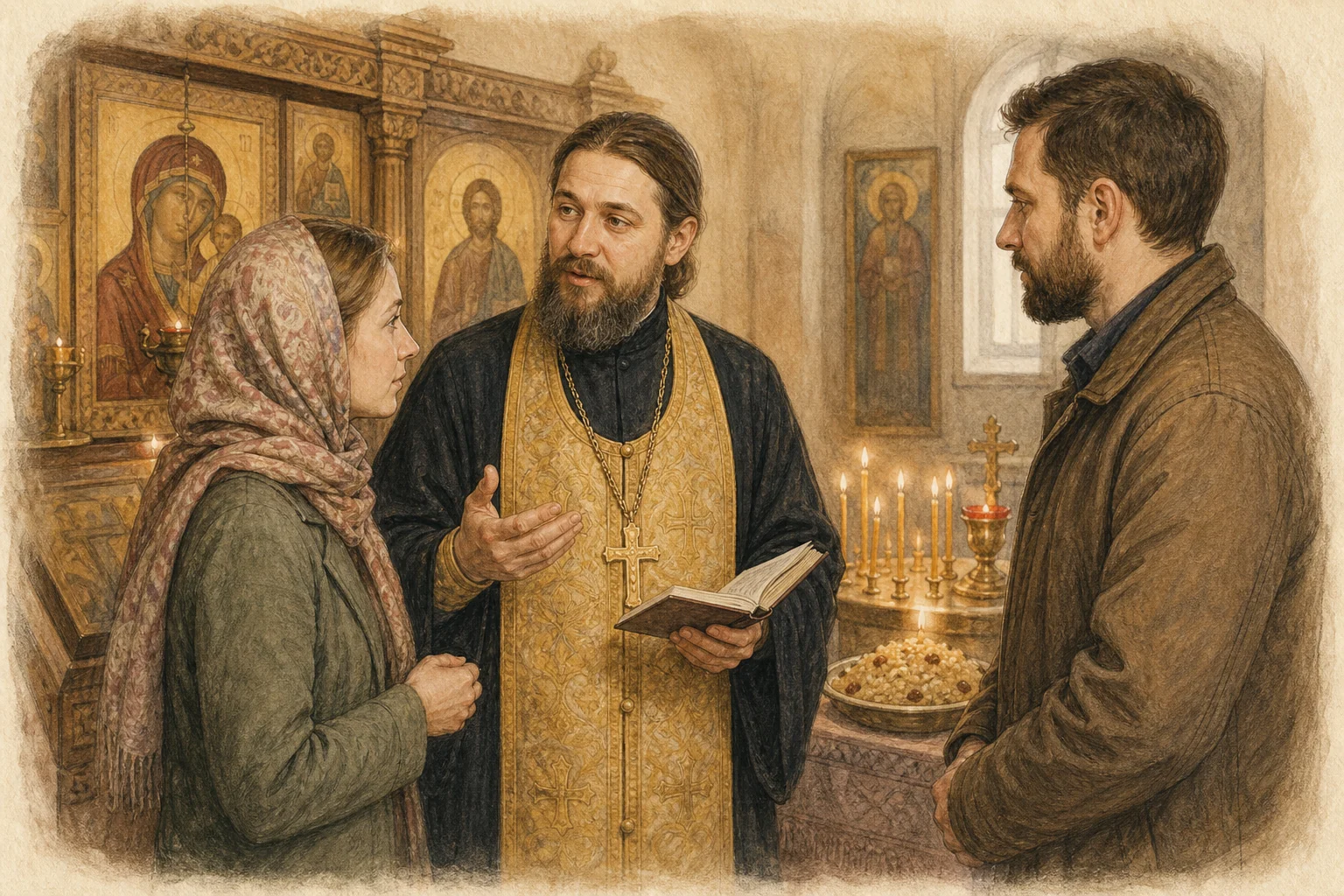
The terms “prayer service” and “memorial service” can be confusing when someone first comes to church with names of loved ones. Both are services of prayer, but they are not interchangeable.
The shortest distinction is this: a prayer service, often called a Moleben, is offered for the living; a memorial service, or Panikhida, is offered for the departed. Remembering that one sentence is enough for a calm beginning.
The main difference
Names of the living and the departed are placed on separate notes because the Church prays for them with different words. This is about the meaning of the service, not fear that a simple mistake could harm someone.
If the terminology is unfamiliar, simply tell a parish worker: “I would like prayer for someone living,” or “I would like to remember someone who has died.”
What is a prayer service?
A prayer service is offered for living people. The Church asks for God's help in a need or gives thanks for a blessing already received.
People may ask for health, strength, peace in a family, safety on a journey, help in study or work, or wisdom in a difficult decision. The prayer asks that help be for the person's true good and salvation.
You do not need an impressive story or a perfect formula. An honest description of your concern is enough.
When a prayer service may be requested
It may be requested during illness, before travel, an examination, surgery, a new responsibility or a time of uncertainty. It can also be a service of thanksgiving.
Gratitude belongs in church life as naturally as a request. We can thank God for recovery, family, help, work completed and kindness received.
Prayer accompanies medical care, professional advice and responsible action. It does not replace them.
Prayer to God and the intercession of saints
Christian prayer is directed to God. A service may invoke the Mother of God or a saint, asking for their intercession before God.
Saints should not be treated as specialists obliged to solve a particular problem. Their lives and prayers help us turn to God with faith, humility and hope.
What is a memorial service?
A memorial service is prayer for the departed. The Church asks for their repose, forgiveness and God's mercy.
For relatives, it becomes shared remembrance in prayer. It does not erase grief or demand that anyone hide tears; it helps a person carry loss within the prayer of the Church.
Love does not end with death. We remember, pray and do good in memory of those who have gone before us.
When memorial services are held
A memorial service may be held after a death, on days of special remembrance, on an anniversary, or on another date agreed with the parish.
The third, ninth and fortieth days have an important place in Orthodox tradition, but practical arrangements should be confirmed with the church schedule.
Missing a particular calendar day is not an irreparable spiritual disaster. Pray at home and arrange a service when it is possible.
Memorial service, funeral and Liturgy
The funeral service belongs to the burial of a departed person and is served once. A memorial service can be held more than once. Liturgical commemoration takes place at the Divine Liturgy.
These services do not compete as “weak” and “strong.” Each has its own place in the prayer and sacramental life of the Church.
Preparing a note for the living
Write the baptismal names of living Orthodox Christians clearly. Surnames, addresses and a full description of the problem are normally unnecessary.
If you do not know how to describe the need, ask when submitting the note. The parish can explain its current practice.
Preparing a note for the departed
Write the baptismal names of departed Orthodox Christians on a separate note. Do not guess when you are unsure about a name or whether someone was baptised.
A complicated personal circumstance deserves a personal and pastoral answer. Speak with a priest rather than relying on an anonymous internet rule.
Private prayer and loving remembrance remain possible even when a name cannot be included in a particular liturgical commemoration.
Should you attend in person?
If possible, come and take part. At a prayer service, bring your request or gratitude before God. At a memorial service, remember the departed and stand with others who grieve.
Illness, distance, work and care for relatives can prevent attendance. Do not turn this into guilt. Pray at home and ask the parish how to submit the name.
How to prepare yourself
Check the names, confirm the time and arrive without haste. You do not need to memorise the order of the service.
Listen as you can. Do not anxiously copy every gesture made by others. Attention and an honest desire to pray are more important than appearing experienced.
After a prayer service, remember your own responsibility: prayer for reconciliation includes willingness to speak; prayer for the sick includes care and treatment.
What should be brought to church?
In many cases, a note with names is enough. Candles, food and other offerings are not conditions for God to hear prayer.
Some parishes have local customs concerning memorial food or charitable offerings. Confirm them in advance instead of following a generic internet list.
Candles, notes and prayer
A candle is a sign of prayer and offering, not a magical object. Its price, size and exact position do not determine the strength of God's help.
A note brings a name into church commemoration. Personal prayer joins the outward action to the heart. Neither replaces love, faith or responsible action.
Donations are not a price for an outcome
A parish may receive a donation when a note is submitted. It helps support worship, the church building, clergy and parish work.
A donation does not purchase healing, forgiveness or a guaranteed result. If money is difficult, speak honestly with the parish.
Submitting a note online
Where an official parish form is available, it may be used to submit names and select an available commemoration. Check carefully whether the note concerns someone living or departed.
An online form is convenient, but it is not a substitute for the whole of church life. Come to worship when you are able.
Prayer at home
You may pray in your own words: name the person, give thanks, ask for help for the living, or ask repose for the departed. Honesty is better than a complicated formula you do not understand.
Home prayer and church prayer are not rivals. In church, a personal request joins the shared prayer of the community; at home, the remembrance continues in daily life.
Care for the living can become action. Good works in memory of the departed can express love, without imagining that mercy can be purchased.
What these services do not promise
A prayer service does not guarantee immediate recovery, restored relationships, examination success or control over another person's decision. A memorial service is not a method for securing a result through an exact number of actions.
Both services turn to God with hope. We ask, thank, remember and learn to trust without trying to control God or another person's will.
When you are grieving
Grief does not follow a timetable. Pain may return after the fortieth day or an anniversary, and this does not mean that faith is weak.
A memorial service offers shared prayer, while a person may also need rest, conversation, family care and professional support. The Church does not require you to carry grief alone.
If words fail, stand quietly and say the loved one's name in your heart. Silent presence can itself become prayer.
Common questions
Can a prayer service be requested for the departed?
A prayer service is for the living. A memorial service and other forms of commemoration are offered for the departed.
How long do the services last?
The length depends on the liturgical order and parish circumstances. Confirm the time in advance.
May I come alone?
Yes. A person may participate without relatives. If grief is difficult to carry, it is also appropriate to ask the parish for support.
What if I do not know whether someone was baptised?
Do not guess. Discuss the specific situation with a priest; private prayer remains possible.
A calm next step
First decide whether you are asking prayer for someone living or departed. Prepare the name and contact the parish to confirm the schedule and practical order.
Prayer and memorial services differ in whom they commemorate, but both call us away from indifference and toward trust in God, faithful remembrance and works of mercy.