
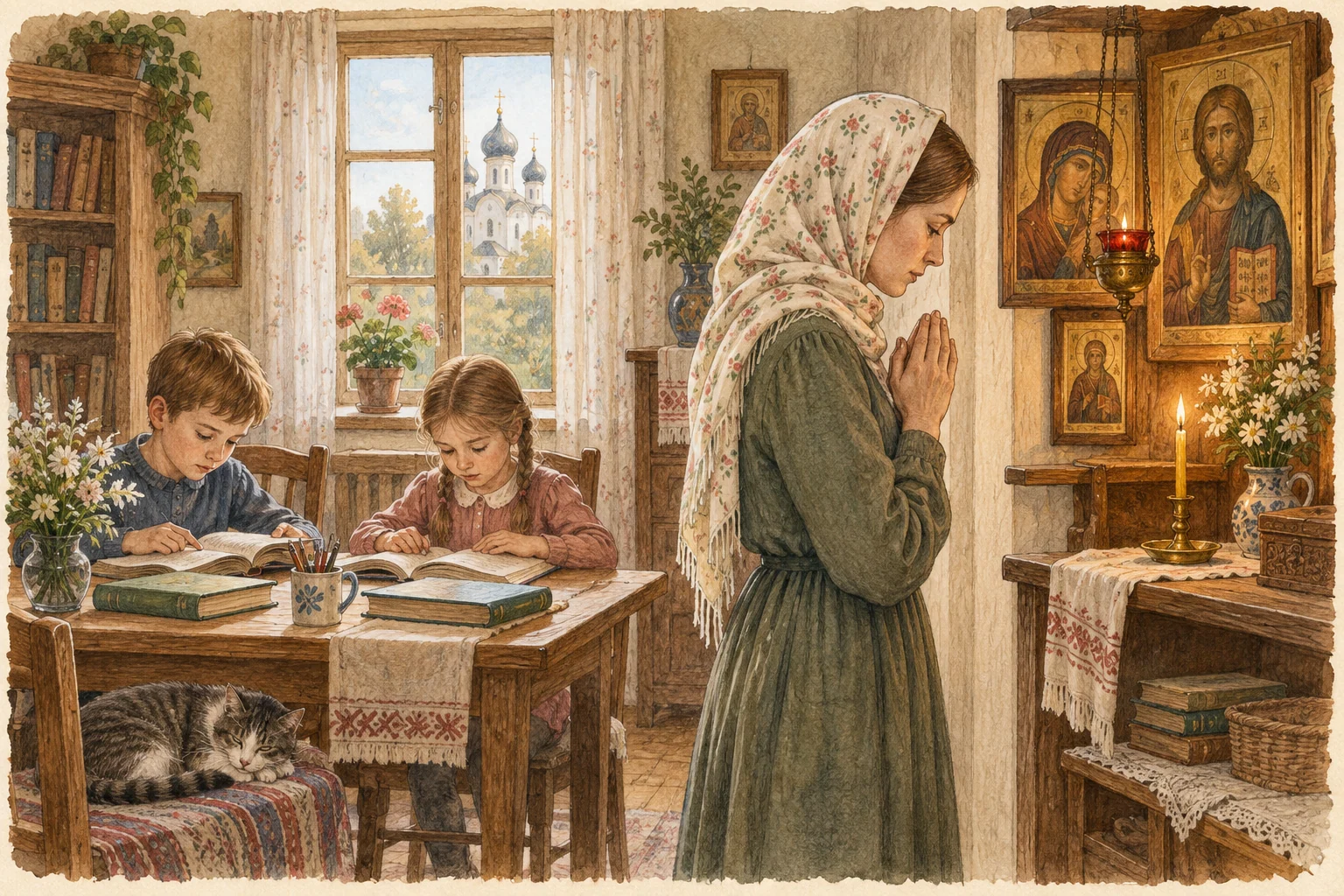
Prayer for children brings parental love before God, but does not provide control over another person's will. Parents ask for help, protection, and salvation while learning responsibility themselves. Neither the length of a prayer nor the number of repetitions guarantees health, examination success, or the life adults have planned in advance.
Short Words With Which to Begin
The morning prayer for blessing children in the Azbyka Orthodox prayer book includes this petition: “Lord, ... have mercy on them and save them, for Your name's sake.” This is an editorial English translation of an excerpt, not an authorised English liturgical text. The ellipsis marks an omission; the full Russian source is linked below. Name your children and offer the request attentively rather than hurrying to complete a quantity.
When a child is ill or a parent feels lost, the Gospel father's words may be especially close: “Lord, I believe; help thou mine unbelief” (Mark 9:24, King James Version). They occur in an account of a father seeking help for his son. He does not first become completely fearless. He approaches Christ with his weakness, not after overcoming it entirely.
Understand the Petition Rather Than Seek a Formula
Asking for salvation is wider than asking for convenient circumstances. A parent prays for the child's life before God, their ability to recognise good, to love, and to find help in difficulty. There is no need to seek the strongest prayer to force admission to a chosen university, a marriage, or immediate agreement with the family. That approach treats another person as something to control.
Read unfamiliar liturgical language with an explanation. Ask a priest or consult a reliable translation when a phrase is unclear. You can also pray in your own words, distinguishing them from an established text. Ask, for example, for patience to hear your child and courage to correct your own mistake. These are genuine parental needs alongside external wellbeing.
A Child's Freedom and the Limits of Care
Parental responsibilities change as a child grows. Praying for an adult son or daughter does not authorise reading private messages, imposing a spouse, or treating every disagreement as rejection of God. Speak honestly about faith and concern, but do not turn the statement that you pray for them into a threat or a means of producing guilt.
If an adult child does not share your faith, you may still pray for them at home. Ask separately about the rules for liturgical commemoration, explaining relevant circumstances to the priest. Do not confuse limits on a particular church action with a prohibition on loving someone and desiring their good. Respect for freedom also does not require approving dangerous conduct or funding harm.
Join Prayer to Action
Alongside prayer for health belong appropriate healthcare and attention to safety. Alongside prayer about studies belong sleep, suitable conditions, and attention to actual difficulties. Prayer does not replace speaking to a teacher, professional, or the child themselves. When danger is recognised, act promptly rather than waiting for a special sign granting permission to protect.
Do not blame yourself for every misfortune by assuming you prayed too little, and do not place that burden on another parent. A family does not know the causes of every event. Choose a brief, manageable prayer and return to it without keeping a score of merit. Its fruit need not resemble a fulfilled parental plan. Sometimes the first change is our willingness to listen, apologise, and remain present without controlling.
When a Child Asks to Pray Together
Begin with what the child wants to bring to God: fear of a new school, an argument with a friend, or a relative's illness. Do not immediately turn the request into a lesson about their faults. Pray briefly, then ask what practical help is needed. If the child does not know established words, offer an understandable personal petition while explaining that it is not a special compulsory formula. Correcting every phrase can replace the wish to pray with fear of getting it wrong.
Thanksgiving can be specific too: for a teacher's help, reconciliation, or a day spent together. Do not attach a promise that obedient children always receive high marks and never become ill. If the hoped-for outcome does not happen, allow disappointment to be expressed. Do not attribute the setback to insufficient belief or incorrectly spoken words. A conversation about faith should leave room for an honest question rather than require pain to be hidden behind the expected answer.
Parental Prayer and an Adult Child's Trust
Before passing a prayer request to acquaintances, consider what information is actually needed and whether your adult son or daughter agrees to its circulation. A diagnosis, marital conflict, or difficulty with studies should not automatically become the property of a large group chat. You can ask for support without disclosing details. Handle photographs and messages with particular care: good intentions do not remove the need to respect privacy.
When a child lives far away, distinguish prayer from continual checking that they are available. Agree on a comfortable frequency of calls instead of requiring a report after every prayer rule you complete. Rather than sending a long anxious message, ask whether specific help would be useful. Parental love remains active even when you cannot solve everything for another person. Prayer can help you acknowledge that limit; it does not remove the need to apologise when care has already become pressure. Trust also grows through the ordinary experience of being heard without an immediate demand.
Sources
- Azbyka Orthodox Prayer Book: Prayers for Children and Godchildren (Russian)
- Mark 9:24: Russian Synodal Translation (Russian)
- Mark 9:24: King James Version