
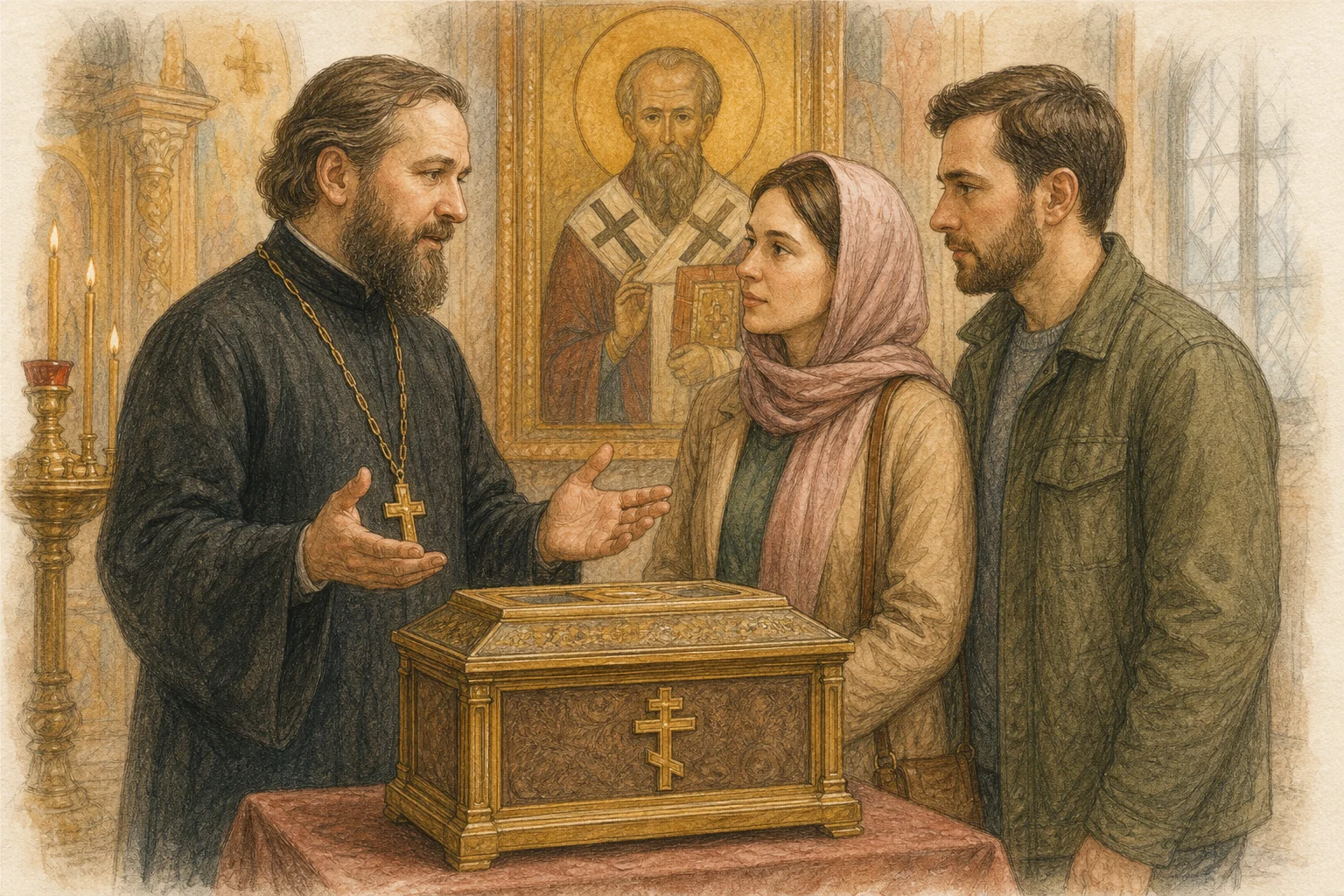
Holy relics are the remains or portions of the remains of people glorified by the Church for life in Christ; they are venerated not as divine objects but as the bodies of members of Christ awaiting the universal resurrection. Through the body a person is baptized, prays, receives Communion, works, and serves a neighbor, so Christianity does not treat matter as foreign to salvation.
Incorruption is not a required condition of sainthood, and touching a shrine does not guarantee healing. The veneration of relics is affirmed by church tradition and the Seventh Ecumenical Council, but always leads toward God, who glorifies the saints.
What the word relics means
In church usage, relics are the honored remains of a saint: a whole body, bones, portions, or very small particles. The term does not require the body to appear unchanged.
The sacred remains are normally placed in a shrine or reliquary and accompanied by a trustworthy identification and seal. The monetary value of the container does not define spiritual significance.
Why Christians honor the body
The Son of God truly assumed human flesh, died bodily, and rose. The human person is called to salvation as a whole, not to the liberation of a good soul from a useless body.
A saint's body participated in prayer, fasting, sacraments, labor, and mercy. Reverence expresses faith that death does not destroy the person and that God will raise the dead.
Veneration is not worship as God
Adoration as divine belongs to the Holy Trinity alone. A saint is honored as a human being in whom grace acted, and the Church asks for that person's prayer before God.
The same distinction applies to icons: honor passes to the prototype. Our practical guide explains how icons are venerated.
Is there a scriptural basis?
The Bible recounts how contact with the bones of the Prophet Elisha became the occasion for a dead man to revive, and how healings occurred through cloths associated with the Apostle Paul. These accounts show that God can work through the material world.
They do not create a magical technology. God acts, not a chemical property of bone or cloth, and a miracle cannot be commanded.
The Seventh Ecumenical Council
The council held in 787 defended the veneration of icons and the Church's reverence toward the honored remains of saints. The Orthodox Encyclopedia situates relic veneration within this conciliar tradition.
This means the practice is not a late folk invention. Conciliar recognition, however, can never justify forgery, commerce, or superstitious stories.
Must relics be incorrupt?
No. A saint's remains may be preserved fully, partially, or may decay naturally. Physical preservation depends on many conditions and does not canonize a person by itself.
“The body did not decay, therefore the person is a saint” is false. The Church studies confession of faith, life, veneration, and testimony; one biological sign is never sufficient.
Why relics are divided into particles
Since ancient times, particles have been transferred to different communities so that believers may pray in spiritual communion with the saint. A small particle does not contain “less grace,” and a large shrine guarantees no larger result.
Division belongs to responsible church authority and documented provenance. A pilgrim may never detach a fragment privately.
Relics in the altar and antimension
Orthodox liturgical tradition connects the Eucharist with the memory of martyrs; a particle of relics is placed in the altar and ordinarily in the antimension on which the Liturgy is celebrated.
This recalls that the Christian community stands upon the witness of those who gave their lives to Christ. A particle does not charge a table with power; it joins worship to the memory of the whole Church.
Shrine and reliquary
A shrine may be a large container, sometimes shaped like a tomb, while a reliquary is often smaller and can hold one or several particles. Both protect the sacred remains and make orderly veneration possible.
Never open one, demand that remains be displayed, or insist on direct physical contact. The church determines the safe and reverent practice.
How to approach relics
Make the sign of the cross, bow, name the saint, and ask for intercession. When permitted, kiss the marked portion of the shrine or its glass and then move aside calmly.
Do not attempt to kiss an iconographic face when another area has been designated. Follow parish workers and avoid holding up a line with a long reading.
Must the shrine be kissed?
No. A person may bow from a distance, especially during illness, limited mobility, a dense crowd, or a period of increased infection risk.
A saint does not hear according to the surface area touched. Abstaining for a serious reason is not a failure of faith.
What people pray for
Ask for fidelity to Christ, repentance, peace, help in illness, wisdom, and strength to carry responsibility. It can be fruitful to connect the request with the saint's life: courage from a martyr, compassion from a merciful pastor.
Saints are not specialists in a service directory. Every saint may receive a good request, which is entrusted to God's will.
Do relics guarantee healing?
No. The Church knows testimonies of healing but promises them to no one and never calls continued illness proof of defective faith.
Pray while consulting physicians, completing examinations, and taking prescribed treatment. A miracle does not require contempt for medicine.
May objects be touched to the shrine?
Some locations permit a cross, icon, or cloth to touch the shrine briefly, while others do not. Follow local practice, ask permission, and never create an obstruction.
The object does not become an amulet or medicine. It can recall prayer but cannot replace faith, sacraments, treatment, and responsibility.
Oil, flowers, and associated blessings
Oil from a lamp, blessed flowers, or ribbons may be distributed with a blessing. Use them reverently without claiming an automatic effect.
Do not buy an unknown liquid advertised as “oil from relics,” and never ingest something not intended for consumption. Verify the source with the church.
How authenticity is established
Church relics should have a provenance, document, or seal from responsible ecclesiastical authority. A transfer records where the particle came from.
An ordinary visitor does not perform scientific analysis but may ask the parish about provenance. A seller's vague story and high price are not evidence.
Why selling relics is forbidden
Human remains of saints are neither merchandise nor a private investment. Buying a supposed particle on an online marketplace encourages sacrilege, forgery, and exploitation of religious trust.
A donation supporting a church differs from payment for a guaranteed miracle. Grace can never be sold.
There are no “strongest relics”
Saints cannot be ranked by power. God alone is the source of grace, and the saints live in communion with him.
Travel to a famous shrine may be a fruitful pilgrimage, but prayer at a small parish is not weaker. Do not neglect the nearby Liturgy through constant pursuit of rarity.
Saint George's relics in our church
A particle of Great Martyr George's relics is venerated among the sacred objects at Saint George Church in Krasavitsa. It joins the parish to the memory of the saint for whom the church is named.
Read about Saint George's martyrdom and witness, and check the current schedule before visiting.
How to explain relics to a child
Say, “These are the remains of a holy person who loved God; we believe God will raise the body, so we treat it with respect.” Avoid frightening photographs and never force the child to kiss a shrine.
A child may bow or stand nearby. When direct questions about death arise, answer truthfully and calmly without details inappropriate to the child's age.
When the area feels crowded or frightening
Step aside, sit down, go outside, and return only if you wish. A crush, faintness, or panic attack does not become a spiritual achievement.
A disabled visitor may request accommodation according to the organizers' practice. Workers should protect both the dignity of pilgrims and the safety of the sacred object.
Frequently asked questions
Are relics always a whole incorrupt body?
No. They may be whole remains, bones, or tiny particles; incorruption is not a required sign of sainthood.
May I choose not to kiss the shrine?
Yes. A bow and prayer are sufficient.
Why are some particles extremely small?
Size does not measure grace. Particles are entrusted to communities through church order.
May relics be purchased?
No. Commerce in the remains of saints is forbidden; dubious offers should be rejected.
Should treatment stop after prayer?
No. Continue medical care unless the treating professional changes the plan.
The central message
Veneration of relics confesses Christ's Incarnation, the dignity of the human body, and hope in the resurrection. It directs the heart toward God and the saint's example, not toward matter as an independent power.
Approach without fear or excitement, pray, follow the order, and seek no guarantee. A true encounter with a sacred object leaves not a charm of magical protection but a desire to live with greater fidelity, mercy, and truth.