
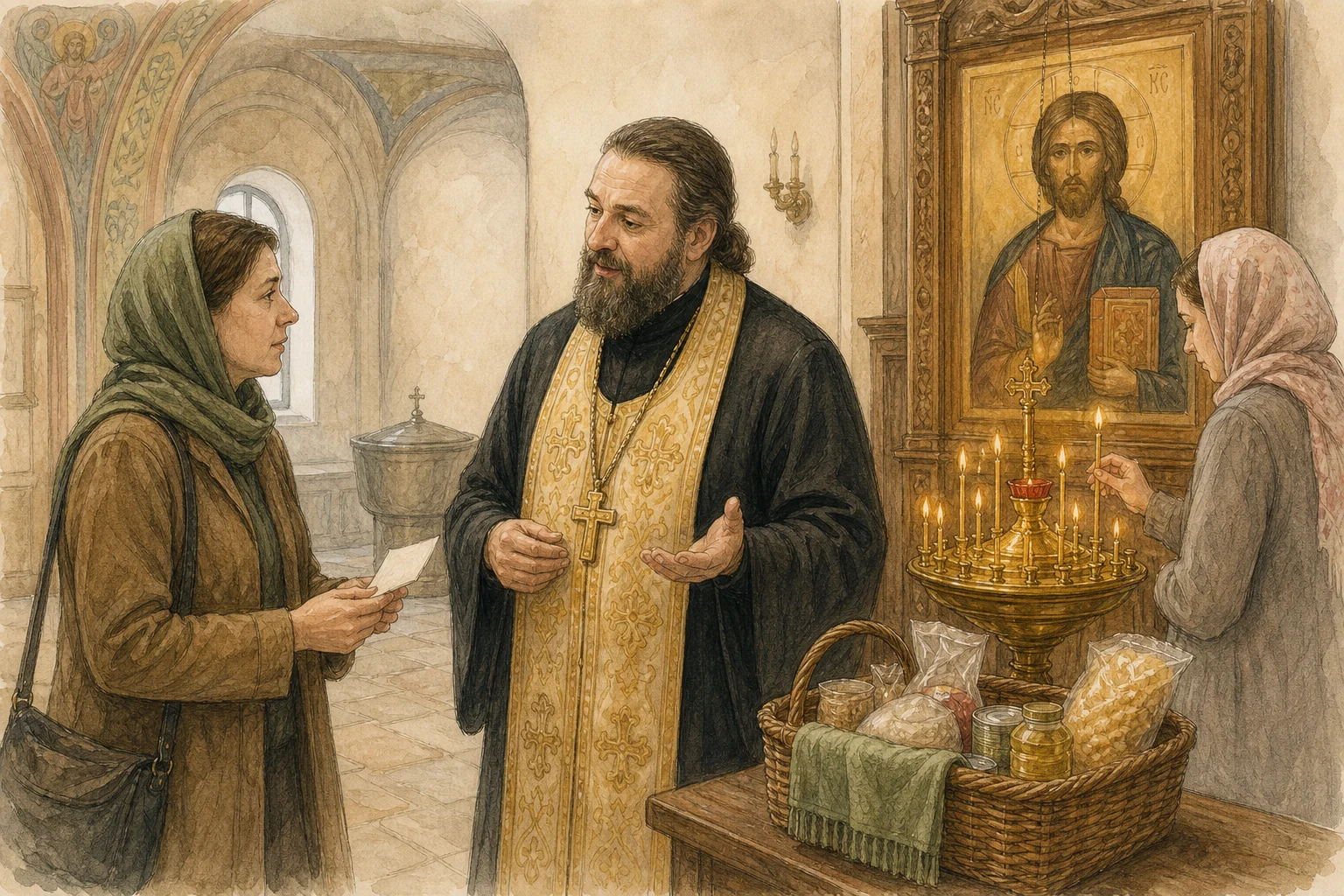
The names of unbaptized people are not normally submitted for the proskomedia, Divine Liturgy, or common panikhida because these forms express the Eucharistic communion of baptized members of the Orthodox Church. A family may still pray personally, ask God for mercy, and perform good works in the person's memory.
This boundary is not a human verdict about eternal destiny. God knows the whole life, freedom, and circumstances of every person; a family should neither deceive the parish nor abandon love and hope.
Why prayer lists are connected with Baptism
At the proskomedia, particles are arranged around the Lamb as an image of the Church gathered in Christ. Baptism is the person's entrance into ecclesial and Eucharistic communion.
The list is therefore not a general register of everyone for whom God can hear prayer. It marks a particular form of the Church's prayer for its members.
Does this mean God does not love the unbaptized?
No. Christianity confesses God's love for the world and his perfect knowledge of each person. The absence of a church list does not limit divine mercy.
The Church cannot claim certain knowledge of one departed person's eternal condition. It honestly keeps the boundaries of its sacraments while calling the family to personal prayer and mercy.
May another name be written instead?
No. Do not choose a similar saint's name, claim a Baptism that never occurred, or submit a person as Orthodox in order to evade the rule.
Deception does not help the departed and wounds trust within the family. When information is uncertain, tell the priest exactly that.
When nobody knows whether Baptism occurred
Ask older relatives and look for a certificate, photographs, baptismal clothing, inscriptions on icons, and earlier church prayer lists. Discover which parish may have celebrated the sacrament.
Lack of a document does not always prove lack of Baptism, especially for an older generation. Until facts are clearer, however, do not confidently invent a church identity.
When the baptismal name is unknown
The civil and baptismal names may coincide but not always. Do not assign a patron solely from an approximate birthday found in a random calendar.
Give the known facts to the priest. At home, you may pray using the familiar name because God knows the person you mean.
May a candle be lit?
Yes. A person may light a candle before an icon of Christ and personally ask for mercy toward the departed. The candle expresses the living person's prayer; it does not automatically place a name in the proskomedia.
Do not search for a secret candle stand reserved for the unbaptized and do not interpret the flame. Follow parish order and basic fire safety.
How to pray at home
Say simply: “Lord, you know the life and heart of this person; have mercy according to your great compassion and console us.” Psalms may also be read with a request for light and peace.
Do not imitate priestly exclamations or describe personal prayer as an official panikhida. Our practical guide explains how to remember the departed at home.
May a canon to Saint Varus be read?
Orthodox devotional tradition includes appeals to the martyr Varus with prayerful hope for people who died outside Baptism. Obtain a suitable text and reading discipline from a priest.
Never treat the canon as a secret bypass of church order or a guaranteed result. A saint does not replace Christ and does not operate through a magical specialty.
May the name be submitted for another service?
The ordinary proskomedia list and several common offices are intended for members of the Church. The possibility of another pastoral prayer belongs to the priest's judgment in the actual situation.
Do not place a living unbaptized person's name in the health column merely because the person is alive. First ask which form the parish offers.
May one pray for a living unbaptized person?
Personally, yes: for health, protection, wisdom, and a free movement toward Christ. Prayer must not ask God to crush a person's will or become a tool of pressure.
Show faith through respect, practical help, and truthfulness. Baptism must be a free response rather than a device for calming relatives.
May someone be baptized against their will?
No. An adult receives Baptism consciously and freely. Serious illness does not remove the person's voice when the person can still express a decision.
Emergency Baptism requires a living person and real consent appropriate to the circumstances. A body cannot be baptized after death, and a sacrament cannot be invented retrospectively.
When a person intended Baptism but died
Tell the priest whether catechesis, parish meetings, a stated intention, and practical preparation had begun. Such circumstances require pastoral and sometimes diocesan consideration.
The family must not declare Baptism completed on its own. Yet sincere intention is known to God and can be brought into personal prayer without despair.
When a catechumen dies
A catechumen was preparing for Baptism and already related to the church community but had not entered the Eucharist through the sacrament. Liturgical practice in that case differs from the ordinary situation.
Contact the parish where the preparation occurred immediately. Do not apply a general internet instruction to an individual life.
When an infant dies before Baptism
The ordinary proskomedia list and funeral office are not used, but the Russian Orthodox Church has a distinct service of consolation for parents who lost a child before Baptism.
It does not baptize the infant after death and does not issue a cruel verdict. The Church prays for the family's consolation and entrusts the child to God's mercy.
Miscarriage and stillbirth
The mother is not automatically at fault and must not be accused of insufficient faith. She needs medical care, permission to grieve, and gentle prayer.
Ask a priest for the service of consolation and avoid random texts that punish the woman. Persistent depression requires help from a professional experienced in pregnancy loss.
May a non-Orthodox Christian be included?
The ordinary Orthodox proskomedia is for members of the Orthodox Church. Baptism in another Christian community does not automatically place someone on the Eucharistic list.
Personal prayer for a loved one remains possible. In an interfaith family, discuss a truthful form of farewell that does not deny the departed person's own faith.
When a baptized person rarely attended church
Rare attendance by itself does not mean Baptism disappeared. The name of a baptized Orthodox person can usually be submitted if the person did not explicitly reject the Church.
Do not edit the biography after death. Tell the priest the truth, especially when the person joined another religion or requested that no rites be performed.
When someone rejected faith
An explicit conscious rejection requires pastoral consideration. Respect for human freedom does not permit relatives simply to hide the person's expressed will.
Personal prayer and love remain. The Church can support mourners even when ordinary public commemoration is impossible.
Do not confuse this with suicide
Baptism and the circumstances of death are separate questions. For a baptized person who died by suicide, church commemoration is considered according to mental condition and diocesan order.
Conceal neither Baptism nor the cause of death. Bring available medical information and ask for help without condemnation.
What personal prayer means
It is one person's appeal to God, not a public declaration that the departed belonged to the Church. It can name pain, love, and hope.
Personal prayer is not second-rate. It remains honestly within our responsibility and entrusts what is unknown to God.
Good works and almsgiving
Help someone in need, support a sick person, bring food to a family, give to a verified cause, or plant a tree where permitted. Dedicate the work to the person's memory.
Almsgiving does not purchase forgiveness and does not require publicity. Do not give away your household's last resources from fear or pay an intermediary for a promised result.
May the person be remembered at a family meal?
A family may gather, begin with a short personal prayer, and remember the person. The meal is not a church panikhida and does not alter the fact of Baptism.
Do not set a separate plate for the dead, pour vodka, or attempt to summon a soul. Food belongs to the living.
May the grave be visited?
Yes. At the grave, a person may pray in their own words, care for the site, and perform a good work. A cemetery does not test church membership.
Leave no food, charms, or written spells. If you wish to invite a priest, state honestly in advance that the person was not baptized.
How to explain the decision to relatives
Say: “We will not put false information on a church list, but we will continue to pray personally and do good.” This joins faithfulness to love.
Do not argue about eternal destiny or blame the departed person's parents. Responsibility for your own prayer does not grant a right to judge another person.
How to avoid exploitation
Offers to conduct a secret funeral for the unbaptized, baptize after death, or guarantee a soul's release for payment contradict church order and exploit grief.
Verify that a clergyman belongs to a canonical parish and do not transfer money to a stranger's personal account. Ask your own parish directly.
What to do now
Clarify the facts about Baptism, record the known name, speak with a priest, choose a short personal prayer, and perform one specific work of mercy.
If grief is acute, ask a trusted person to accompany you. Every theological question does not need to be solved in one day.
Frequently asked questions
May an unbaptized name be submitted for the departed?
Not on the ordinary proskomedia list; pray personally and discuss the situation with a priest.
May I light a candle?
Yes, as an expression of personal prayer before God.
May I pray in my own words?
Yes. Ask for divine mercy without presenting personal prayer as church commemoration.
What if Baptism cannot be confirmed?
Continue searching for reliable information and tell the parish honestly that you are uncertain.
May Baptism be performed after death?
No. Baptism is given to a living person and cannot be fabricated retrospectively.
The central message
Do not submit an unbaptized person on a proskomedia list under false information. The boundary of Eucharistic commemoration speaks about church communion; it does not give a family permission to judge eternity.
Pray personally, light a candle safely, perform good works, and ask a priest for guidance. Honest love is stronger than deception, magic, or a paid promise of certainty.