
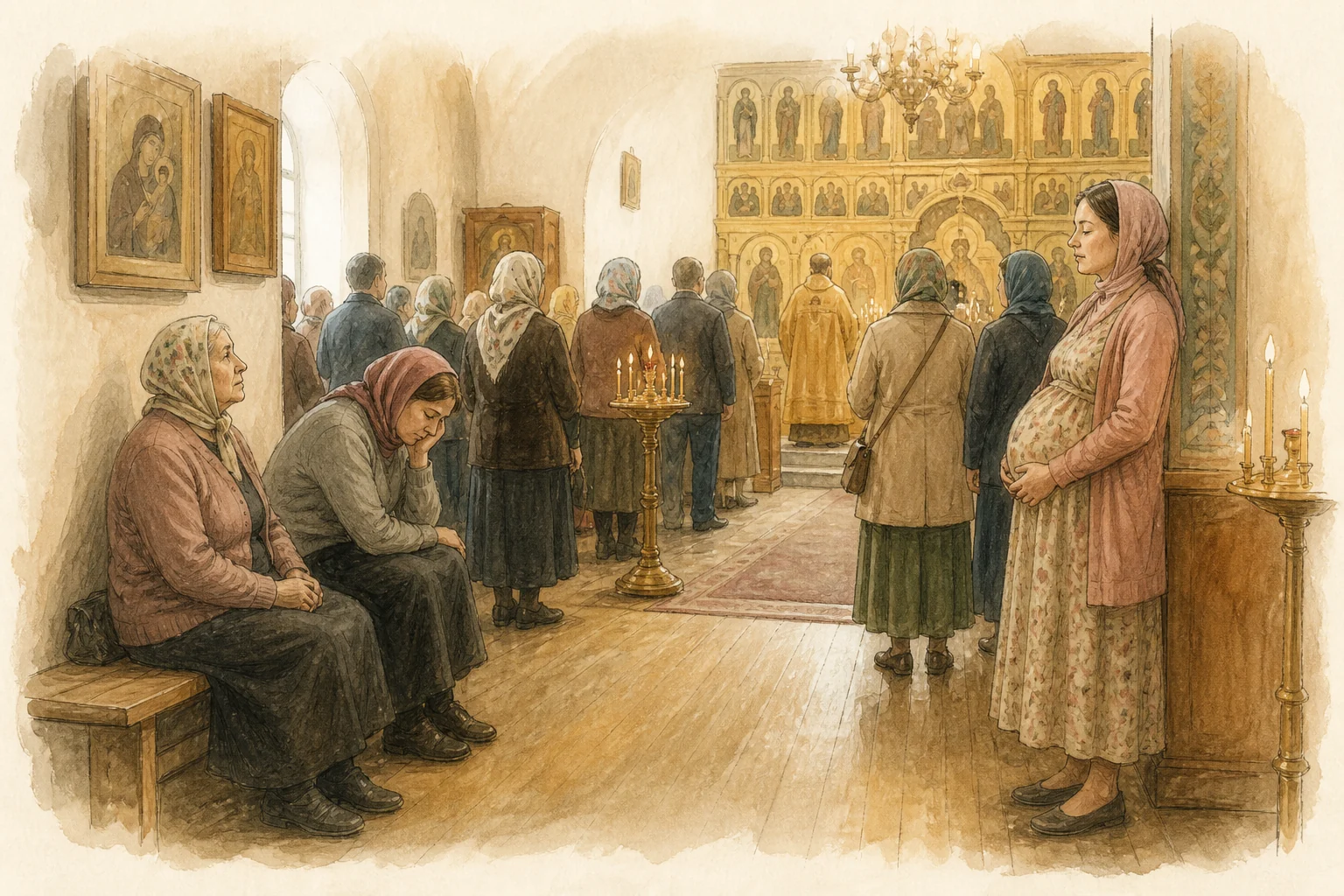
You may sit during an Orthodox service when standing is difficult because of age, illness, pregnancy, injury, weakness, or fatigue. Orthodox tradition values prayer while standing, but it does not demand self-harm and does not measure faith by minutes spent on one’s feet.
If you are healthy, it is considerate to stand at the most important moments and leave limited seating for those who need it. If your health is restricted, sit without embarrassment. If you suddenly feel worse, step into fresh air and ask for help.
Why do Orthodox Christians usually stand?
Standing expresses wakefulness, respect, and readiness to appear before God. Sunday worship is especially linked with the image of humanity raised by Christ from death. Russian Orthodox churches therefore commonly have open floor space and fewer rows of pews than many Western churches.
Yet bodily posture serves prayer, not the reverse. If all your strength is consumed by pain and fear of falling, attention becomes impossible. Reasonable rest allows you to remain at the service and does not make a seated person less worthy.
Who may sit without hesitation?
- an older person or anyone unable to stand for long;
- a pregnant woman, especially with weakness or medical advice;
- someone recovering from surgery or injury;
- a person with heart, joint, spinal, or balance conditions;
- someone experiencing dizziness, fever, low blood sugar, or sudden weakness;
- a parent carrying a tired child who also needs support.
This is not a medical tribunal. No one has to prove a diagnosis to a church attendant or neighbor. You know your condition, and medical uncertainty belongs in a conversation with a clinician.
When does a healthy person normally stand?
Even in churches with pews, worshippers normally stand for the Gospel, entrances, Eucharistic prayer, presentation of the Chalice, blessings, and other important moments. Local practice varies.
A newcomer does not need an anxious timetable. If able, rise with the congregation, especially for the Gospel or a priestly blessing. If you cannot, remain seated and pray.
A person on a bench may incline the head or make the sign of the cross. Reverence does not disappear because the body is seated.
Where is it best to sit?
Arrive early and look for chairs or benches, often placed along the walls or at the rear. Choose a place where you will not repeatedly have to stand to let a large procession of people pass.
If you need a chair, ask an attendant before the service. In a small church, someone can identify a safe place away from processions, censing paths, and the line for Holy Communion.
Do not sit on the steps of the solea, kliros, or in an aisle. These are liturgical and emergency-access areas.
What if there are no seats?
Stand near a wall or stable support and shift your weight carefully. Rest briefly in the narthex if needed. Do not wait until you are about to fall.
It is entirely normal to say, “It is difficult for me to stand; could I have a chair?” Chest pain, near-fainting, trouble breathing, or another acute symptom requires medical help, not an attempt to finish the service heroically.
May I sit during the Psalter and kathismas?
The word kathisma is related to sitting. During certain sections of psalm reading, the faithful traditionally may sit, though they rise for appointed prayers within the section. The transitions may not be obvious to a newcomer.
Follow the general movement peacefully while remaining free to sit for health. Other people rising does not cancel your real weakness.
What if someone reproaches me?
Most people will be understanding, but an abrupt comment is possible. Do not argue during worship. Quietly say that standing is difficult or ask a church attendant for help.
One careless remark does not represent the whole Church and should not close your path to prayer. After the service, you may explain what happened to a responsible parish worker, especially if accessible seating is inadequate.
For your own part, do not correct a seated stranger. A diagnosis, pregnancy, or pain may be invisible.
Children and sitting during worship
A child is not required to display adult endurance. Let a tired child sit or step outside briefly. It is better to spend less time in church without fear and conflict than to enforce motionlessness at the cost of resentment.
Explain gradually why the family stands for the Gospel and why people try not to make noise. Age, temperament, and developmental needs require different pacing.
A chair should not become a reason for shame
Some people stay home because they fear judgment: “I cannot last,” “everyone will see,” or “sitting is sinful.” This is a false choice. You may attend part of a service, find a place beforehand, and alternate standing with rest.
A Christian community is called to support weakness, not test endurance. Accessibility is ordinary care for a neighbor: clear paths, stable chairs, willingness to bring water, and readiness to call for help.
How can I remain attentive while seated?
Sitting may make the body too relaxed, so keep a prayerful posture: do not stretch your legs into an aisle, use your phone, or converse. Listen to the readings, join the litany responses, and stand at key moments when possible.
If pain makes a long text difficult, use a short inward prayer: “Lord, have mercy,” “I thank Thee,” or simply the name of a person you are remembering. Bodily limitation does not cancel living participation.
How can a parish make worship more accessible?
Accessibility is more than a ramp. Stable chairs, clear passages, understandable help for someone using a cane or wheelchair, a place for a pregnant woman, and an approachable attendant all matter.
Parishioners may help without taking control: offer a seat, hold a door, or bring water, but first ask whether help is wanted. A disabled person remains a full participant in the community, not an object of pity.
Why is standing not a spiritual achievement by itself?
Someone can stand through an entire service while angry and judgmental, while another person may sit in pain and pray attentively. Bodily effort has meaning when it serves love, repentance, and presence before God.
If you can stand, do not dismiss that small offering; receive it without pride. If you cannot, do not assign yourself guilt. Both people are called into the same prayer and mercy toward one another.
Frequently asked questions
Is sitting during worship a sin?
Sitting itself is not a sin. Deliberate contempt is one thing; necessary rest is another. God knows a person’s condition.
Do I need a blessing to use a chair?
No special blessing is required for ordinary rest due to health. Ask an attendant about the practical location.
May I sit during the Divine Liturgy?
Yes, when necessary. If able, stand for the Gospel, Eucharistic prayer, and presentation of the Chalice; if not, remain seated without guilt.
What should I do if I become dizzy?
Sit immediately, tell someone nearby, and move into fresh air with assistance. Seek medical help for serious symptoms.
May I bring a folding chair?
Ask the parish so it will not block a passage. The church may already be able to provide a suitable place.
What should I confirm with the parish?
Use the contacts to ask about seating, an accessible entrance, or space for a wheelchair. Check the schedule and choose a service of manageable length if your strength is limited.
Standing prayer is beautiful when the body can sustain it. Seated prayer remains prayer when a person accepts real limits with humility. We come to church not to display strength but to meet God and learn mercy toward one another.