
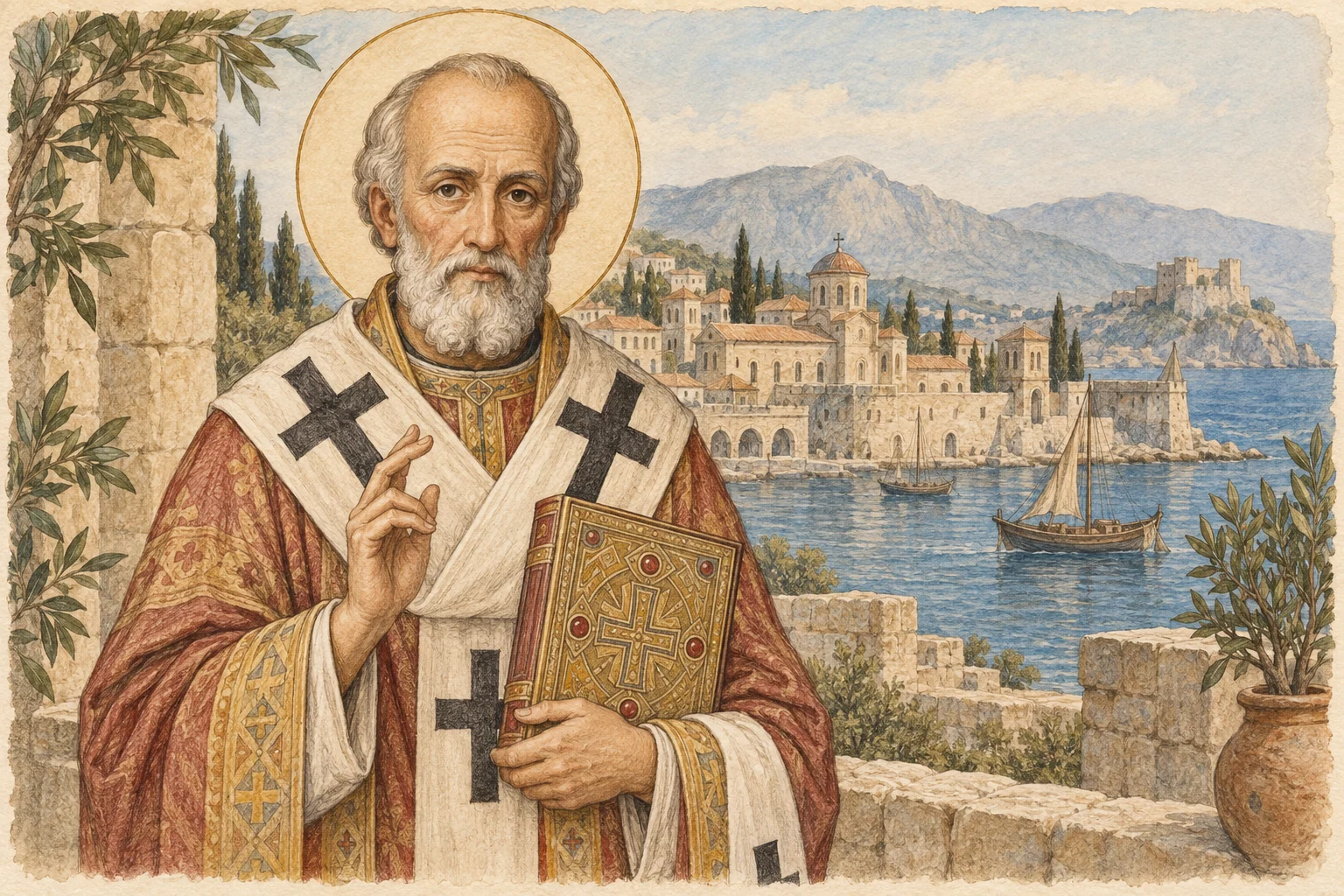
Saint Nicholas the Wonderworker is first of all a holy bishop. His popularity should not obscure his pastoral ministry: his memory is associated with care for people and faithfulness to Christ. He is not an independent source of good fortune to approach instead of God when a difficult problem needs solving.
Myra in Lycia and the bishop's memory
The Church's Life connects Nicholas with Patara and with episcopal ministry at Myra in Lycia in late antiquity. These cities were in Asia Minor, in what is now Turkey. He was not a Russian ascetic, although generations of Russian Christians have become deeply attached to his memory.
His Life preserves accounts of secret assistance to a poor family, protection of people unjustly condemned, and the rescue of travellers. These different episodes focus on people threatened by deprivation, humiliation or arbitrary power. Details of a hagiographical narrative should be identified as tradition, not presented as a modern documentary record whose every element has the same historical certainty.
What discreet generosity can mean
The account of help to a family raises a practical question: how can we assist without making another person's hardship a spectacle? Possibilities include paying for a necessary purchase through a reliable intermediary, helping a family without publishing its photograph, or accompanying someone through a task they cannot manage alone. Respect for the recipient matters more than the scale of the gesture.
Accusatory language in a retelling must not become a judgement against people experiencing poverty today. Poverty does not establish moral failure. Venerating a compassionate bishop loses its meaning when combined with contempt for those needing help. Particular care is needed with the private stories of children and adults dependent on others for support.
The winter and spring commemorations
The principal commemoration falls on December 6 in the Julian church calendar, corresponding to December 19 in the civil calendar during the twentieth and twenty-first centuries. The transfer of the relics from Myra to Bari in 1087 is remembered on May 9 Old Style, May 22 New Style. These commemorate one saint, not two different men named Nicholas.
Parishes following the new calendar may observe these fixed feasts on civil December 6 and May 9. When attending abroad, check the particular community's calendar. The historical date of an event and the time of the next parish Liturgy are different pieces of information.
Venerating Nicholas today
Read his Life, pray for people you know, attend worship and choose a specific act of mercy. Asking for help during travel or hardship is natural, but prayer does not remove the need to prepare for a journey, handle financial decisions responsibly or seek appropriate assistance.
No required number of candles guarantees that a request will be fulfilled. An unexpected outcome does not authorize blaming someone for praying badly. A fruitful encounter with Nicholas leaves more than a collection of extraordinary stories: it encourages attention to people who are easily overlooked. His memory then connects us with the life of the Church rather than with an attempt to bargain with heaven.
In a family conversation, distinguish a gift from a reward for being faultless. A child can learn about generosity and take part in a small act of kindness without fearing that every mistake makes them unlovable. An adult can ask whether their own help comes with demands for obedience, gratitude or public recognition.
Mercy Can Mean Standing Up for Someone
The Life published by the OCA distinguishes Nicholas's defence of people unjustly condemned from his gifts of money. He intervenes when an unjust sentence threatens their lives. Notice the different needs involved: one person lacks food, another cannot get a hearing, and someone else is blamed for something they did not do. Giving money is not the only expression of mercy.
Applying this account today does not mean appointing yourself a judge or rescuer. If a colleague is accused on the basis of rumour, refuse to repeat the allegation, separate what you witnessed from what you heard, and allow the person to answer. Where professional advocacy is needed, help find someone qualified rather than promising to resolve everything through personal influence. Supporting someone is not permission to conceal genuine evidence or answer one slander with another.
Choosing an Act of Care for the Feast
Start with the recipient's need rather than a purchase. A family might need travel costs to visit a relative more than another parcel of goods; someone living alone might need company at an appointment. Ask whether help through an intermediary is welcome and what should remain private. Discretion is compatible with accountability: a donor can receive confirmation of an expense without another person's hardship being made public.
As a family, make a brief plan: whom to help, what is affordable, and who will keep the promise. Afterwards, return to the Life and discuss the recipient's dignity rather than your own generosity. This keeps Nicholas's feast connected with his pastoral ministry. It also helps distinguish dependable care from a burst of seasonal enthusiasm that leaves someone alone again once the celebration has ended.