
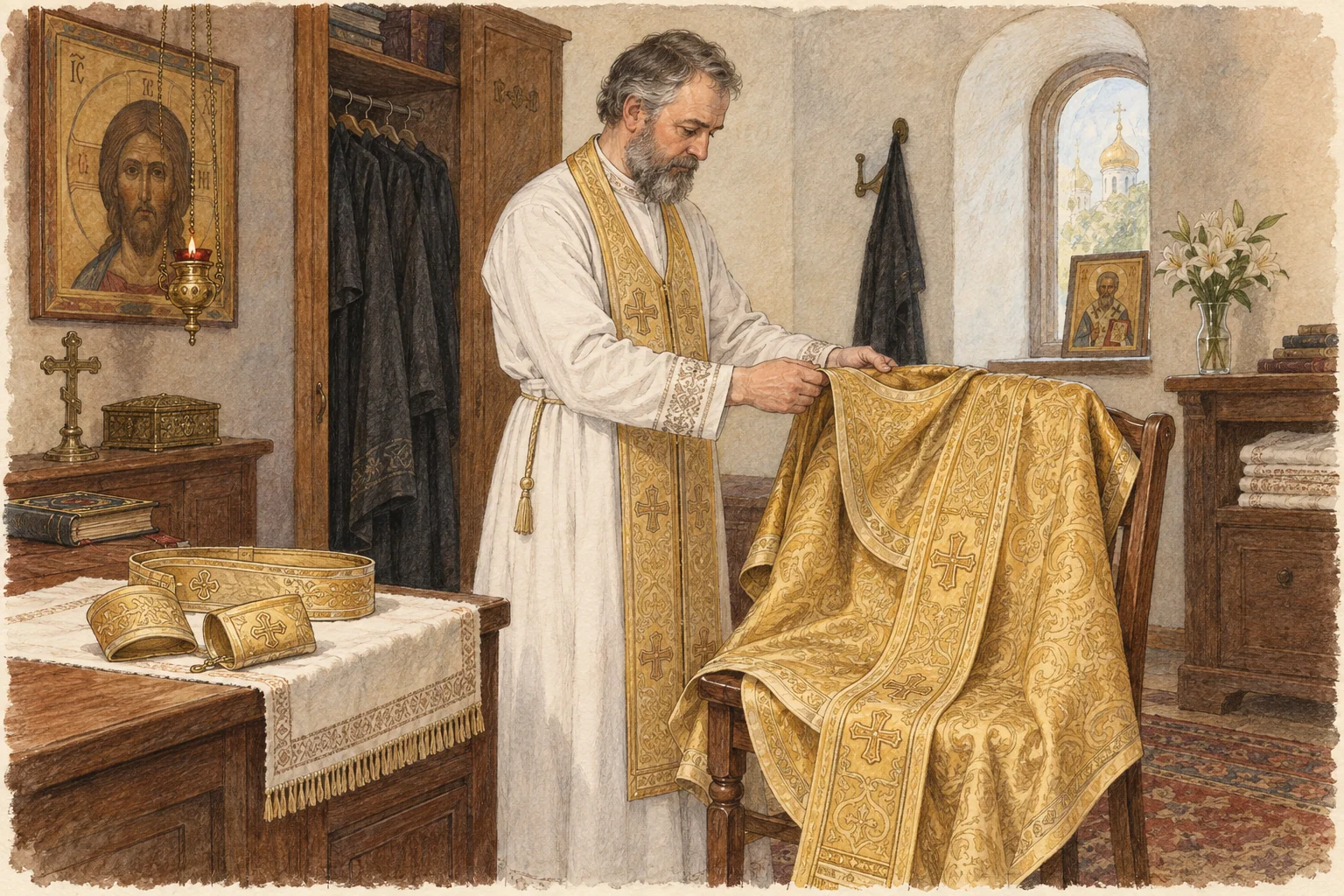
A priest's liturgical vestments include several distinct garments. The easiest way to recognize them is by their position: a long undergarment, a stole at the front, a belt, cuffs at the wrists and a broad outer garment. They belong to the ministry being exercised, not to a scale of personal holiness or speaking ability.
The undergarment and the stole
The priest's sticharion, called a podriznik in Russian, is a long liturgical undergarment. During the Liturgy it is largely covered by other vestments. It should not be confused with the cassock worn outside full liturgical vesting. Similar-looking garments can serve different purposes.
The epitrachelion passes around the neck and hangs down the front in two joined strips. It is a particularly recognizable sign of priestly ministry. When a priest conducts a service without the complete eucharistic set of vestments, this stole may be the most visible indication of his liturgical role. A single photograph, however, cannot explain the whole service.
The belt, cuffs and phelonion
The belt holds the garments in place and allows freer movement. Cuffs, called epimanikia, gather the sleeves at the wrists. The priest's broad outer vestment is the phelonion. Its high, stiffened back is especially recognizable in Russian practice; other traditions use a different cut. This does not imply a different sacrament or order of priesthood.
For a simple visual memory aid, connect position with name: around the neck and down the front means epitrachelion; around the wrists means cuffs; broadly covering the shoulders and body means phelonion. Shape is a better guide than colour. Several pieces in the same set may all be gold or white.
Distinctions worth keeping
The deacon's orarion is also a long strip of cloth, but it should not be called an epitrachelion. A bishop's omophorion is another particular vestment, not simply a larger scarf. Identify the ministry first, then name the item. An unfamiliar clothing term does not necessarily identify another clerical order.
The nabedrennik and epigonation, head coverings and varieties of pectoral cross are associated with particular church traditions and awards. Their presence cannot measure the reliability of pastoral advice. Rector, archpriest and a priest wearing a certain phelonion are not three labels for the same category: one concerns an appointment, another an honorific title, and the third clothing.
Using the vocabulary
A parish talk or a labelled photograph is a good setting for learning these names. Avoid stopping the priest during a service to ask about an item. Write the question down and ask afterwards. Permission to take photographs does not authorize entering the sanctuary or obstructing worshippers to obtain a particular angle.
For a child, begin with just two landmarks: the epitrachelion at the front and the broad phelonion over it. Add further names gradually. Vestments make a particular ministry visible, but should not distract from the prayers. Forgetting a Greek term does not make your participation in worship less real. The vocabulary is there to support attention, not to display superior knowledge to other parishioners.
A useful study note has three columns: name, position and recognizable shape. It need not include assumptions about the wearer's personal merits. If you are unsure between two terms, leave the question open until you can check. A label can easily be corrected; a confidently circulated but inaccurate explanation may remain in readers' memories much longer.
What the prayers of vesting explain
Vesting concerns more than appearance. The OCA's guide draws attention to the prayers said when putting on cuffs and belt: they recall God's help and the responsibility of ministry. A practical object that gathers a sleeve or secures a garment thus belongs within prayerful preparation. This is a useful interpretive key. An item's practical purpose and its spiritual significance do not have to exclude each other, and a dictionary of shapes alone cannot convey the whole meaning.
A symbolic interpretation is not, however, proof of how every detail originated. We can describe the meaning given to a vestment now while separately studying changes in its cut. If a guide says that an item recalls something, do not retell this as the precise historical reason it was invented. That distinction prevents attractive but unsupported stories, especially claims about antiquity or exact dates. It also makes room for an honest answer when the history is not known.
Why different services show different garments
The full set of vestments seen at the Liturgy may differ from what a priest wears for another particular service. Two photographs of the same person therefore do not necessarily reveal an irregularity or a change of clerical order. Comparison needs a caption identifying the service, not merely recognition of the cloth. For vocabulary study, choose a clearly described photograph: a cropped portrait may simply hide most of the items you are trying to identify.
If you would like to help supply the parish sacristy, do not begin by purchasing an expensive set independently. Ask what is needed, who decides and what measurements are appropriate. Cleaning or repairing a vestment also requires agreement. Ordinary treatment of household clothes may not suit its fabric, embroidery or ornament. Begin with a defined task. Knowing the names helps you discuss the actual item accurately, avoid taking on responsibilities that were not assigned, and protect the work entrusted to your care.