
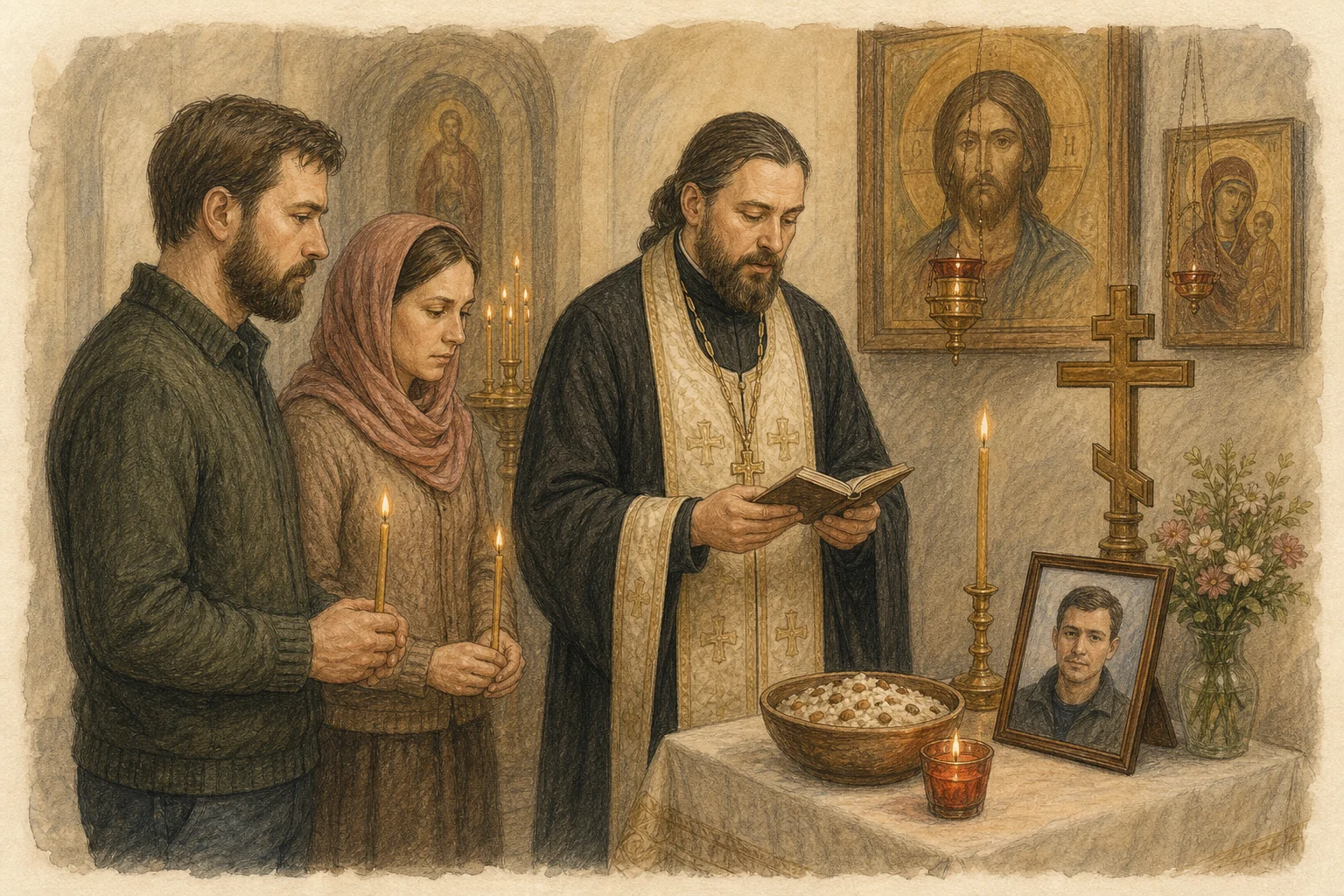
An Orthodox funeral service is normally celebrated once over the departed before burial, while a panikhida is a repeatable memorial service that may be offered on commemorative days and many years later. Both are prayers of the Church for the departed, but they have different settings, length, and purposes.
The funeral service does not erase sins automatically and does not guarantee salvation in exchange for payment. A panikhida is not a shortened second funeral. Both stand within hope in Christ's Resurrection and an appeal to the mercy of God.
The difference in one paragraph
The funeral service accompanies the community's farewell to the body and the movement toward burial. It contains prayers, readings, hymns, and a final reverent farewell.
A panikhida is celebrated without the body on anniversaries, memorial Saturdays, the third, ninth, and fortieth days, and other occasions of remembrance. It can be celebrated many times.
What an Orthodox funeral service is
The liturgical name is the order for burial. It is a particular office of the Church, distinct from a civil farewell and not one of the seven sacraments.
The Church accompanies one of its departed members with prayer, reminds the living of death and Resurrection, and entrusts the person to the judgment and mercy of God.
What a panikhida is
A panikhida is a memorial office containing psalms, litanies, hymns, and prayers for rest. It may be celebrated in a church, a cemetery chapel, or by arrangement at another suitable place.
A memorial table with a cross and candles is often used, and koliva may be placed nearby. A coffin is not required.
How many times a funeral service is celebrated
The usual funeral office is celebrated once before burial. The full service is not repeated on the anniversary or fortieth day.
If the family is unsure whether a funeral took place, it should not simply order another “for certainty.” First establish what happened and speak with a priest.
How often a panikhida may be celebrated
A panikhida can be served repeatedly: soon after death, on commemorative days, anniversaries, name days, and occasions of particular family prayer. The Church also celebrates common memorials on appointed dates.
The number of services is not a spiritual score. Conscious prayer and the family's participation are better than anxious accumulation of orders.
How a panikhida differs from a litiya
A litiya is a shorter prayer office for the departed. It is often served at the grave, after the Divine Liturgy, or where a full panikhida is not possible.
Being shorter does not make the prayer weaker. The choice depends on the liturgical order, available time, and pastoral circumstances.
How both differ from the Divine Liturgy
At the Divine Liturgy an Orthodox Christian is commemorated during the preparation of the Gifts and in the common prayer of the Church. This remembrance is united to the Eucharist and has a distinctive central place.
Neither the funeral nor the panikhida replaces the Liturgy. A family may submit the baptismal name before the service and participate personally when circumstances permit.
When the funeral service takes place
It is normally celebrated after the legal registration of death and before the journey to the cemetery. Coordinate with the parish first and then align the funeral provider and cemetery so the schedules do not collide.
Do not promise relatives a precise hour before the church confirms it. Great feasts and special periods of the liturgical calendar may impose practical restrictions.
Where the funeral may be held
The preferred place is an Orthodox church. According to circumstances, the office may be celebrated in a cemetery chapel, farewell hall, or another dignified place approved by the priest.
Not every commercial facility can accommodate the full service. Call the parish before signing a final agreement for the place and time.
Where a panikhida is celebrated
It is most often served in church before the memorial table, after the Divine Liturgy, or at a time stated in the schedule. Prayer may also take place in a chapel, at a grave, and sometimes in a home by arrangement.
Check the parish service schedule and contact the church. During certain liturgical periods ordinary memorial services are moved.
How long the services last
A full funeral commonly takes about forty-five minutes to an hour, though the order, singing, and local conditions can change the length. A panikhida often takes twenty to thirty minutes.
These are estimates. Allow time for receiving the coffin, gathering the family, travel, and farewell without rushing the priest or mourners.
What happens during the funeral
Appointed psalms and hymns are sung, readings from the Epistle and Gospel are heard, litanies are offered, and the prayer of absolution is read. The office concludes with farewell and departure for burial.
The precise order changes in the Paschal season and in services for an infant, a priest, and other particular circumstances. Do not compare every minute to a random online video.
What happens during a panikhida
The priest and congregation ask that the departed may rest in a place of light, refreshment, and peace. The names are repeated and the hymn asking Christ to grant rest with the saints is sung.
The service contains hope as well as grief. Relatives may hold candles, respond to petitions, and continue with personal prayer afterward.
Who ordinarily receives an Orthodox funeral
The full office is normally for a person baptized in the Orthodox Church who did not explicitly reject belonging to it. When facts are uncertain, the priest applies diocesan guidance to the individual case.
Do not conceal the absence of Baptism, adherence to another religion, or the person's clear expressed wishes. Honesty allows the Church to find a form of support that does not falsify the person's life.
May the unbaptized or non-Orthodox receive it?
The ordinary Orthodox funeral is not celebrated for someone who was unbaptized or belonged to another faith. Relatives may still pray personally, perform works of mercy, and seek pastoral support.
This is not a verdict about the eternal destiny known only to God. Our guide explains prayer lists and the unbaptized in greater detail.
What happens in a case of suicide?
The matter must not be decided through rumor or pressure on a parish. Give the priest the known circumstances, information about possible mental illness, and relevant medical documentation; the priest may refer the case to diocesan authority.
Do not conceal the cause of death and do not condemn the person. The family needs prayer, support in acute grief, and protection for relatives who blame themselves or develop suicidal thoughts of their own.
Is there prayer for an unbaptized infant?
The ordinary funeral office is not celebrated for an infant who died without Baptism, but the Russian Orthodox Church has a separate service of consolation for parents who lost a child before Baptism.
This is not Baptism performed retrospectively. Contact a priest for support that avoids blaming the mother or making cruel claims about the child.
Must the body be present?
The ordinary office is celebrated in the presence of the body. If the body is missing, inaccessible, already buried, or cremated, pastoral provisions exist but should not be assigned by the family alone.
Tell the parish the complete situation. A funeral in absentia is not a convenient commercial product; it is used for a serious reason under an established church order.
What if cremation is chosen?
Orthodox tradition prefers burial in the earth as an image of sowing and expectation of resurrection. Yet a cremation that has occurred does not end prayer for the person.
If cremation is unavoidable or already selected, arrange the service and a dignified burial of the ashes in advance. Do not keep an urn as household decoration or scatter ashes casually.
What to bring to the funeral
The parish will explain whether it requires a death certificate, hand cross, funeral crown, covering cloth, candles, and an icon. Practice varies, so a package bought from the internet may include unnecessary items.
Do not place money, food, cigarettes, a phone, or charms in the coffin “for the journey.” These objects do not assist the departed and do not belong to Christian burial.
What to bring to a panikhida
The essentials are the baptismal name and people willing to pray. According to local custom, a family may bring koliva, candles, or food designated for charitable distribution.
Ask about parish practice. Food does not feed the departed, and a donation does not purchase a stronger prayer.
Is payment required?
Parishes may suggest a donation connected with organization, singers, travel, and practical costs, but the mercy of God is never sold.
If the suggested amount is beyond the family's means, say so calmly to the rector or responsible worker. Do not take an emergency loan out of shame.
May a funeral agent arrange the church service?
An agent may assist with transport and timing, but church matters should be confirmed directly with the parish. An advertisement promising that a funeral is “guaranteed” does not replace the priest's agreement.
Do not give religious documents or unreceipted payments to a stranger. One relative should keep direct contact with the church.
How the family participates
Stand in prayer, listen to the readings, hold a candle safely, and follow the guidance of parish workers. Nobody is expected to know every response from memory.
The final farewell is an act of love, but no one should be forced to touch the body. With a closed coffin or health restrictions, farewell may take place before the cross or icon as the priest directs.
May relatives give speeches?
The funeral has its own prayerful order, so lengthy civil speeches are normally reserved for a farewell hall, cemetery, or memorial gathering. A brief word in church requires prior agreement.
Do not turn worship into a place for settling family conflicts or constructing an unreal biography. Prayer can contain both love and difficult truth.
May children attend?
They may attend if they are told in advance what they will see and are permitted not to approach the coffin. Use the direct word “died” rather than saying the person is in a long sleep.
A calm adult should remain ready to step outside. Participation must not become a test of courage or faith.
What follows the funeral?
After burial, remembrance continues at the Divine Liturgy, at panikhidas, and at home. Particular attention is given to the third, ninth, and fortieth days.
Our practical guide explains how those first memorial dates are counted and observed.
Frequently asked questions
Can a panikhida replace the funeral?
It is not the burial office, but it remains genuine prayer when a funeral is impossible; discuss the circumstances with a priest.
Should the funeral be repeated on the fortieth day?
No. The Liturgy, a panikhida, or a litiya is appropriate then.
May a panikhida be served without relatives present?
Yes, although personal family participation is valuable when possible.
Must the coffin be open?
No. A closed coffin does not prevent the prayer of the Church.
What matters more, a panikhida or the meal?
Prayer matters more. A meal can support people but does not replace worship.
The central message
The funeral is the Church's one-time farewell before burial; the panikhida is a repeatable prayer for the departed. They do not compete and their value is not measured by price.
Contact the parish first, describe the facts honestly, agree on time and place, and participate in prayer. Continue remembrance afterward through the Divine Liturgy, prayer at home, and works of mercy.