
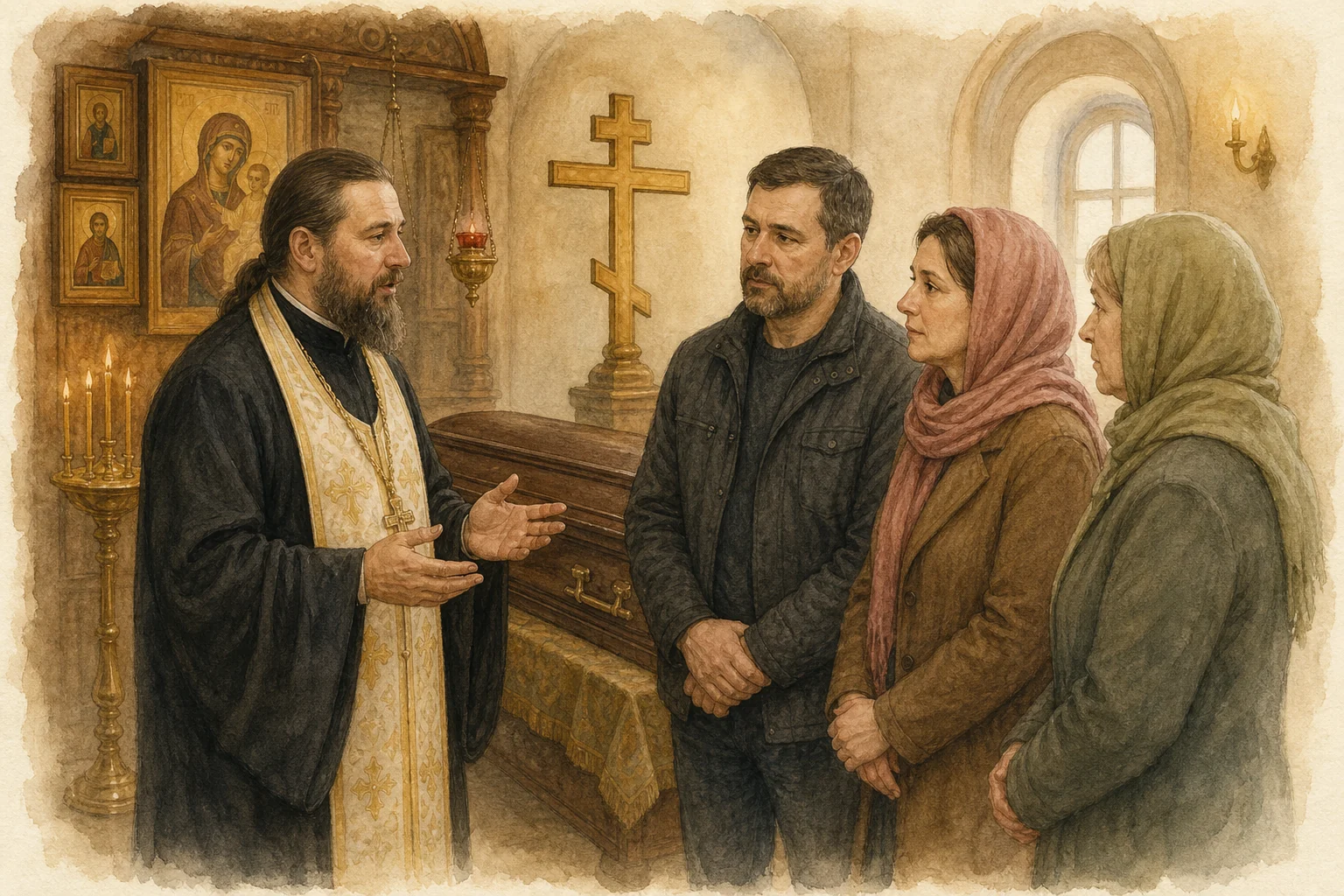
To prepare an Orthodox funeral service, first call the chosen parish, give the departed person's baptismal name, date and circumstances of death, and confirm whether, where, and when the service can take place. Only after that confirmation is it wise to finalize the schedule with the funeral provider and cemetery.
No family needs to know the entire order during the first hours of grief. Choose one relative to communicate with the parish, write down every agreement, and speak honestly about Baptism, religious affiliation, and any exceptional circumstances.
First step: contact the parish
Call the church where the funeral may take place or visit the parish office during working hours. Explain directly that a person has died and the family needs help arranging an Orthodox burial.
Our parish details are available on the contact page. If time is short, do not rely only on a social media message; confirm that a real person has received the request.
What to say during the first conversation
Give the date of death, proposed burial date, baptismal name, age, and whether the person was baptized in the Orthodox Church. Explain where the body is and whether burial or cremation is planned.
If death occurred under unusual circumstances, state the facts without trying to produce a church ruling yourself. The priest needs truth, not a perfectly composed narrative.
Why the church schedule should be confirmed first
A parish already has Divine Liturgies, pastoral services, feast days, and other funerals. A priest may be serving elsewhere, so any time must be explicitly confirmed.
If an agent reserves a hall and cemetery without the church, the family may have to rush the prayers or rebuild the route. Coordinating all three parties reduces pressure.
Choosing one family coordinator
Select one adult able to record names, times, addresses, and telephone numbers. This person shares only confirmed information and protects the closest grieving relative from dozens of calls.
The coordinator does not make every spiritual decision alone. Important questions belong to the family and priest together, with respect for the known wishes of the departed.
Who ordinarily receives the funeral office
The full Orthodox order is normally celebrated for someone baptized in the Orthodox Church who did not clearly renounce belonging to it. When facts are uncertain, the parish considers the individual case.
Do not invent a Baptism or conceal another religion simply to obtain a rite. God knows the person without an administrative fiction, and the Church must pray honestly.
How to find the baptismal name
Ask older relatives, inspect a Baptism certificate, look at inscriptions on personal icons, or find earlier prayer lists. A civil and baptismal name often coincide but not always.
If the name cannot be established, tell the priest. Do not assign a patron randomly from the first calendar table found online.
Documents the parish may request
A church may ask to see a death certificate or medical confirmation, especially for a funeral in absentia or a complex case. The exact documents depend on local and diocesan practice.
Bring an original and copy if requested, but do not send passport information to an unknown intermediary. Verify requirements directly with the parish.
When death resulted from suicide
Do not conceal the cause and order an ordinary funeral under false information. Tell the priest about the circumstances, possible mental illness, treatment, and available medical records.
A decision may require diocesan blessing. This is not permission to condemn the person or abandon the family; relatives especially need safe support during acute grief.
When the person was unbaptized or belonged to another faith
The ordinary Orthodox funeral is not celebrated in that case. The family may still seek a conversation, personal prayer, and help finding a truthful, respectful form of farewell.
Do not interpret the absence of a particular rite as a human curse. God alone knows eternal destiny, while relatives can express love through honesty, mercy, and remembrance.
When an infant died before Baptism
A separate church service of consolation exists for parents who have lost an unbaptized child. It is not the ordinary funeral and does not perform Baptism retrospectively.
Ask to meet a priest and refuse any attempt to blame the mother. The loss of a child requires gentle spiritual, medical, and psychological support.
The preferred place for the service
An Orthodox church is the normal and preferred setting. It provides appropriate space, liturgical books, singers, and the prayer of the community.
According to circumstances, the office may take place in a chapel, farewell hall, or another location approved by the priest. Check vehicle access, steps, accessibility, and the time at which the coffin may enter.
May the coffin remain closed?
Yes. A closed coffin does not interfere with prayer and may be required for sanitary, medical, legal, or personal reasons.
Do not demand that funeral workers open the body for supposed correctness and never force relatives to look. The priest will explain how farewell can occur before the cross or icon.
When the body is unavailable
If a person is missing, the body cannot be recovered, burial has already occurred elsewhere, or death happened far away, special pastoral provisions may exist. A funeral in absentia is not automatic.
Gather verified information and approach the priest. Do not purchase an online promise of a funeral “by photograph” disconnected from a real parish.
How to proceed when cremation is planned
Orthodox tradition prefers burial of the body in the earth. If the family is considering cremation because of circumstances, discuss it before signing the contract and agree when the funeral service will take place.
After cremation, the ashes should receive dignified burial. Prayer for the person continues; cremation is not a reason to erase the name.
Who prepares the body
Washing, sanitary preparation, and dressing are normally handled by a mortuary or professional funeral team under legal and safety requirements. The family may provide clean, modest clothing.
Relatives do not need to perform tasks at home for which they are physically or emotionally unprepared. Reverence does not require exposure to infection or injury.
Choosing clothing
Use clean, dignified, modest clothing consistent with how the person lived. Monastic or priestly vestments belong only to someone who actually held that state.
The most expensive outfit is unnecessary. Love for the departed is not measured by fabric and decoration.
Church items that may be needed
The parish will explain the hand cross, funeral crown, covering cloth, small icon, candles, and printed prayer of absolution. Some items may already be included in the parish arrangement.
Do not buy duplicate packages from different intermediaries in advance. Checking with the church saves money and avoids unsuitable symbols.
What not to place in the coffin “for the journey”
Money, alcohol, food, cigarettes, a telephone, grooming objects, wish notes, and charms do not help the departed. Christianity does not teach that the soul needs household equipment.
Keep a meaningful possession in the family or give it to someone who can use it. Only items consistent with church and legal practice belong in the coffin.
Positioning the coffin in church
Parish workers and the funeral team will indicate the entrance, support, and direction. Do not attempt to move a heavy coffin according to advice found online.
Confirm the number of bearers, the presence of a ramp, and a safe place for flowers. Practical preparation prevents injury and delay.
Flowers, wreaths, and charitable gifts
Living flowers are permitted, but a large number of wreaths is not a religious requirement. Some families invite people to support a charitable cause instead of buying more flowers.
That choice must remain voluntary. Never shame someone who brings a modest bouquet or arrives without one.
How long the funeral usually lasts
Allow approximately forty-five to sixty minutes, but ask the parish. The Paschal order, local singing, the number of mourners, and logistics can change the duration.
Add a buffer before departure for the cemetery. A transport schedule that is too tight puts painful pressure on prayer and farewell.
The sequence of the service
The coffin is received, worshippers take their places, psalms and hymns are sung, the Epistle and Gospel are read, litanies are offered, and the prayer of absolution is pronounced. The family then says farewell.
There is no need to print a random order and police every phrase. The office varies with the liturgical season and the circumstances of the departed.
What the prayer of absolution means
The priest asks God to forgive sins for which the person repented or which were forgotten through human weakness. After the reading, the text is placed according to local funeral practice.
It is not an administrative document that automatically cancels a person's free life and the judgment of God. The Church's hope remains prayerful, not bureaucratic.
Preparing relatives
Share the confirmed address and time, estimated duration, seating possibilities, and whether the coffin will be closed. Arrange transport and a place to rest for elderly and disabled relatives.
Do not demand identical outward grief. One person weeps, another is silent, and another concentrates on organization; each response may be normal.
Head coverings and black clothing
Women commonly cover the head according to local Orthodox practice, but the absence of a scarf in an emergency should not bar a mourner. Men normally remove hats unless a medical need prevents it.
Entirely black clothing is not mandatory. Choose a modest appearance without turning the funeral into a wardrobe examination.
May children attend?
Tell a child honestly that the person died and that there will be a coffin, prayer, and adults who may cry. A child may attend but does not have to approach or touch the body.
Assign an adult who can step outside. Do not say that the departed is merely asleep, because this can create fear of sleep.
Photography and video
Agree on any recording with the family and parish. Do not photograph the face of the departed or people's acute grief without clear consent, and never upload material automatically to social media.
One quiet general photograph may preserve memory, but a camera must not obstruct prayer or turn farewell into content.
Arranging singers
The parish will explain whether singers are included and how many normally serve. Any choir invited independently must know the Orthodox office and be approved by the church.
Recorded hymns through a loudspeaker are not the same as living prayer and should be used only if the parish considers it appropriate to the circumstances.
Donation and financial hardship
Ask directly which practical costs are expected and what receives a receipt. A parish may suggest a donation, but prayer is never sold.
If the family cannot afford the amount, tell the rector or responsible worker before the service. Do not take a payday loan or accept the claim that a costly package changes the person's destiny.
Avoiding unwanted commercial services
Request a written list of funeral services, compare prices, and avoid signing unclear clauses while in shock. Confirm church items and the funeral service with the parish itself.
Never share message verification codes or transfer money to a stranger's personal account without verification. Ask a calm relative to read the agreement again.
Immediately after the funeral service
Burial takes place at the cemetery, accompanied by a short prayer when possible. A family meal is permitted but not compulsory and must not displace care for the most vulnerable relatives.
Remembrance continues at the Divine Liturgy, at home, and through memorial services. Our article explains the difference between the funeral and panikhida.
The first commemorative days
The date of death is counted as day one, followed by particular prayer on the third, ninth, and fortieth days. Counting begins with death, not the funeral.
A practical sequence appears in our guide to the third, ninth, and fortieth days.
A short checklist
Call the parish; state Baptism, name, date, and circumstances; confirm place and time; then confirm transport and cemetery; ask about documents, church items, singers, and donation; appoint one family coordinator.
Separately prepare essential medication, water, transport, extra time, and an adult responsible for children. Keep all contact numbers in one shared message.
Frequently asked questions
Should the family arrive early?
Yes. Extra time allows the coffin to enter safely and relatives to gather; the parish will give the exact arrival time.
May the service be held with a closed coffin?
Yes. A closed coffin does not prevent the prayer of the Church.
Must a church package be purchased from the funeral agent?
No. Ask the parish first which items are actually needed.
What if the family cannot afford the donation?
Tell the rector or responsible parish worker; financial hardship should not deprive a person of prayer.
Can the service move after the cemetery is booked?
Sometimes, but coordinating all three schedules first is much safer than an urgent change.
The central message
Preparation for an Orthodox funeral begins not with buying a ritual package but with an honest conversation with the parish. The Church helps the family accompany the departed in prayer without turning grief into an examination in customs.
Write down agreements, refuse superstition and imposed expenses, and protect children and vulnerable relatives. At the center remain Christ, hope in the Resurrection, and love that continues to pray.