
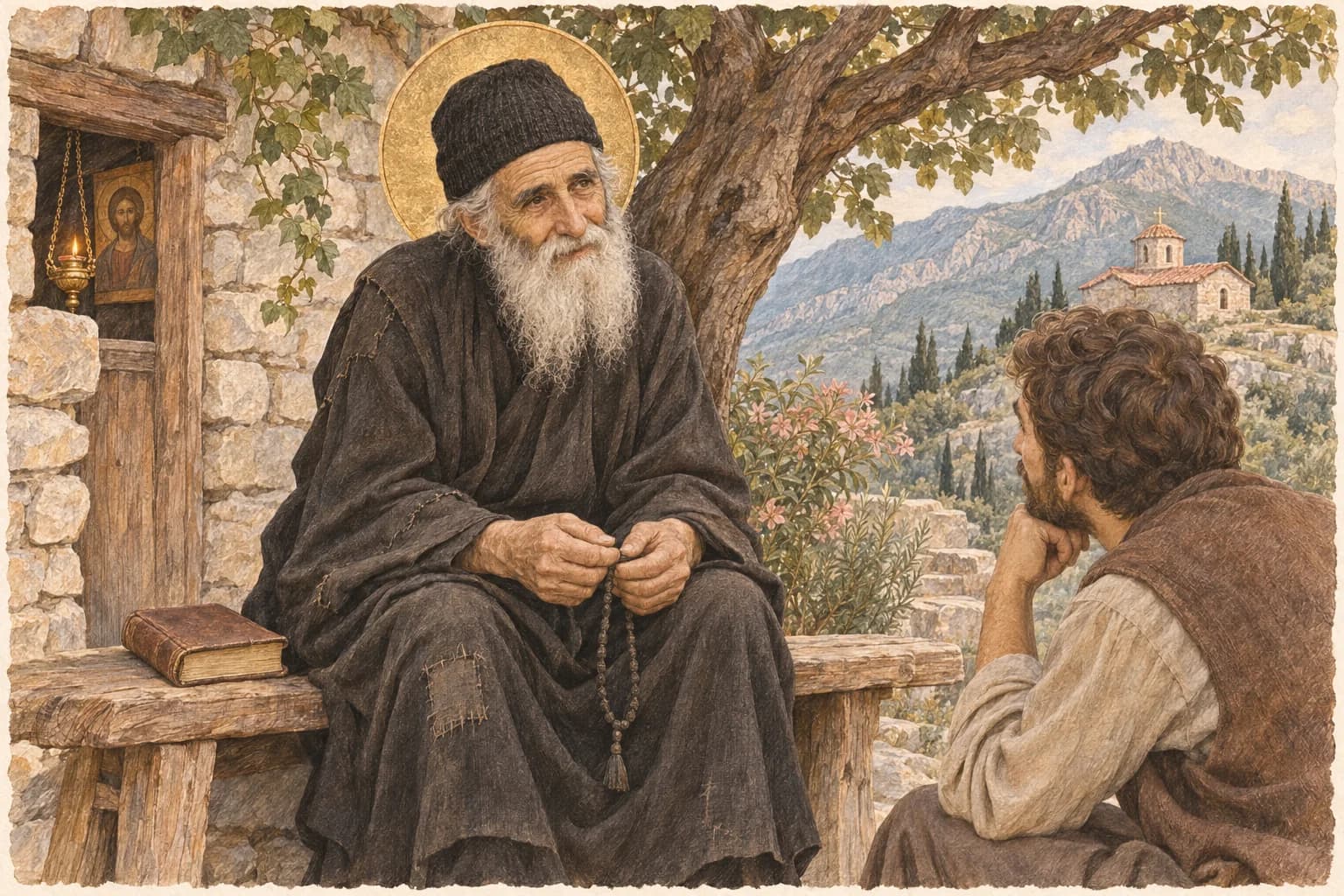
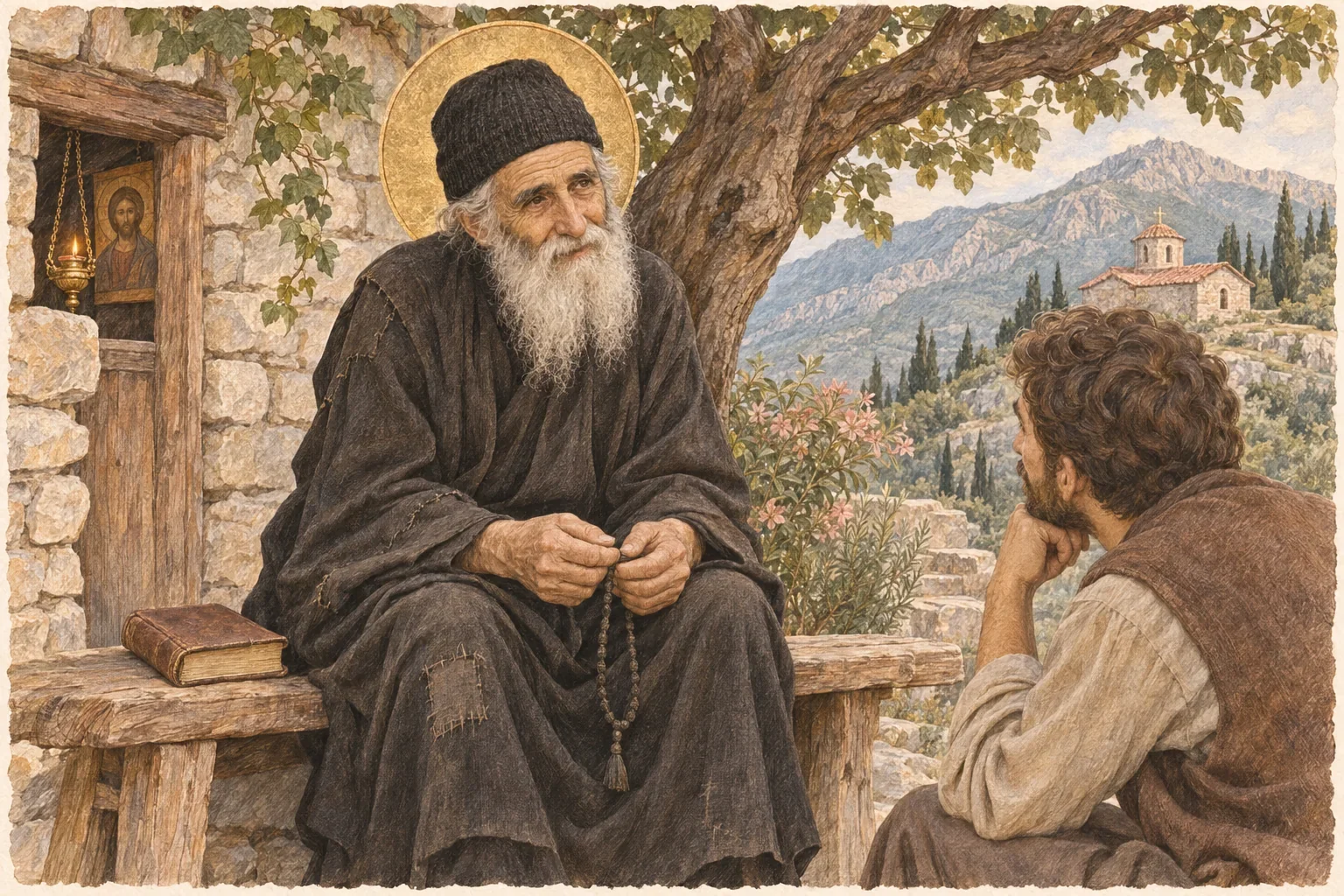
Saint Paisios the Athonite was a twentieth-century Athonite monk honoured for spiritual guidance. His name appears in collections of conversations and online quotations. Begin with editions of clear provenance rather than sensational predictions.
An elder’s advice is often addressed to a particular person in particular circumstances. The question being answered matters. Without that context, even authentic words can be given a very different meaning by a later reader.
Do not use an unsourced image to impose a severe rule on yourself or predict events. Honouring a saint does not require accepting every post carrying his photograph. Checking a source respects his memory rather than questioning holiness.
Read short passages and note their practical meaning and intended recipient. If counsel concerns a difficult situation in your life, discuss it with your priest. Recognising your own capacity is more useful than copying someone else’s monastic struggle.
Arsenios Eznepidis: childhood and the path to monastic life
Paisios the Athonite was born in 1924 in Farasa in Cappadocia and received the baptismal name Arsenios. Soon afterwards his family joined the Greek refugees leaving Asia Minor, and his childhood unfolded in Greece. Before becoming a monk he learned carpentry and served in the army. These circumstances reveal, behind the familiar image of an elder, someone acquainted with displacement, manual work and life outside a monastery.
His monastic journey was not confined to a single location. His biography includes Athonite communities, Stomion and Sinai. These stages concern prayer, obedience and care for people rather than a search for the most famous address. Names received at different stages of monastic life explain why early accounts mention Arsenios and Averkios before Paisios. These are not three different spiritual teachers but names connected with one person’s developing life.
Athonite is neither a surname nor a priestly rank
Athonite identifies a connection with Mount Athos; it is not a surname. Paisios was a monk, not an ordained priest. Accounts of his spiritual counsel should therefore not automatically be described as his celebration of sacramental confession. A monk can offer conversation and share spiritual experience, while priestly absolution belongs to a different ecclesiastical ministry.
His life at the Panagouda cell became especially well known, as many people visited him there. A secluded place thus became closely connected with a large flow of visitors and their difficulties. Church remembrance presents Paisios as a person of attentive encounter, not the author of a universal instruction capable of settling another person’s destiny in one sentence. His experience of monastic prayer cannot be transferred mechanically to a working parent, someone with an illness or a teenager without considering their responsibilities and capacities.
Understanding philotimo in his teaching
English editions often retain the Greek word philotimo, while Russian translations commonly use lyubochestie. In this setting it concerns a grateful, freely offered readiness to do good in response to God’s love. It is not fear of losing face or a determination to earn praise at any cost. A person acts for reasons beyond being compelled, monitored or rewarded.
For example, someone may help a tired relative without waiting for an argument over duties. Yet this disposition does not remove the need for rest, treatment or reasonable limits. Using the concept to shame an exhausted person into giving still more can distort its meaning. Paisios’s discussion should be read alongside his concern for others, attention to circumstances and emphasis on inward freedom. A brief definition is useful, but several different conversations reveal the word’s nuances more faithfully than a motivational slogan.
How the books of counsels are arranged and how to check quotations
Many readers encounter Paisios through thematic collections prepared from records and recollections of conversations. This matters for interpretation: the text is not always a treatise that he wrote from beginning to end as a single system. Editors group answers by subject, and the question originally asked may explain the tone and proportion of a particular recommendation.
To check a quotation, find the edition, volume or section and the surrounding passage. The assertion that an elder said something does not establish authenticity without a reference. Particular care is needed with claims about precise political dates, guaranteed disasters or actions supposedly required of an entire population. Even an authentic statement must be understood within the circumstances of the conversation. Beginning with prayer, relationships and perseverance in work is more useful than assembling sensational predictions from repeated second-hand reports.
Illness, the final years and church remembrance
Paisios’s final years included serious illness. He died in 1994 and was canonised by the Church of Constantinople in 2015. His grave is at the Monastery of Saint John the Theologian in Souroti. Visiting his burial place and visiting his former Athonite cell are therefore different journeys with different access arrangements.
His life should not be made into an argument against medical assistance: illness and receiving treatment do not contradict monastic prayer. Readers can instead notice the combination of trust in God with attention to an actual human person. If a saying attributed to Paisios produces anxiety or hopelessness, return to the whole section and discuss whether its context has been understood. Veneration does not require accepting every online account as a mandatory component of Orthodox belief or treating all reported advice as personally addressed to every reader.
A question for reflection
Does the quotation you like have a verifiable source and intelligible context?