
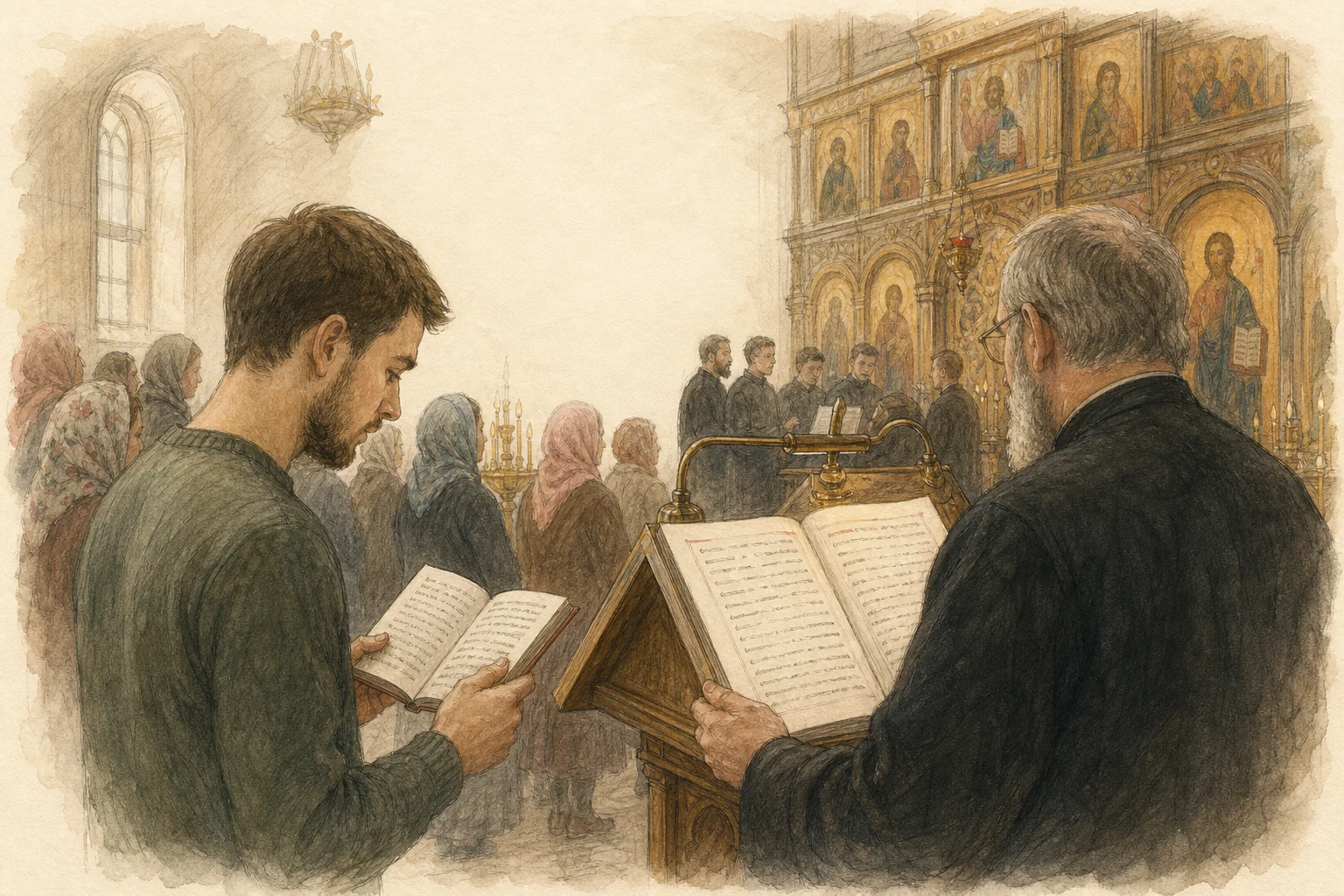
Worship in the Russian Orthodox Church is traditionally celebrated in Church Slavonic because it has served for centuries as a common language of prayer, preserves biblical and liturgical translations associated with Saints Cyril and Methodius and their disciples, and carries stable theological meanings. It is not magically holier than every other language and should not turn worship into an impenetrable mystery.
If you do not understand everything, this is not evidence of weak faith. Learn recurring words gradually, read the Gospel and reliable translations, ask questions, and return to worship.
What is Church Slavonic?
Church Slavonic is the liturgical literary language of several Slavic Orthodox Churches. Its foundation is connected with translations of Scripture and Church books begun in the ninth-century mission of Saints Cyril and Methodius and continued by their disciples.
It is not simply colloquial “Old Russian,” nor was it the everyday speech of everyone living in what is now Russia. Texts, pronunciation, and spelling developed over centuries, and local recensions appeared. The Russian Church uses its inherited reading tradition.
Church Slavonic is related to Russian, so many roots are recognizable, while grammar and meaning may differ. A familiar-sounding word can carry an older or more precise sense.
Why preserve a distinct liturgical language?
Important human practices develop a language of their own. Law, medicine, poetry, and family memory all use expressions that cannot be replaced by casual speech without loss. Liturgical language creates a space for common prayer and reminds us that we enter the inheritance of many generations.
It connects parishes and centuries through shared texts, allows choirs and communities to recognize familiar hymns, and preserves subtle theology. “Grace,” “Peace be unto all,” or “O Gladsome Light” carry layers of biblical and ecclesial memory.
Tradition matters not because everything old is automatically better, but because it transmits faith without arbitrary alteration.
Does God not understand modern Russian?
Of course He does. A Christian may pray at home in modern Russian and in personal words. Orthodox Churches throughout the world worship in Greek, Romanian, Arabic, English, Japanese, and many other languages.
Church Slavonic is used not because God cannot hear another language but because it is the established common language of a particular Church tradition. It must not become a reason for pride or a claim that prayer in Russian is inferior.
Why not translate the whole service into modern Russian?
Liturgical translation is not a mechanical replacement of old vocabulary. A translation must preserve doctrine, rhythm, biblical quotations, singability, and recognition by the whole community. One modern phrase may convey only part of a Slavonic word’s meaning, and translators may reasonably choose different expressions.
Church translations require careful common examination and official authorization rather than one reader’s improvisation. At the same time, explanations, parallel translations, catechesis, and preaching in contemporary language already help people understand.
The appropriate use of modern language is discussed within the Church. We need not choose between “change nothing” and “replace everything immediately.” The task is fidelity joined with accessibility.
What can a newcomer understand now?
Large parts of worship repeat. “Lord, have mercy,” “To Thee, O Lord,” “Amen,” and “Glory to the Father and to the Son and to the Holy Spirit” soon become familiar. Litanies, troparia, and the main exclamations of the Liturgy then begin to stand out.
The Epistle and Gospel may be read beforehand in a modern translation. When the feast’s theme is known, unfamiliar hymns have context. After several visits, the service no longer sounds like one unbroken stream.
How can I learn without overload?
- Begin with the unchanging parts of the Liturgy rather than an entire service book.
- Read the Sunday Gospel in a modern translation beforehand.
- Choose one hymn and look up its translation after worship.
- Use an edition with parallel Slavonic and modern text.
- Write down two or three unfamiliar words, not everything at once.
- Listen to the priest’s explanation and ask a concrete question.
A phone can distract others during worship. A printed text or preparation at home is usually better.
What if the reading is too fast?
Liturgical reading has its rhythm, but it should not become meaningless sound. A pace familiar to a regular worshipper may feel very different to a newcomer. Reading the text beforehand helps greatly.
If words are consistently impossible to distinguish, give calm feedback after the service. Comments about diction, sound, or printed aids can help when offered without accusation.
Church Slavonic and children
A child need not learn the language before entering church. Children meet recurring responses, short prayers, and the feast’s meaning through explanation by adults.
At home, retell the Gospel simply and explain one hymn. Do not demand that a child follow every word without movement. A parish school may offer systematic learning, but confirm its actual program locally.
Do not turn language into a wall or a weapon
An experienced worshipper should not shame a newcomer for not understanding, and a newcomer need not mock tradition as meaningless. Both reactions refuse to hear another person.
The purpose of liturgical language is common prayer. Greater knowledge should make someone more patient and willing to explain; limited knowledge can be acknowledged honestly while learning.
Why does sound matter too?
Liturgical text is not only read. It is sung, repeated, and heard within the architecture of a church. Translation must consider stress, melody, and the choir’s common response. A sentence accurate on paper may be awkward to sing or lose its connection with a familiar chant.
This is not an argument against translation but an explanation of its difficulty. Good work requires theologians, philologists, choir directors, and real parish communities, followed by an ecclesial decision.
Words that are easy to misunderstand
Some Slavonic words resemble modern ones but mean something different. A word may retain an older sense such as life, people, deception, or spectacle. These shifts explain many phrases that first sound strange.
Do not collect random vocabulary merely for display. Study a word within a particular prayer and its scriptural context. The language then opens meaning instead of becoming a cabinet of curiosities.
Frequently asked questions
Did Christ and the Apostles speak Church Slavonic?
No. Aramaic, Greek, and other languages were used in first-century Palestine. Church Slavonic arose as a language of Christian translation for Slavic peoples.
May I pray in modern language at home?
Yes. Use reliable translations and pray in your own words. Learning Slavonic gradually helps participation in common worship.
Why is the sermon in modern Russian?
A sermon explains Scripture and addresses people here and now, so contemporary speech is natural. Liturgical texts have a different, stable ecclesial status.
Is it a sin not to understand?
No. Lack of understanding is a task for gradual learning, not a sin. What matters is not closing yourself off or pretending to know.
Are services ever celebrated entirely in modern Russian?
Practice differs among parishes and jurisdictions. Consult official schedules and do not treat one local experience as a universal rule.
What should I ask the parish?
Ask whether parallel texts, talks about the Liturgy, or adult parish education are available. Check the schedule and send a specific question through the contacts.
Understanding Church Slavonic comes not before the first visit but within living Church life. Begin with several familiar words, the day’s Gospel, and an attentive return. Gradually the language ceases to be a wall and becomes a guide into common prayer.