
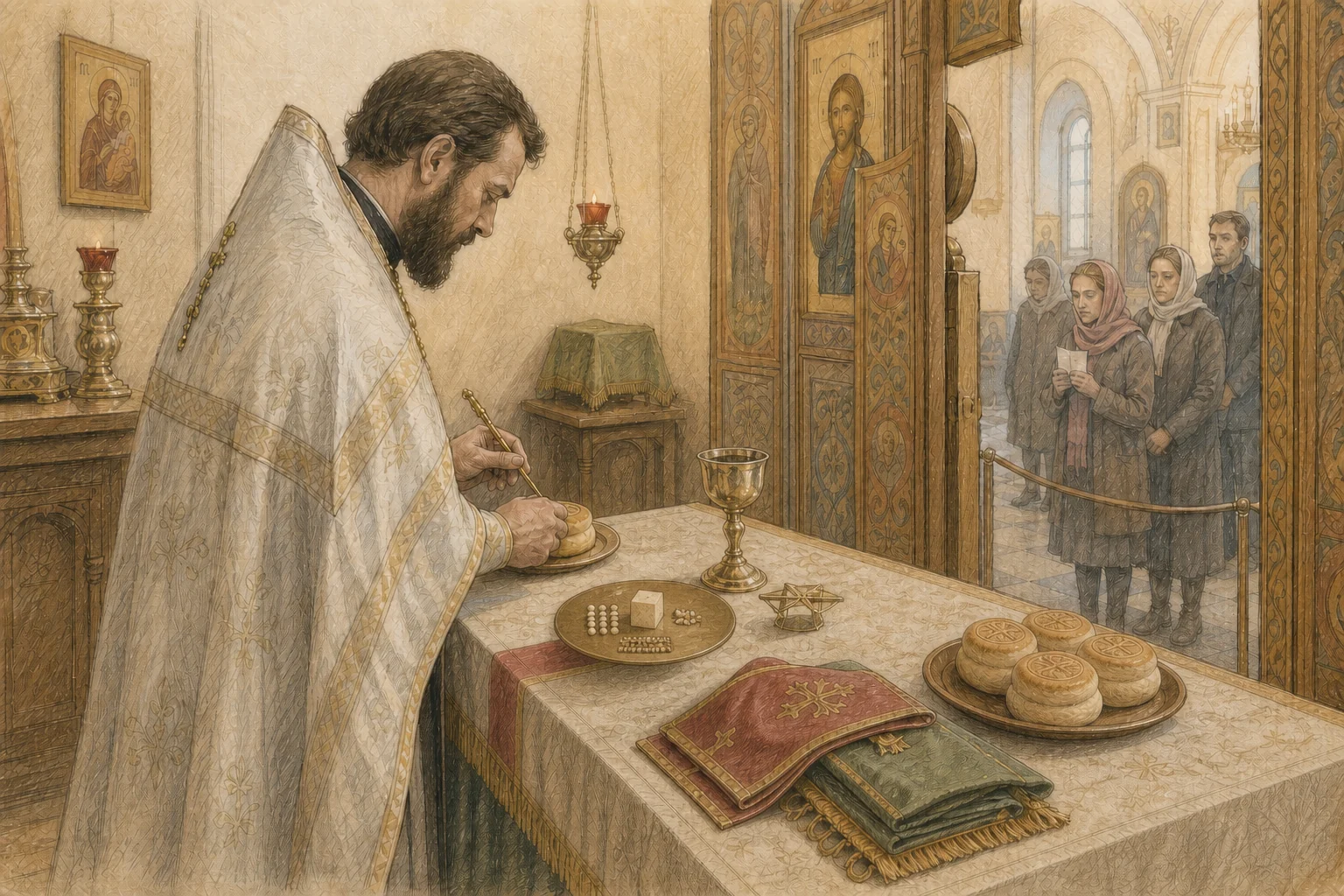
Commemoration of the departed at the Divine Liturgy begins during the proskomedia: the priest names baptized Orthodox Christians and removes small particles from prosphora, arranging them on the diskos around the Lamb. At the end of the Liturgy these particles are placed in the Chalice with a prayer that Christ wash away the sins of those commemorated through his precious Blood.
This is not a paid guarantee of salvation and not a magical operation upon a name. Liturgical commemoration expresses the love of the whole Church and entrusts the departed to Christ, who conquered death.
What the proskomedia is
The proskomedia is the first part of the Divine Liturgy, when bread and wine are prepared in the altar for the Eucharist. It is commonly celebrated during the reading of the Hours before the public beginning visible to the congregation.
The word means an offering. The ancient practice of the faithful bringing bread remains present in the name prosphora and in the remembrance of those who offer and those for whom the offering is made.
What the Lamb is
From the principal prosphora, the priest removes a cubical portion bearing the seal of Jesus Christ. This is called the Lamb, and it alone is consecrated to become the Body of Christ in the Eucharist.
The Lamb stands at the center of the diskos. Around Christ the whole Church is symbolically gathered.
How the particles are arranged
A distinct particle is removed in honor of the Mother of God, and nine groups commemorate the ranks of saints. Below them, particles are placed for living and departed Orthodox Christians.
This is a theological image of the Church around Christ, not a ranking of human worth. The size or position of a particle does not reveal whom God loves more.
What the priest does with a prayer list
The priest reads the names and removes one or more small particles from prosphora according to the received order. When lists are numerous, assisting clergy may read names while particles are removed in groups.
A name has not been ignored merely because a parishioner did not hear it spoken aloud. The proskomedia takes place quietly within the altar.
What happens after Communion
After the faithful receive Holy Communion, the priest places the memorial particles in the Chalice and asks that the sins of those commemorated be washed away by the precious Blood of Christ.
This completes the image of prayerful gathering around Christ's sacrifice. The action cannot be separated from the entire Liturgy and sold as an independent technique.
Do the particles become the Body of Christ?
No. The Lamb is consecrated, while the particles for the Mother of God, saints, living people, and departed people do not become the Body of Christ and are not distributed as Holy Communion.
Their role is commemoration and liturgical presence beside the Lamb in the image of the Church. This distinction protects accurate teaching about the Eucharist.
Why remembrance is joined to Christ's sacrifice
The Church prays not through its own merit but in the name of the Savior's death and Resurrection. The departed can no longer alter earthly life but remain within human love and prayer.
We do not tell God a name he has forgotten or negotiate with him. We bring the person into the common thanksgiving and ask for mercy.
How to write a prayer list
Mark the list for the departed and write baptismal names clearly in the grammatical form used by the parish, one per line. Ask a worker for a model if you do not know the local convention.
Surnames, ages, occupations, causes of death, and relationships are ordinarily unnecessary. The description “newly departed” may be added during the first forty days when that is parish practice.
When to submit the list
Arrive before the Hours and Divine Liturgy begin. If the proskomedia has ended, the list may be used in another part of worship or moved to the next Liturgy.
Ask about local procedure and never demand interruption of the sacred action. For a known anniversary, bring the names on the evening before.
Must a person attend personally?
Personal participation is desirable: one enters the prayer of the community, hears the Gospel, and, with preparation, may receive Communion. Illness, distance, or care for another person may prevent attendance.
In that case, send the list through someone trusted or an official parish channel. Personal prayer at home remains important.
Must I receive Communion after submitting a name?
A list may be submitted without receiving Communion, but the purpose of the Liturgy is revealed in Eucharistic life, not in a service for delivering names. A prepared Orthodox Christian seeks fuller participation.
Do not approach the Chalice mechanically on behalf of the departed. Preparation includes repentance, prayer, fasting, and the parish discipline for Confession.
Who is commemorated at the proskomedia?
Normally, baptized Orthodox Christians, both living and departed. Through the particles, the Church expresses the Eucharistic communion of its members.
Do not conceal lack of Baptism, adherence to another religion, or the departed person's explicit rejection of the Church. Discuss a difficult situation with a priest.
May an unbaptized person be listed?
Ordinarily, no. A family may pray personally and do good for an unbaptized person but should not submit the name as though the person were Orthodox.
The reasons and available forms of support are explained in our article on church prayer lists and the unbaptized.
May a non-Orthodox Christian be listed?
Baptism in another Christian community does not automatically include someone in Orthodox Eucharistic commemoration. The ordinary proskomedia list is for Orthodox Christians.
Personal prayer for God's mercy remains possible. If the person was a spouse or close relative, ask a priest to explain local pastoral practice.
When the baptismal name is unknown
Check a Baptism certificate, previous prayer lists, an inscription on a personal icon, and ask older relatives. Do not assign a baptismal name from an approximate birthday.
If it cannot be established, pray at home for your departed relative and explain the situation to a priest. God knows the person without our archival accuracy.
Should a surname be written?
Usually not, although identical names may be distinguished by an initial if the parish requests it. In the altar, the personal baptismal name is what is commemorated.
Follow the model displayed at the parish desk. A prayer list is not a questionnaire.
What an ordered memorial list means
Terminology differs among parishes. A special list may mean commemoration at the proskomedia together with the name spoken at a litany or panikhida.
Ask what the parish actually means. A larger donation does not make divine mercy stronger.
What a forty-Liturgy commemoration is
This practice, commonly known by a Slavic term meaning “forty,” commemorates a name at forty Divine Liturgies. It does not always mean forty consecutive calendar days because a parish may not celebrate daily.
It is not an automatic guarantee. It sustains the longer prayer of the Church and family.
May a name be sent to several churches?
A name may be offered in several real parishes or monasteries as a free expression of love. The number of locations, however, must not become an anxious score.
Do not borrow money or send funds to anonymous aggregators. Participation in one's own community and help for someone in need may be more fruitful.
How to verify online commemoration
Confirm that the website belongs to a specific canonical parish or monastery and includes an address, clergy, and contact details. Check how donations are used and whether a confirmation is provided.
Promises of an instant eternal commemoration, a secret rite, or a guaranteed change in destiny are warning signs.
Why a name was not heard at the litany
A memorial litany depends on the day and liturgical order, and numerous names may not be proclaimed one by one. This does not mean that remembrance at the proskomedia failed.
Do not evaluate prayer from a recording alone. If there is a genuine concern, ask a parish worker calmly after the service.
Holy Week and Bright Week
Ordinary public panikhidas and memorial litanies are restricted during these periods because worship is concentrated on Pascha. Yet the private commemoration at the proskomedia and the appointed prayer after the consecration continue.
Do not treat a transferred panikhida as refusal to pray. Radonitsa provides the public Paschal memorial after Thomas Sunday.
Memorial Saturdays
On particular Saturdays, liturgical remembrance is joined to a parastas and panikhida. Meatfare and Trinity Saturdays are the two universal memorials.
The dates and practice are explained in our guide to Memorial Saturdays.
May someone who died by suicide be listed?
Do not decide alone and do not conceal the cause of death. Church commemoration depends on circumstances, mental condition, and diocesan blessing.
Approach the priest with available medical information. The family needs help without condemnation and without anonymous promises of a special rite.
How a departed infant is commemorated
A baptized infant is commemorated by name without attributing personal sins. A child who died before Baptism requires a different pastoral practice and the service of consolation for the parents.
Do not blame the mother or invent a Baptism. Speak with a priest promptly.
What to do after the Liturgy
Remain for a panikhida when one is celebrated, pray at home, visit the grave according to strength, and perform a good work. Remembrance does not end when a paper list is handed over.
A practical order for the home appears in How to Remember the Departed at Home.
Donations and prayer without payment
A donation sustains the parish but is not the price of God's access to a name. If there is no money, explain the situation to a worker or the rector.
Do not shame someone for a small amount and do not treat a large transfer as proof of love. The Church does not pray by tariff.
Frequently asked questions
Must I hear the name aloud?
No. The proskomedia is quiet, and numerous names may be read without public proclamation.
When should the list be submitted?
Before the Divine Liturgy begins, ideally before or during the Hours.
Do the particles become Holy Communion?
No. The Lamb is consecrated as the Body of Christ; memorial particles have a different liturgical role.
Does forty-Liturgy commemoration last forty days?
It means forty Liturgies, which need not occur on forty consecutive days.
May a list be submitted without money?
Yes. Explain financial hardship to the parish; prayer is not sold.
The central message
Commemoration at the Liturgy gathers the names of living and departed people around Christ. A particle on the diskos is not a charm but a visible sign of the Church's prayer before the Eucharistic sacrifice.
Write names honestly, bring the list early, and participate in the Divine Liturgy whenever possible. Continue remembrance at home and through works of love without turning the number of orders into a measurement of hope.