
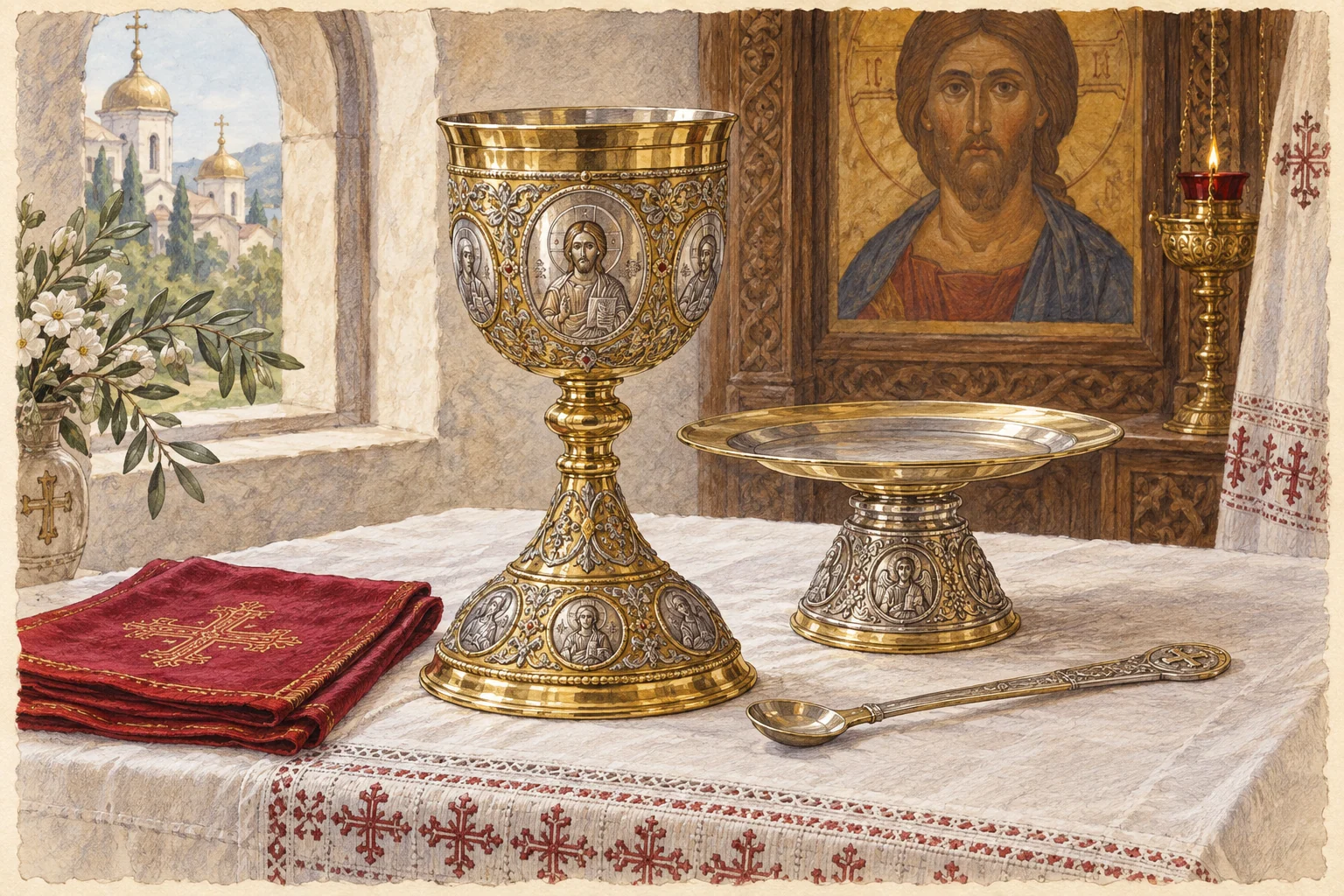
The chalice, diskos and Communion spoon belong to eucharistic worship. Their unfamiliar names describe recognizable forms: a cup, a shallow plate on a stand and a small spoon. Learning the vocabulary helps with understanding a service, but knowing the names does not authorize someone to pick up or handle these objects.
The chalice: the eucharistic cup
The chalice is a cup with a stem and stable base. Wine mixed with water is placed in it for the Eucharist; after the consecration of the Gifts, Communion is administered from it. The term distinguishes this vessel from a bowl used to bless water, an ordinary mug or a cup used for a drink after Communion.
In a photograph, look for the bowl, stem and base together, but do not identify an object by shape alone. Similar cups in a museum may have had other uses. In church, the purpose of the particular vessel matters as well as its appearance.
The diskos and asterisk
The diskos is a small plate, usually raised on a stand. It holds the prepared eucharistic bread and particles taken from the offering loaves. It is not the plate used for distributing ordinary blessed bread. The asterisk consists of two joined arches forming a small crossed framework above the diskos, supporting its covering over the bread.
Compare silhouettes as a visual memory aid: the chalice is tall and deep, the diskos broad and shallow, and the asterisk a framework. This is more useful than identifying decoration. Similar ornament may appear throughout a set and therefore cannot explain each item's purpose. Recognizing the shapes does not require copying liturgical actions from pictures.
The spoon, spear and coverings
The Communion spoon is used to administer Communion to the laity in usual Orthodox practice. The spear is a special cutting implement used in preparing the bread; its name recalls the Gospel account of Christ's Passion. Spoon and spear are not interchangeable, even if they are laid near one another.
Small cloths cover the vessels, while the larger covering is called the aer. Its name, related to the word for air, does not immediately tell a newcomer that it is a textile. During a class, name each item while pointing it out in an authorized photograph. The vocabulary enables recognition, not independent performance of sacred actions.
Respectful handling and approaching Communion
Sacred vessels should not be picked up to test their weight, obtain a photograph or inspect a maker's mark. If you are helping with cleaning, clarify the limits of the task: general permission to dust furniture does not automatically cover everything in the church. Report damage to a responsible person rather than attempting a repair yourself.
Before receiving Communion for the first time, discuss preparation and the practical approach with the priest. At Communion itself, follow the minister's directions, avoid sudden movements near the chalice and help a child remain calm. These vessels deserve reverence because of their purpose, not because they might be expensive artworks. Understanding that distinction leaves less room for confusion, fear of unfamiliar vocabulary and curiosity that distracts from prayer.
Not every vessel brought out of the sanctuary is a chalice. Different services use different objects, and a visitor may see them only briefly. If a name matters for a caption or an explanation to a child, check it afterwards. Acknowledging that an object is unfamiliar is better than assigning a purpose from a casual resemblance to household equipment.
Shape, use and symbolic interpretation
Three questions can be asked of each object: what does it look like, how is it used, and what does it recall in the Church's interpretation? Archpriest Mikhail Sokolov's guide connects the diskos with Christ's manger and tomb, and the asterisk with the star of Bethlehem. This reads the objects in relation to the Nativity and Passion. It does not remove their practical purpose or identify them as household objects preserved from the Gospel events themselves.
This approach avoids two extremes: seeing only precious metal or turning every detail of ornament into an independent secret sign. Name the object, explain its use, and then introduce a symbolic interpretation with its source. If you do not know the meaning of a particular decorative pattern, say so. Not every ornament calls for a theological explanation improvised on the spot. A limited but accurate account helps a beginner more than a complete-sounding set of guesses.
Distinctions near the chalice
A first-time observer may notice bread and a drink given after Communion and assume that every nearby vessel serves the same purpose. The chalice and the cups used for the drink afterwards are not interchangeable. Ask beforehand or after the service rather than holding up the line at Communion. Understanding the distinction helps prevent an accidental action based only on copying the person next to you, particularly when the local arrangements are unfamiliar.
If movement is difficult or a child needs particular support to remain calm, discuss this before approaching so that the minister knows the circumstances. Avoid trying to hold a phone, a bag and a child simultaneously for fear of missing something. A photograph for study belongs at another agreed time and place. Attention here takes a straightforward form: prepare, listen to the directions and move without rushing. Learning about the vessels should reduce confusion, not encourage inspection at the very moment when that would distract both you and those administering Communion. Questions can wait without being forgotten.