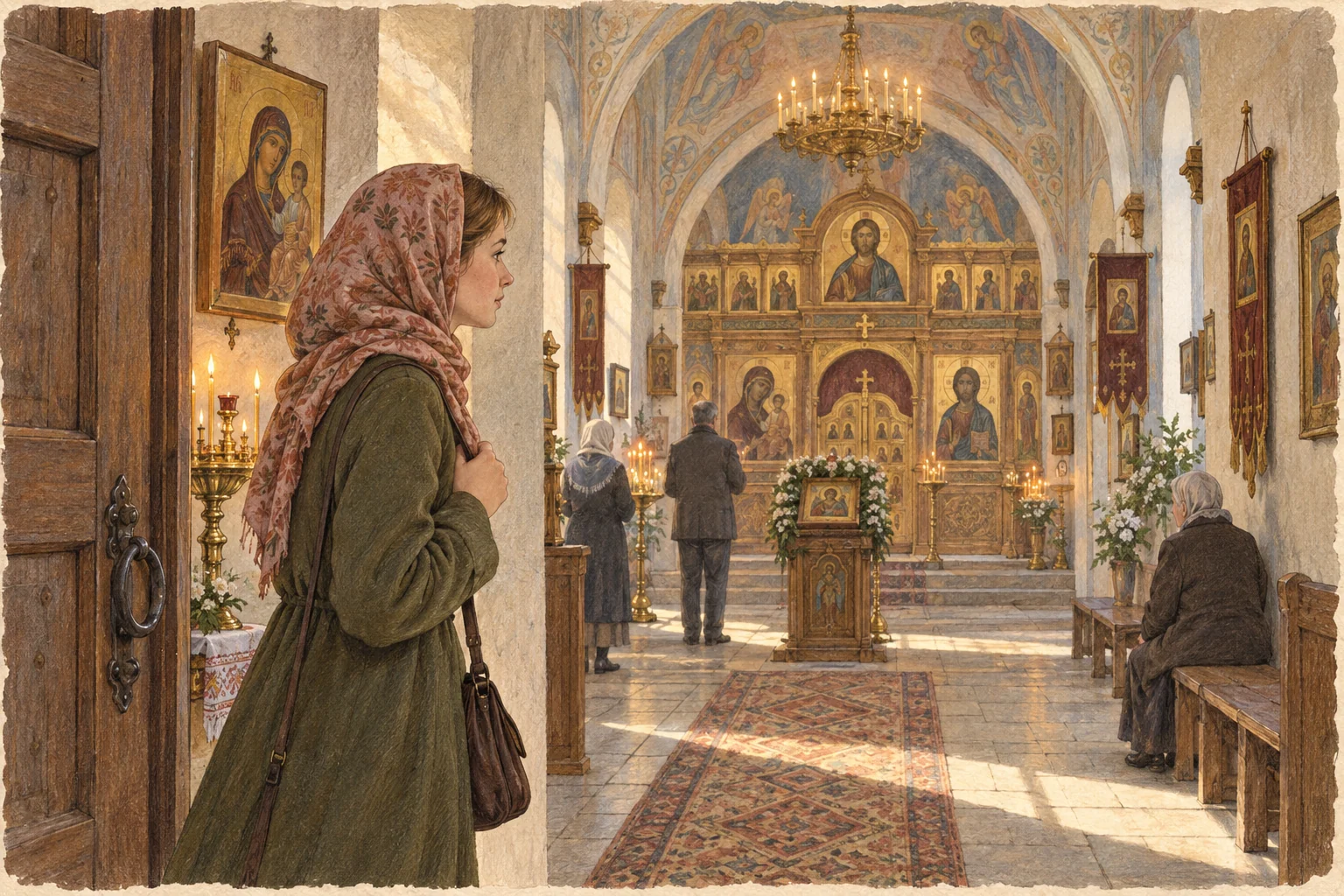
On a first visit, a church may seem complicated: several entrances, candle stands, icons, steps and doors beyond them. Three basic areas are enough to get your bearings: the narthex, nave and sanctuary. They explain the arrangement and purpose of the space, not a division between people who are more or less worthy.
The narthex: near the entrance
The narthex is the entrance area before the main body of the church. Depending on the building, it may be a separate room, a small vestibule or an only loosely defined space. A church without a spacious narthex is not therefore incorrectly designed. Historically this area was associated with various services and with catechumens preparing for Baptism.
Today you may find notices, books or a place to submit prayer requests here. A sales counter and a narthex are not the same thing, however: practical arrangements vary between parishes. Pause near the entrance, silence your phone, read the schedule and see where you can walk without obstructing others. Buying a candle is not an admission fee.
The nave: where the congregation gathers
Most worshippers stand or sit in the nave. Here they hear the readings, sing, pray and approach icons when appropriate. A stand with an icon may be placed centrally, but its position can change with the service. There is no single compulsory spot assigned to newcomers.
Choose somewhere with a reasonable view and a clear passage. If standing is difficult, ask about seating. Fatigue, age or reduced mobility do not make someone an outsider in the congregation. Children benefit more from calm orientation than from being expected to understand an unfamiliar room immediately. A family may prefer a place near the exit if a child sometimes needs a break.
The raised area before the iconostasis
The raised platform along the iconostasis is called the solea; its central projection is commonly called the ambo in Russian usage. Particular parts of the service take place here, so it should not be occupied for a better camera angle. The iconostasis marks the sanctuary boundary, not an ordinary doorway to another public room.
When clergy or a procession pass, leave a clear path. There is no need to guess the route and hurry across the church. A server asking you to move is usually making a practical request. Calm attention to other people is more helpful than trying to imitate every movement of an experienced worshipper.
The sanctuary and other spaces
The sanctuary is behind the iconostasis; visitors should not enter on their own initiative. The Holy Table, table of oblation and other furnishings deserve a separate explanation. A side door inside the building does not necessarily lead to a public exit: it may open into a room reserved for particular responsibilities.
Larger churches sometimes contain side chapels with their own dedication to a saint or feast. An individual icon surrounded by candles does not by itself identify a chapel. To find your way, ask where the service you intend to attend is taking place, where the accessible exit is, and whom to approach with questions. That is enough for a first visit: architectural terms should support participation in prayer, not turn the visit into a test.
When the church is crowded, identify somewhere you can pause without blocking a doorway. This is particularly useful when accompanying an older person or a family using a pushchair. Ask a parish worker about an accessible route: a floor plan may not show a threshold, temporary closure or staircase that matters for your particular visit.
A route for a first visit
Imagine arriving a few minutes before a service in an unfamiliar building. First identify the entrance in use and the schedule, then look from the narthex for a clear route into the nave. You do not have to visit every icon and candle stand immediately. Find a quiet place and discover where the reading is audible. If you have come for a conversation or a Baptism, ask where to meet: it need not be the same place used for the Sunday gathering.
When leaving, avoid a long conversation in a narrow doorway. People entering may not see the step behind you, and someone using a walking stick needs room to turn. If accompanying another person, agree beforehand where to meet afterwards instead of searching for each other in a moving crowd. These are small practical arrangements, but they can make the difference between attending to worship and worrying throughout the visit about how to find your way out.
What a floor plan cannot tell you
An architectural diagram shows rooms and boundaries, not necessarily where prayer requests are received today, where confession takes place, or where a parish worker is available. Those arrangements can change. Ask one precise question instead of trying every door: where can I wait for the priest afterwards, or is there a route without steps? An answer about the actual building is more useful than an assumption based on photographs of a different church.
The word narthex does not identify a place for people considered less important by the community. If you remain near the entrance because of anxiety, a child's needs or a need to sit, do not measure your participation by your distance from the iconostasis. On the other hand, words may be harder to hear there; when possible, find a place where they are intelligible. Discuss comfort and access with the parish. The building's arrangement should help someone join the common prayer rather than become an obstacle or a reason to feel that they do not belong.