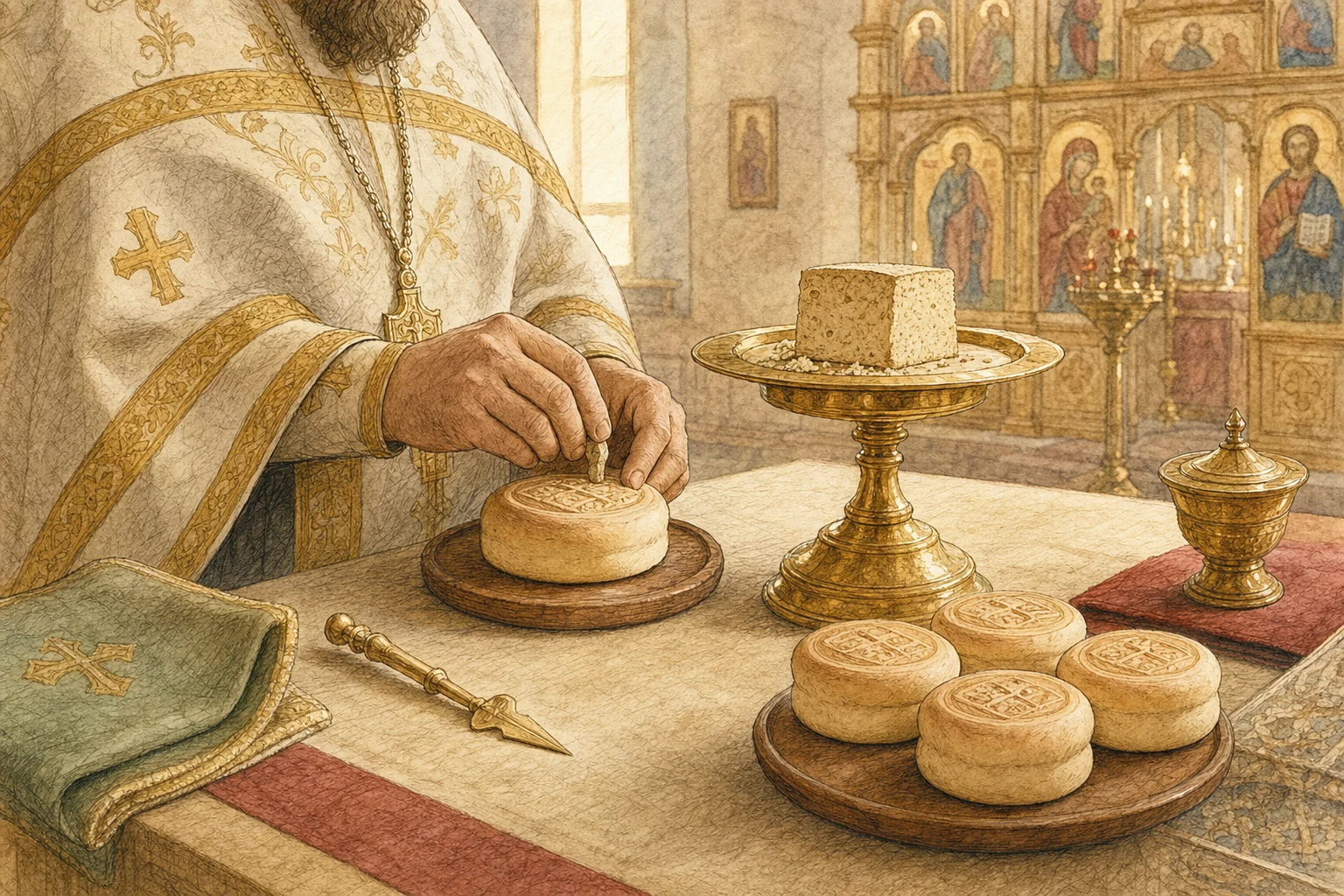
The word Proskomedia can appear beside notes for the living and the departed, yet it may sound unfamiliar to someone new to church. A simple beginning is enough: it is the first part of the Divine Liturgy, when the priest prepares bread and wine for the Eucharist and offers commemoration in prayer.
This guide does not replace a conversation with your parish or impose local rules. It explains the word, its connection with names in a note, and why church prayer should never be treated as a mechanism for controlling life.
Who this guide is for
It is for anyone who has encountered the word for the first time, wants to submit a commemoration note without anxiety, or wishes to understand the Liturgy more clearly. You do not need to know technical language before asking.
A personal question is best brought to the parish. A real conversation is safer and kinder than trying to apply a generic online rule to every situation.
Proskomedia in simple words
Before the public part of the Divine Liturgy begins, the priest prepares the bread and wine that will take part in the Sacrament of the Eucharist. At this time the Church also prayerfully remembers the living and the departed.
That is why Proskomedia is connected with notes, but it is not merely a list of names. Each name belongs to a person whom the Church brings before God in prayer.
Its place in the Divine Liturgy
Proskomedia comes at the beginning of the Liturgy; the congregation then gathers for the shared service. You do not have to understand every moment on a first visit. Come, listen as you can, and let your understanding grow gradually.
A church service is not an exam. Quiet attention and a willingness to learn are a real beginning.
Bread, wine and the Eucharist
In the Liturgy, bread and wine are not decorative objects. They belong to the Sacrament of Holy Communion. Proskomedia prepares them reverently for that purpose.
This is why it is more truthful to speak of a service of prayer than of “ordering a result.” Church life has a concrete liturgical order and a shared prayer, not a transaction.
How notes are connected with Proskomedia
When a parish receives a note for Proskomedia, the writer asks that the named people be remembered during the Liturgy. In the usual practice, names of baptised Orthodox Christians are written; ask your own parish about its specific guidance.
Write names clearly and do not guess when you are uncertain about a baptismal name. A parish worker can help without embarrassment.
For the living and for the departed
Prayer for the living asks for God’s help in illness, work, family life, difficult choices and the path toward peace and salvation. It is wider than a request for an immediate practical outcome.
Prayer for the departed remembers people with love. It does not erase grief or reduce memory to a formality; it brings a beloved name before God.
Proskomedia, a note, and Sorokoust
People often call every paper with names “a note,” though forms of commemoration can differ. Proskomedia belongs to a particular Liturgy. A Sorokoust is commemoration at the Liturgy over a set period in the tradition of forty days.
Neither should be treated as an intensified formula that guarantees a desired change. The meaning is prayer and trust in God, not spiritual control.
Does one need to attend the Liturgy?
If you can come, it is good to pray with the congregation and bring your own gratitude or concern to God. A submitted note does not have to make a person a distant observer.
Illness, travel and care for others can make attendance impossible. Do not turn that into guilt: pray where you are and come when you can.
What Proskomedia does not mean
It is not magic, a payment for prosperity, or a test of whether someone believes correctly. Prayer does not replace medical care, reconciliation, work, honest conversation or responsible decisions.
Nor does it give us a right to demand a particular script from God. We ask for mercy and help, and we continue to learn faithfulness in ordinary life.
If this is your first visit
You may simply say at the parish that you would like to submit a note for the Liturgy but do not know the order. That is an ordinary question. The church does not require instant expertise from a newcomer.
Beginning slowly is not a failure. It is often the most honest way to enter church life.
Common questions
May I write a loved one’s name?
In the usual church practice, commemoration notes name baptised Orthodox Christians. Ask the parish about a particular situation.
Is Proskomedia the same as a prayer service?
No. Proskomedia belongs to the Divine Liturgy. If you are unsure what kind of prayer you seek, explain your intention at the parish.
Must I know the whole order of the Liturgy?
No. Respectful presence and a desire to pray are enough for a beginning.
A calm next step
If you want practical help, contact the parish before the service. If you first want to understand the Liturgy, come and allow yourself to be new. Proskomedia becomes clearer through living participation in the Church’s prayer, not through anxiety over unfamiliar terms.
The Guide to the Divine Liturgy shows where Proskomedia belongs in the complete order of service.