
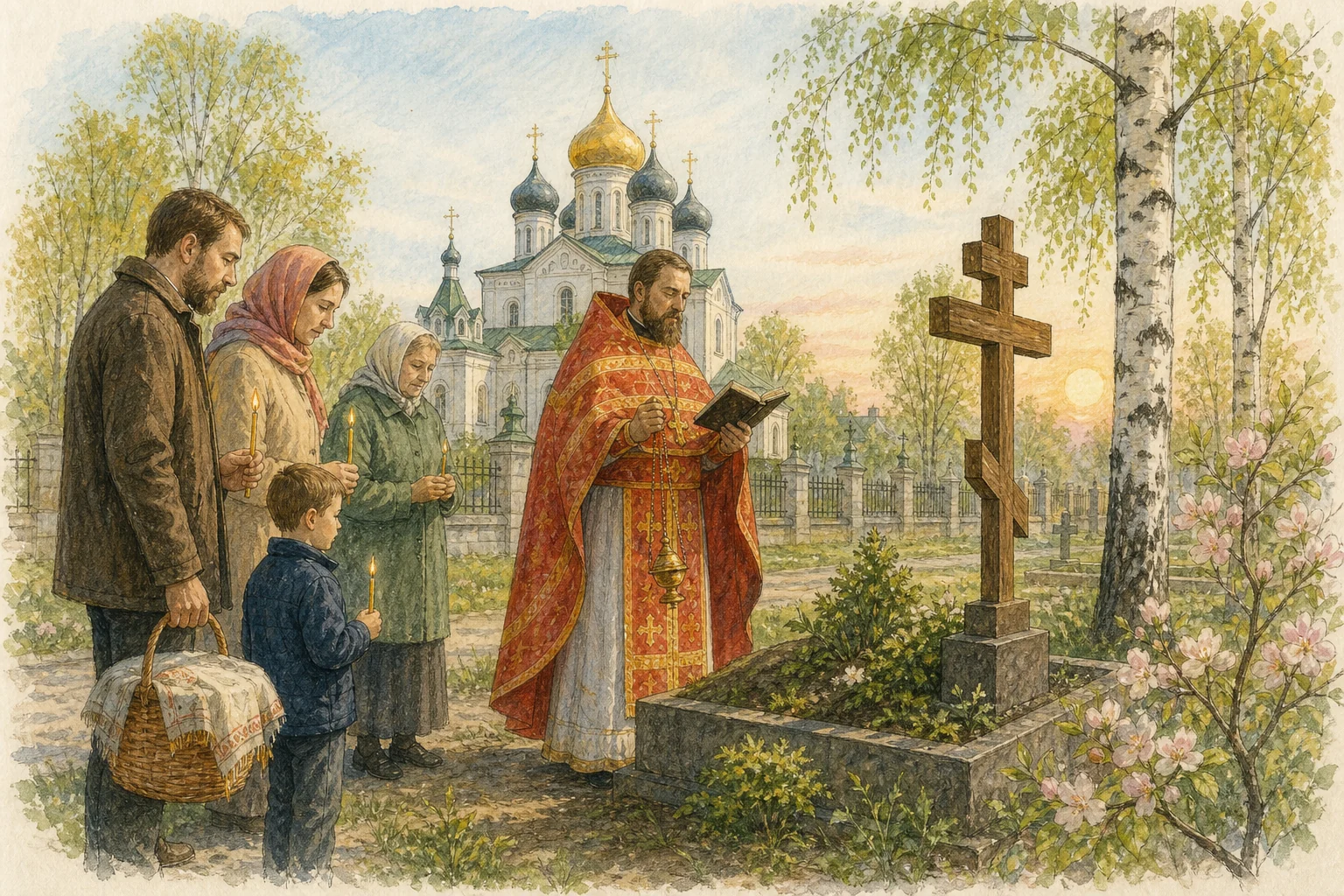
Radonitsa is the Paschal commemoration of the departed observed on Tuesday of the second week after Pascha, immediately after the Monday following Thomas Sunday. Its civil date changes every year together with Pascha.
The purpose of Radonitsa is to bring the joy of Christ's Resurrection into our remembrance of people who have died. It is not a “festival of the dead,” a picnic at graves, or an obligation to reach a cemetery at any cost.
When Radonitsa occurs
It falls on Tuesday of the second week after Pascha. The Church first completes Bright Week and Thomas Sunday and then resumes particular memorial prayer.
To find the civil date in a given year, check the current Orthodox calendar and our parish schedule. Never rely on last year's date.
What the name means
The name is associated with joy. Paschal faith does not eliminate grief but places grief within hope: Christ is risen, and death is not the final disappearance of a human person.
Joy does not mean loud celebration or a ban on tears. A mourner may believe in the Resurrection and still experience the absence of a loved one with great pain.
Why remembrance follows Bright Week
During Holy Week and Bright Week, worship is entirely focused on the Cross, the Resurrection, and the Paschal celebration. Ordinary panikhida services are not celebrated in that period.
After Thomas Sunday, the typikon again permits memorial litiya prayers. Radonitsa becomes the first widely known Paschal encounter with remembrance of the departed.
Why it is a Tuesday
A new liturgical week begins after Thomas Sunday, and memorial observance traditionally takes place on Tuesday. This keeps the particular memorial outside Bright Week itself.
There is no secret hour when souls are said to arrive. The date belongs to the order of the church calendar, not to a supernatural timetable.
What is celebrated in church
The Divine Liturgy is commonly served in the morning, followed by a Paschal panikhida. Some parishes may appoint an additional memorial on the evening before or use another local schedule.
In the stricter liturgical order, the weekday service of the second Paschal week remains festive, while the memorial office is celebrated separately rather than combining unrelated texts arbitrarily.
What a Paschal panikhida is
It is prayer for the departed in which the hymns of Resurrection and the victory of life are especially prominent. Sorrow remains real but receives the language of Paschal hope.
The panikhida is not a second funeral service. It may be celebrated repeatedly on appointed days and at the request of a family.
Why the Divine Liturgy comes before the cemetery
At the proskomedia the priest commemorates the names of baptized Orthodox departed people, while the whole community participates in the Eucharist. This is the central church form of remembrance.
A cemetery preserves a concrete human connection, but it does not replace the Liturgy. When time is limited, first discover when the parish prayer takes place.
How to submit a prayer list
Mark the list for the departed and write baptismal names clearly in the grammatical form used by the parish. Submit it before the Liturgy begins so the names can be commemorated at the proskomedia.
If Baptism or the church name is unknown, say so honestly. Do not invent a name simply to make the person fit the list.
Who is commemorated on Radonitsa?
Church lists may include baptized Orthodox relatives, friends, and other known departed people. Remembrance is not limited to those who died during the previous year.
Personal prayer and works of mercy remain possible for the unbaptized and non-Orthodox; speak with a priest about the appropriate church form.
Is a cemetery visit compulsory?
No. Illness, employment, distance, difficult weather, pregnancy, and care for a child are real reasons to remain at home or in church.
Love is not measured in kilometers. You may submit a name, pray, call an isolated relative, and visit the grave on another peaceful day.
When to visit the grave
Many people go after the Divine Liturgy and panikhida. If crowds are expected or walking is difficult, the site may be cleaned beforehand and Radonitsa itself kept primarily in prayer.
Do not choose an exact hour from superstition. Consider transport, cemetery safety, opening rules, and the strength of elderly relatives.
How to pray at the cemetery
A priest may be invited to serve a litiya, or laypeople may read a short approved prayer from a prayer book. It is also possible simply to ask God in one's own words to grant rest.
Do not imitate priestly exclamations and censing on your own. A simple attentive prayer is enough.
May “Christ is risen” be said at the grave?
The Paschal greeting at a grave expresses the Church's faith in the Resurrection. It may be spoken as a confession of hope, not an attempt to produce an answer.
Do not interpret wind, sound, flame, or an animal's behavior as a reply. The departed do not owe the family a sign.
Paschal eggs and bread at the cemetery
Paschal food may be shared with living people after prayer or given to someone in need. Eggs, sweet bread, and sweets should not be left on the grave as food for the departed.
Food spoils, attracts animals, and becomes rubbish. The Paschal symbol is fulfilled through thanksgiving and the fellowship of the living.
Why alcohol should not be left
Vodka at the grave, alcohol poured into the ground, and a “glass for the deceased” do not belong to Christian remembrance. They provide no help to the soul.
Alcohol increases the risk of conflict, injury, and severe reactions during grief. Both the cemetery and the journey require sobriety.
Must the grave be cleaned that day?
Caring for the burial place is respectful, but it can be completed earlier or later. Radonitsa is not a competition in monuments and flowers.
Remove waste, check unstable structures, and avoid open flame in dry grass. The safety of living people matters more than visual perfection.
What flowers are appropriate?
A modest living bouquet or a suitable planted flower is appropriate when cemetery rules permit. Artificial flowers quickly become plastic waste.
The absence of flowers does not mean forgetfulness. Money may instead support a living person in memory of the departed.
May Christians work on Radonitsa?
Radonitsa is not a mandatory nationwide day off in Russia, although an individual region may create a local holiday. Necessary employment is not a sin.
Submit a prayer list in advance, pray in the morning or evening, and do not blame someone who could not leave work. Local civil rules should be checked separately.
The family memorial meal
After prayer, relatives may gather at home. Keep the food simple, the conversation respectful, and the memory honest.
Do not impose special toasts as a compulsory rite and never pressure someone to drink. A meal supports the living but does not replace the panikhida.
When the loss is recent
The first Radonitsa after a death may be especially difficult. Bring a calm companion, decide in advance how long you can remain, and preserve the freedom to leave.
Deep weeping does not contradict Pascha. Panic attacks, persistent inability to sleep, or thoughts of one's own death require help from a physician, mental health professional, and trusted person.
When cemetery meetings are unsafe
You do not have to arrive at the same time as a relative who threatens, humiliates, or provokes conflict. Choose another time and maintain safe distance.
Prayer does not require enduring abuse. Forgiveness is not the cancellation of boundaries or protection.
How to explain Radonitsa to a child
Say: at Pascha we rejoice in Christ's Resurrection, and on Radonitsa we bring this hope into prayer for people who died. Use the word “died” rather than describing death as a long sleep.
A child may water a plant, light a candle safely with an adult, or remember a kind event. Do not force the child to kiss a monument or frighten the child with a soul's supposed presence.
When the grave is distant or unknown
Prayer in church and at home does not depend on geography. Submit the name for the Divine Liturgy, read a prayer at home, and perform a good work in the person's memory.
When the burial place is unknown, pray for all departed relatives. God knows a name and history without cemetery coordinates.
How Radonitsa differs from Memorial Saturday
Radonitsa occurs on a Tuesday and has an explicitly Paschal character. Memorial Saturdays occupy other points of the yearly cycle and follow their own liturgical order.
The principal dates and their meaning appear in our guide to Memorial Saturdays.
Prayer at home on this day
Read Paschal and memorial prayers from an approved prayer book, a section of the Psalter, or a short request for rest. An approved lay order can help when church is inaccessible.
A photograph may stand nearby as a memory, but it is not an icon. Do not place food or water before it for the soul.
Frequently asked questions
Is Radonitsa always on Tuesday?
In the ordinary Orthodox calendar it is Tuesday of the second week after Pascha.
May the cemetery be visited another day?
Yes. Prayer matters more than the physical precision of the journey.
Should a Paschal egg be left at the grave?
No. Share the food with living people or give it to someone in need.
May I commemorate at home?
Yes, especially when health or distance prevents travel.
Is Radonitsa a day of sorrow or joy?
It is a day of real grief illuminated by Paschal hope.
The central message
Radonitsa joins the memory of the departed to the proclamation that Christ is risen. The Church does not demand that pain be forgotten; it helps the faithful carry pain in the presence of Christ's victory over death.
Begin with the Divine Liturgy and panikhida, then visit the grave according to your strength. Leave no food or alcohol, seek no signs, and condemn no one who could not travel. Prayer and love matter more than a ritual of fear.