
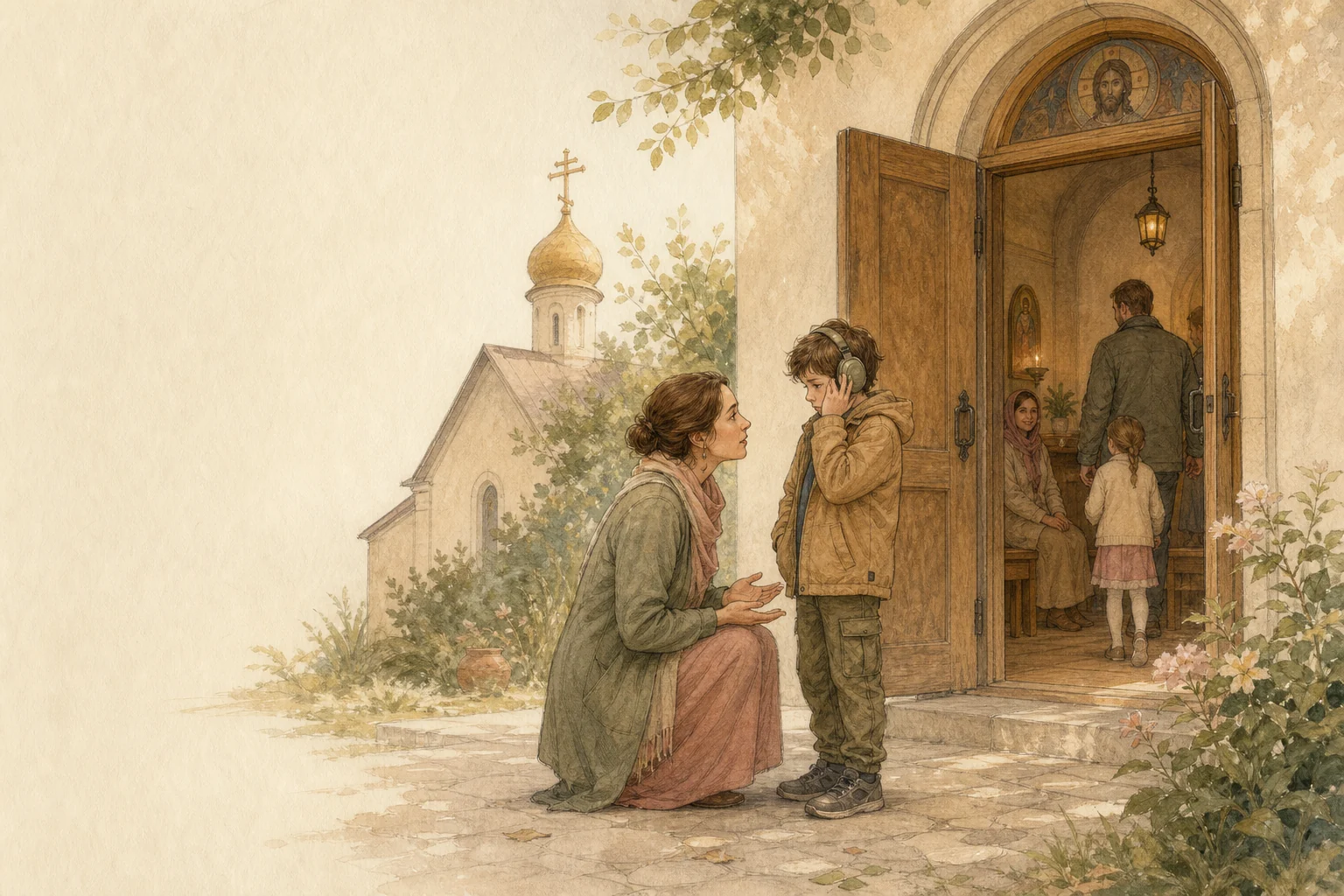
When a child does not want to go to church, do not begin by dragging or calling the refusal unbelief: calmly identify the specific obstacle, remove obvious overload, and agree on one small safe step. “I don't want to” may mean inadequate sleep, hunger, a long service, noise, incense, conflict, shame, fear of Confession, or troubling conduct by an adult.
The parent's purpose is not to produce a beautiful picture at any cost but to preserve the child's relationship with Christ, trust within the family, and safety. The right response may be a short visit, a quiet space, another service, or a temporary pause.
First stop the struggle
When the morning has already become shouting, threats, and physical resistance, a spiritual conversation is nearly impossible. Stop, secure everyone's safety, and move the discussion to a calm time.
Refusing a physical contest does not mean parents have abandoned guidance. It chooses a method in which faith is not remembered as humiliation and helplessness.
Ask what is difficult, not what is wrong with the child
Use concrete questions: “Is waking early hard? Is it too loud? Is standing painful? Did someone hurt you? Are you afraid of Confession?” Allow time for an answer.
Do not argue with the first description. “It is boring” may conceal unfamiliar language, lack of a meaningful role, fatigue, or fear of naming something more serious.
Age changes the reason
A toddler protests changes in routine and limits on movement. A school-age child may be exhausted by unpredictable duration or conflict with peers. A teenager tests freedom, notices adult inconsistency, and asks worldview questions.
One universal command cannot fit every stage. The parent keeps direction while changing the form of help.
Check sleep, food, and clothing
A late Saturday night, early rising, heat, tight shoes, and hunger can make even a beloved activity unbearable. Prepare clothes in advance and evaluate sleep honestly.
Fasting before Communion for children depends on age and health. Do not impose an adult rule of complete abstinence on a young or ill child without pastoral guidance.
How long can the child remain?
A beginner need not immediately endure an entire service. Agree to attend one portion, leave during overload, and expand participation gradually.
Our guide to the length of Orthodox services helps explain the sequence and choose a realistic arrival time.
May a child sit or step outside?
Yes. A tired or unwell child may sit and may leave quietly with an adult. A position near the exit reduces anxiety and avoids pushing through the church.
Our article on sitting during worship gives a balanced explanation. Returning after a break is not defeat.
Noise, smell, and touch
Bells, choir, microphone, crowds, incense, and unexpected touch can be painful for a sensitive child. This is not mere caprice or evidence of spiritual corruption.
Try a less crowded service, hearing protection, a place by the door, a break outdoors, and a route shown beforehand. Ask the parish where a quiet seat is available.
Autism, ADHD, and other needs
A child may need a visual plan, predictable duration, permission to move, a regulating object, or an aide. “Standing like everyone else” is not a measure of faith.
Tell a priest or responsible person about the need without publicly announcing a diagnosis. Seek a concrete accommodation that the parish can actually provide.
When another child caused harm
Take seriously a report of mockery, pushing, humiliation by a teacher, or conflict in Sunday school. Never respond, “That cannot happen in church.”
Record facts, speak with the responsible adult, and separate children if harm continues. Reconciliation can follow only after acknowledgment and safety measures.
When the child fears a particular adult
Do not leave the child alone with that person and do not demand an immediate greeting or Confession. Ask what happened calmly without supplying a desired answer.
A report of intimate touching, threat, demands for secrecy, communication outside safeguarding rules, or attempted isolation requires immediate protection. A possible crime must be reported to appropriate authorities, not only handled within the parish.
Fear of Confession
A child may expect public scolding, disclosure to parents, or pressure to name sins not understood. Explain that Confession is neither an examination nor a tool of family surveillance.
Never interrogate afterward or demand the content spoken to the priest. When a pastoral relationship feels unsafe, a parent may seek another trustworthy priest and discuss the process in advance.
Do not use God as a threat
Statements such as “God will punish you,” “your angel will turn away,” and “you upset the saint” connect faith with anxious control and distort repentance.
Speak truthfully about actions and consequences while preserving the image of God to whom a person may return. A mistake never removes a child's right to love and help.
Examine the adults' example
A teenager sees when parents demand worship but humiliate people at home, lie, or use prayer as punishment. The protest may question authenticity rather than merely reject authority.
The best response is not defense of reputation but an admission: “I also act wrongly and need to change.” Adult repentance restores weight to words.
A small-step plan
On the first visit, come for ten minutes, show the space, and leave before exhaustion. Next, choose one calm part of worship, light one candle, and state the departure time in advance.
After success, do not immediately double the requirement. Repeat the familiar step until safety becomes predictable.
Give the child a meaningful role
The child might locate the feast icon, hold a text, hand a prayer list to the parent, help arrange books, or choose a person for whom the family will pray. A role gives presence meaning.
Do not turn it into a public performance without consent. The ability to decline protects trust.
Sunday school: help or added burden?
A welcoming group can provide friendship and a language for faith. Yet another hour after a long service may be the final overload.
Meet the teacher and learn the format; our Sunday school guide lists questions to ask before enrollment.
What to do with a teenager
Acknowledge that faith cannot be inherited as family property and requires a personal answer. Permit uncomfortable questions and do not demand an immediate approved conclusion.
Agree on limited common participation—perhaps one service within a defined period—and preserve personal conversation. Force may bring a body into the building but cannot create faith.
When parents disagree
Do not argue over the child in the child's presence or force a choice between the believing and unbelieving parent. Define minimum shared rules: safety, respect, and no ridicule.
A mixed family may consult a pastor and a family professional who will not use the meeting to pressure one side.
When a pause is useful
After illness, bullying, family crisis, or panic, temporarily reducing visits may support recovery. A pause need not mean rejection of God.
Keep a short voluntary prayer at home, a walk near the church without entering, or contact with one trusted kind person. Plan the return together.
When to seek a clinician
Panic attacks, severe sensory overload, depression, self-harm, prolonged insomnia, or an abrupt change in behavior require professional assessment. Pastoral conversation and medicine can complement each other.
If a child speaks of wanting to die or cause harm, do not leave the child alone and obtain emergency assistance. Never explain the danger only as “spiritual warfare.”
How to speak with a priest
Arrange a brief meeting away from a crowd and state in advance that the child is anxious. Do not bring the child to an unexpected disciplinary conversation as though meeting a principal.
A good conversation gives the child a voice, avoids shame, and offers one achievable step. If the relationship does not work, consulting another pastor is permitted.
What to say before the next visit
“We will stay for twenty minutes near the exit. If it becomes too loud, we will go outside. Nobody will force Confession or make you kiss an icon.” Keep the promise.
Afterward ask, “What was manageable? What should change?” Do not grade the answer as gratitude or ingratitude.
Frequently asked questions
Must parents make the child go anyway?
Parents give life direction, but physical and humiliating coercion destroys trust; discover the cause and seek sustainable participation.
May the family leave before the end?
Yes, especially during adaptation, illness, or overload. Short peaceful participation is better than crisis.
Are hearing protectors acceptable?
Noise reduction can be a reasonable accommodation; explain its purpose calmly to a worker if needed.
What if the child will not kiss an icon?
Do not force it. A bow, sign of the cross, or quiet presence is acceptable.
Does refusal prove loss of faith?
No. It reports a present experience requiring conversation; one Sunday cannot diagnose a child's spiritual path.
The central message
A refusal to enter church almost always carries a concrete experience rather than abstract “badness.” Listen first, remove overload and danger, and then offer one small understandable step.
Do not sacrifice the child's trust to an external image of piety. A calm parent, safe parish, honest questions, and freedom to answer God gradually create a far stronger road toward church life.