
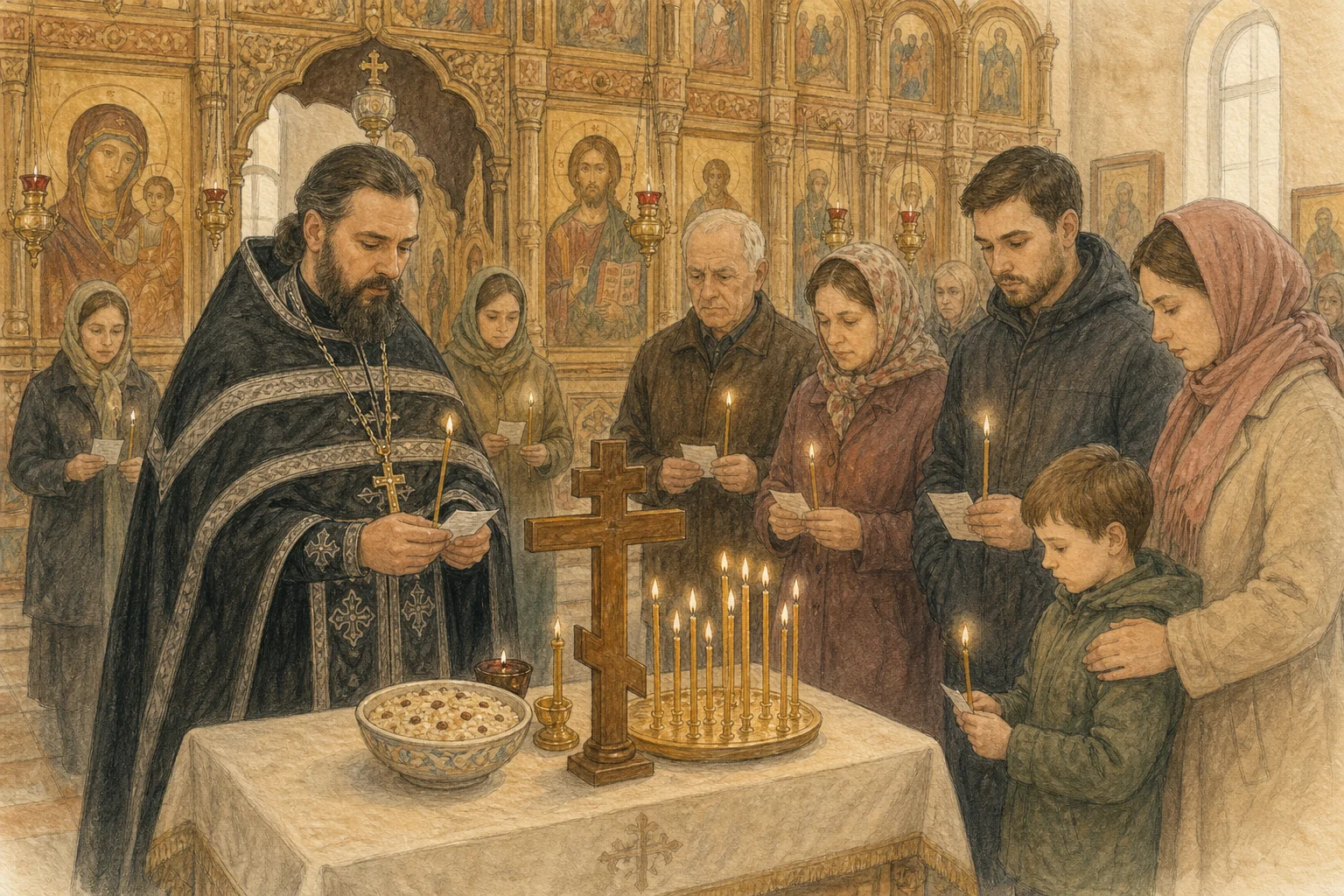
Memorial Saturdays are particular days of Orthodox commemoration when the faithful participate in the Divine Liturgy, submit prayer lists, and pray at a panikhida for the departed. The Russian expression often translated as “parental Saturdays” is not limited to one's mother and father. The Church remembers all departed Orthodox Christians as well as relatives, friends, mentors, and members of the parish.
Most of these dates depend on Pascha and change each year. They should be checked in the current church calendar and the schedule of the particular parish, not copied from an old picture on social media.
Why Saturday is associated with remembrance
In the weekly liturgical cycle, Saturday is connected with rest and the memory of all saints and all the departed. Christ's body rested in the tomb on Holy Saturday before the victory of the Resurrection.
Memorial prayer on Saturday therefore does not remain closed inside sorrow. It looks toward Sunday and confesses that death does not have the final word.
Why they are called parental Saturdays
The name grew from the natural duty of children to pray for deceased parents and ancestors. Yet the remembrance of the Church has always been wider than one household.
A prayer list may contain a spouse, child, friend, godparent, teacher, or any baptized Orthodox Christian. Lack of a blood relationship does not diminish prayer.
Which Saturdays are universal memorials?
Two are called universal: Meatfare Saturday and Trinity Saturday. At their services the Church prays especially for all Orthodox Christians who have departed through the ages, including those whose names and graves are unknown.
“Universal” does not mean a single interreligious observance. It describes the fullness of remembrance within Orthodox worship.
Meatfare Memorial Saturday
This memorial falls before the Sunday of the Last Judgment, also called Meatfare Sunday. The Gospel theme of the coming Judgment is joined to prayer for mercy toward the departed and responsibility among the living.
Its date moves because it is determined by Pascha and the beginning of Great Lent. It should not be confused with the Saturday immediately before Forgiveness Sunday.
Trinity Memorial Saturday
This memorial takes place on the Saturday before the feast of the Holy Trinity, or Pentecost. The Church remembers all the departed in expectation of the fullness of the Holy Spirit and the resurrection of all.
It is the second universal Memorial Saturday. Its distinctive memorial worship commonly begins on Friday evening.
The second, third, and fourth Saturdays of Great Lent
The full Divine Liturgy is celebrated less frequently on weekdays during Great Lent. The Church therefore appoints particular remembrance on the Saturdays of the second, third, and fourth weeks.
These dates preserve regular prayer for the departed in the middle of the Lenten journey. They are not universal in exactly the same liturgical sense as Meatfare and Trinity Saturdays.
Demetrius Memorial Saturday
In Russian church tradition this observance falls before the feast of the Great Martyr Demetrius of Thessalonica on November 8, unless a liturgical coincidence requires a transfer.
It is a Russian pious institution rather than one of the ancient universal Saturdays of the common typikon. It should not automatically be attributed to every Local Orthodox Church.
Other days of particular remembrance
Radonitsa, the commemoration of fallen soldiers, and several local observances are also connected with the departed, but not every one is a “parental Saturday.” The names reflect different histories and liturgical ranks.
Paschal remembrance is discussed separately in our article about Radonitsa.
Why the dates change every year
Meatfare, the Lenten Saturdays, and Trinity Saturday belong to the movable Paschal cycle. When the date of Pascha changes, all the days related to it also move.
Demetrius Saturday is calculated in relation to November 8, but its service can also be transferred when it meets a higher feast. Always verify the actual parish schedule.
When the liturgical day begins
The church day begins in the evening. On the eve of a Memorial Saturday, many parishes celebrate a fuller memorial office called a parastas, followed in the morning by the Divine Liturgy and a panikhida.
Schedules differ. One parish begins the parastas after Vespers, while another holds only a morning memorial. Participation in the service you can realistically attend is better than anxiety about missing part of the cycle.
What a parastas is
A parastas is an extended memorial office that includes the seventeenth kathisma of the Psalter and prayers for the departed. In ordinary parish speech it may be called a great panikhida.
It is not a repeated funeral. No body is present, and the Church is praying for many departed people.
What happens at the Divine Liturgy
Before the public portion of the Liturgy, the priest celebrates the proskomedia and commemorates the names of baptized Orthodox living and departed people. Particles from the prosphora are arranged near the Lamb.
At the end of the Liturgy they are placed in the Chalice with a prayer for the cleansing of those commemorated. Our guide to commemoration at the Divine Liturgy explains this more fully.
How to submit a prayer list
Mark the list for the departed and write baptismal names clearly in the grammatical form used by the parish. Bring it before the Liturgy begins so that it can reach the proskomedia in time.
Surnames, causes of death, biographies, and household nicknames are not needed. If the baptismal name is unknown, ask a parish worker rather than guessing.
Whose names may be included?
Lists for the proskomedia normally contain baptized Orthodox Christians. Personal prayer remains possible for the unbaptized and non-Orthodox, but the facts should never be concealed.
The pastoral boundaries are explained in our separate article on prayer lists for the unbaptized.
Must every deceased relative be listed?
A family may keep a private book of names and transfer a manageable number to a parish list. Do not fear that a person omitted through forgetfulness will be abandoned by God.
The Church also prays for all who have departed before us and whose names are unknown. A very long list should not obstruct parish work or become a subject of comparison.
What to bring to church
The essentials are the names and your own participation in prayer. According to local custom, people may bring koliva, candles, and suitable food for parish charitable distribution.
Ask what the parish accepts and where it should be left. The gift serves living people and the common ministry; it is not food offered to the dead.
Is koliva required?
No. Grain prepared as koliva or kutia expresses hope in resurrection, but the absence of the dish does not make commemoration incomplete.
Do not become anxious about a recipe and do not waste the food. After it is blessed, share it with family members or people who need it.
Must the family visit the cemetery?
A grave visit is appropriate after worship or at another suitable time when health and weather permit. At the cemetery a family may read a short prayer, care for the site, and remember the person quietly.
The journey does not replace the Divine Liturgy. When a choice is unavoidable, church prayer and care for a living vulnerable relative may matter more than distant travel.
What should not be done at the grave?
Do not leave vodka, bread, sweets, cigarettes, or other supposed gifts for the departed. Do not pour alcohol on the ground or invite the soul to a meal.
Give food to someone in need, remove rubbish, and express memory through prayer. A cemetery should remain a place of dignity, sobriety, and peace.
May remembrance take place at home?
Yes. Read a prayer from an Orthodox prayer book, a section of the Psalter, or simply name the departed before God. A candle may be used but is not necessary, and a flame must never remain unattended.
Prayer at home is especially valuable for those who are ill, elderly, or far away. It complements rather than replaces the common Liturgy when church participation is possible.
Is a memorial meal necessary?
A meal can gather relatives after worship, but it is not a required church rite. Keep it simple and sober, without a competition in expense.
Begin with prayer and allow people to speak honestly about memory. Nobody should be forced to make a toast or hide complex feelings.
When the relationship with parents was painful
Prayer for a departed parent does not require calling abuse good or abandoning personal boundaries. A person may ask God for mercy while truthfully acknowledging harm.
No one is obliged to visit a traumatic grave or listen to an idealized account. A priest and a qualified therapist may help join remembrance to safety.
When the parents' names are unknown
An adopted person, someone raised in an institution, or a descendant of a family whose records were lost may pray for “my departed relatives” and for all who have gone before.
God does not need archival precision in order to know a person. Genealogical research may be meaningful, but it is not a condition for prayer.
When no relative can attend
A list may be given in advance through a trusted person or an official parish service. Confirm that it belongs to a real church rather than an anonymous seller of “guaranteed commemorations.”
Pray at home on the day itself. Physical absence does not mean an absence of love.
How to explain the day to a child
Say: we remember people who have died and ask God to give them rest. Do not tell the child that the dead certainly watch every mistake and become offended from another world.
A child may write a known name, light a candle safely with an adult, or recall one kind action. Never force a frightened child to approach a grave.
Work and household tasks
A Memorial Saturday does not turn necessary work, cleaning, or cooking into sin. When possible, make room for worship and reduce distracting entertainment.
Do not quarrel over a supposed ban on laundry or sewing. Mercy toward the living and prayerful remembrance matter more than household superstition.
Frequently asked questions
How many Memorial Saturdays are there?
The answer depends on which universal, Russian, and local observances are included; use the calendar for the particular year.
Which Saturdays are universal?
Meatfare Memorial Saturday and Trinity Memorial Saturday.
May I submit a friend's name rather than a relative's?
Yes, when the friend was a baptized Orthodox Christian.
Is a cemetery visit compulsory?
No. The Divine Liturgy, panikhida, and prayer at home do not depend on a journey.
Can remembrance take place without an expensive donation?
Yes. The amount of a donation does not determine the power of the Church's prayer.
The central message
Memorial Saturdays gather the private memory of a family into the common prayer of the Church. They teach us to remember not only those we knew and loved but also the departed for whom nobody is left to speak a name.
Check the calendar, bring a list before the Liturgy, remain for the panikhida when possible, and perform a work of mercy. Do not replace prayer with a meal, fear, or cemetery magic.