
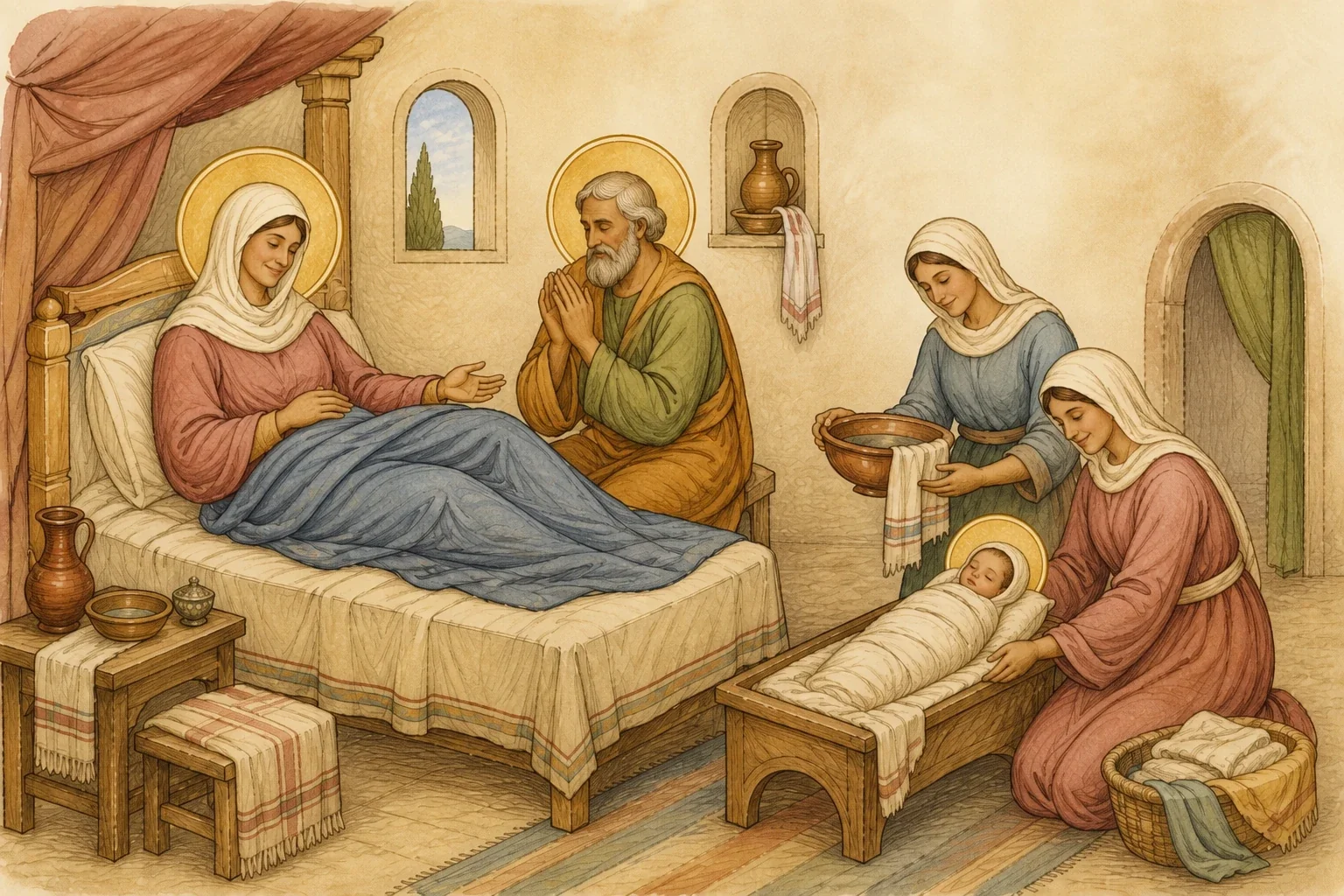
The Nativity of the Mother of God is one of the Twelve Great Feasts, kept on September 21 in the civil calendar used by the Russian Orthodox Church. It commemorates the birth of the Virgin Mary to the righteous Joachim and Anna and opens the sequence of major feasts in the new church year.
The Church rejoices not merely because an exceptional child was born. The one through whom the Son of God would receive a real human nature has entered the world. Yet this feast is not a promise that every long prayer for a child will end in pregnancy, and Mary must never be treated as a means of forcing a desired result.
When the feast is celebrated
The Russian Orthodox Church keeps the Nativity of the Mother of God on September 8 according to the Julian calendar, corresponding to September 21 on the modern civil calendar. It is a fixed feast, so the date does not move from year to year.
It belongs to the Twelve Great Feasts. Its place in the annual cycle can be seen in our guide to the church year and its principal feasts.
Is the event described in the Gospels?
The canonical Gospels do not narrate the birth of the Virgin Mary and do not give the names of her parents. The account of Joachim and Anna, their long childlessness, and the birth of their daughter comes from Church Tradition, reflected in ancient writings, worship, and iconography.
It is therefore more accurate to say “according to Church Tradition” than to present every detail as a direct quotation from Scripture. Making that distinction does not weaken the feast; it teaches us to handle sources honestly.
Who were Joachim and Anna?
Tradition identifies Joachim as a descendant of King David and Anna as a woman from a priestly family. They lived as husband and wife, prayed faithfully, and suffered because they had no child.
The Church calls them righteous not simply because they eventually received what they wanted. Their righteousness is seen in their effort to remain faithful amid shame, loneliness, and the judgment of other people.
Why their childlessness caused particular pain
In the ancient world a child was often regarded as the continuation of a family and an obvious sign of blessing. A childless couple could be humiliated and wrongly treated as though God had rejected them.
The feast overturns that judgment. Joachim and Anna did not lose their dignity during the years of waiting. A modern parish likewise must not measure the worth of a married couple by whether they have children or how many children they have.
How Tradition tells of Mary's birth
Joachim and Anna pray, receive good news, and meet again after a time of separation. A daughter is born and is named Mary. The parents later dedicate her to God.
The central point is not a secret method of conception or a magical rite. It is the providence of God, the fidelity of two human beings, and the birth of the woman who will become the Mother of the Savior.
Why the feast comes near the beginning of the church year
The liturgical year begins on September 1 in the Julian calendar, corresponding to September 14 in the civil calendar. The Nativity of the Mother of God is the first of the Twelve Great Feasts encountered after that beginning.
The arrangement expresses a theological movement. The festal cycle opens with the birth of Mary, through whom Christ enters human history, and reaches its later conclusion in August with the Dormition of the Mother of God.
Why Mary's birth matters for salvation
The Son of God becomes truly human, not merely in appearance or by adopting a temporary role. From Mary he receives human nature, a genealogy, a body, and life within a human family and society.
Her birth prepares this meeting of God and humanity. Its importance is not limited to the happiness of one household; it begins the immediate historical path toward the Incarnation.
Was Mary free when she gave her consent?
Yes. Her birth and upbringing do not erase her personal freedom. At the Annunciation she gives the Archangel a conscious answer of trust and obedience.
God does not use a person as a passive instrument. This essential freedom is explored further in our article on the meaning of the Annunciation.
Does the Church worship Mary as a goddess?
No. Orthodox Christians worship the one God and honor Mary above the other saints as the Mother of the incarnate Son of God. They ask for her intercession but do not consider her the source of divinity.
The title “Mother of God” first safeguards the truth about Christ: the Jesus born from Mary is truly God and truly human. The title is Christological before it is devotional.
What the feast says about the dignity of a child
Mary has not yet performed any work or achieved anything, yet her birth is already greeted with joy. A child's worth does not depend on success, convenience to adults, physical ability, or a future profession.
This truth obliges families and parishes to protect children, listen to them, and refuse every attempt to turn a child into a spiritual project for adults. Religious language can never justify humiliation or violence.
What the feast says about older parents
Joachim and Anna remind us that age does not make a person insignificant before God. Their story, however, is not a command to pursue pregnancy at any cost and does not condemn a family's medical decisions.
The Church can support couples with prayer, discreet presence, and practical help. It should not ask intrusive questions or promise a particular outcome in exchange for a prayer, pilgrimage, or donation.
When a family is facing infertility
People may and should pray, but prayer is not a contract requiring God to provide a child. Examination and treatment by competent medical professionals do not contradict faith.
Do not tell a couple that they simply need to pray harder. Do not blame the woman or call a diagnosis a punishment. Decisions about treatment, adoption, foster care, or life without children require freedom, time, privacy, and careful pastoral guidance.
When there has been pregnancy loss
The joy of this feast can be painful for someone who has experienced miscarriage, stillbirth, or the death of a child. A grieving person is not required to perform happiness and may step out of a service if the emotions become overwhelming.
What is needed is gentle prayer, appropriate medical care, and steady human support. Phrases such as “God needed another angel” or “you can have another baby” cause harm and do not explain the mystery of suffering.
How to read the festal icon
In the icon, righteous Anna is commonly shown reclining after childbirth. Attendants prepare water or care for the mother, while the infant Mary is washed or shown wrapped in swaddling bands in a cradle.
Joachim may appear apart in a posture of prayer. Domestic details affirm the reality of the birth, while the halos and calm composition reveal its place within the history of salvation.
Why childbirth scenes appear in the icon
They do not turn the icon into a medical illustration. The Church confesses that Mary was truly born as an infant and that Anna's motherhood was bodily, ordinary, and human.
This keeps Christians from despising the body, childbirth, or the daily labor of care. At the same time, the icon remains modest and never turns a sacred event into a spectacle of curiosity.
How the services are celebrated
On the eve, a parish will normally celebrate the All-Night Vigil with festive hymns, and the Divine Liturgy follows in the morning. The hymnography calls Mary's birth joy for the whole inhabited world and the beginning of salvation.
Always verify the exact time in the parish schedule. When the feast falls on a working day, attending the evening service may be the realistic way to enter the celebration.
Is there a fast on this feast?
The date does not fall within one of the four extended fasting seasons. If September 21 is a Wednesday or Friday, the festal rule commonly permits fish, although the calendar and local parish guidance should be checked for the particular year.
Medical diets, pregnancy, breastfeeding, childhood, and frailty require sensible adaptations. Fasting must not damage health or become a competition in severity.
Preparing for Holy Communion
Holy Communion is the center of the Divine Liturgy, not a prize attached to a holiday. Preparation includes prayer, repentance, the Eucharistic fast, and the discipline received in one's parish.
If you have been away from Communion for a long time, speak with a priest in advance. Do not postpone the conversation until the moment immediately before approaching the Chalice.
What may be included in prayer
We may thank God for the gift of life and ask for peace in a family, patience in waiting, protection for children, and strength for parents. A couple longing for a child may bring that sorrow before God honestly.
There is no guaranteed formula or deadline. Christian prayer changes our relationship with God and opens us to grace; it does not compel God to carry out a private script.
Are Joachim and Anna patrons of family life?
Orthodox Christians often ask their intercession in family needs and honor them as an image of marital fidelity. This is healthy when it does not become a magical system assigning each saint a guaranteed specialty.
Their intercession does not replace honest conversation between spouses, medical care, psychological support, legal protection, or responsibility toward one another.
Must a child be named Mary or Anna?
No. The feast does not require a particular name. Parents choose a name, while the heavenly patron and name day can be clarified from the calendar and the practice of their parish.
What matters is not the rarity or prestige of a name but love, Baptism, formation without humiliation, and room for the child gradually to make faith personally meaningful.
May Christians work and do household tasks?
Necessary employment, caring for an infant, preparing food, and looking after someone who is ill are not sins. A feast asks us to make room for prayer; it does not ask us to fear every ordinary task.
There is little value in postponing laundry out of fear and then quarreling with the family. Peace, mercy, and faithful participation matter more than a calendar superstition.
Folk signs and fertility rituals
Weather predictions, fortune-telling about marriage, special actions said to cause conception, and bans on touching particular objects do not belong to Orthodox worship.
Do not leave food before icons or carry blessed objects as charms. A candle, an icon, and prayer direct the heart toward Christ; they do not manipulate circumstances automatically.
Explaining the feast to a child
Say simply: today the Church rejoices because Mary, the future mother of Jesus, was born. Look together for the infant, Anna, Joachim, and the people helping the family in the icon.
You might view family photographs, thank God for older relatives, or help a household caring for a new baby. Discussions of infertility should be adapted carefully to the child's age and questions.
Frequently asked questions
On what date is the Nativity of the Mother of God?
It is September 21 in the modern civil calendar followed by the Russian Orthodox Church.
Is the event found in the Bible?
The canonical Gospels do not describe it. The account is preserved in Church Tradition.
May I ask the Mother of God for a child?
Yes, while also seeking medical care and refusing to treat the outcome as a measurement of faith.
Is all work forbidden?
No. Attend worship and reduce needless bustle when possible, but necessary labor and care remain good.
Why is this feast called the beginning of salvation?
Mary's birth opens the immediate historical path toward the Incarnation of Christ.
The central message
The Nativity of the Mother of God joins the joy of a household to the hope of the whole creation. The daughter of Joachim and Anna will become the Mother of the Savior, yet her path begins in the ordinary vulnerability of an infant who needs human care.
Celebrate without magic and without pressure on people whose family story is painful. Give thanks for life, protect children, support parents, and meet Christ in the Divine Liturgy and in works of patient love.