
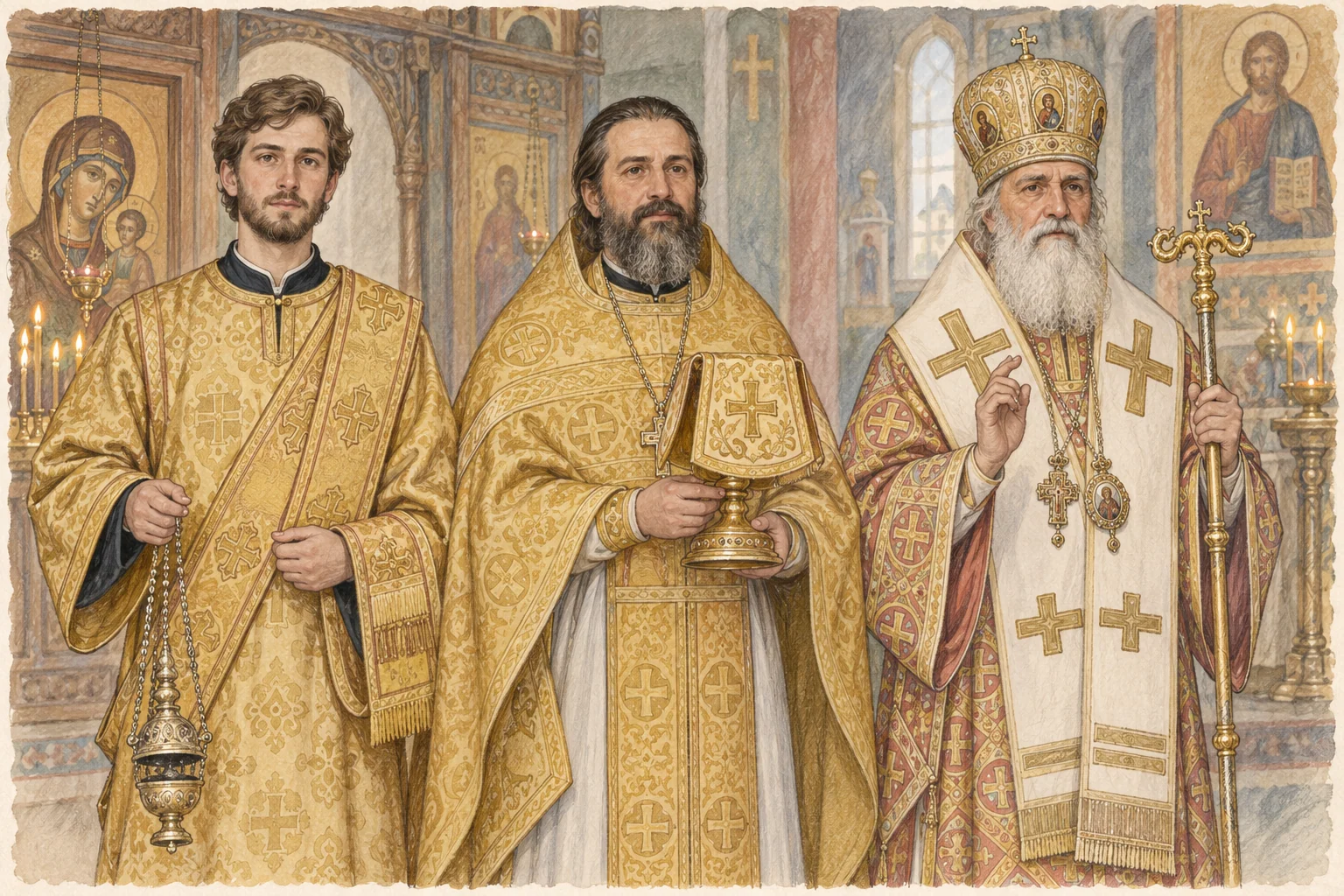
Deacons, priests and bishops have different ministries in the Church. These are not three grades of personal holiness or three levels of education. An experienced man may remain a deacon; a newly ordained priest is not expected to know the answer to every practical question. Ordination identifies responsibility, not universal expertise or freedom from mistakes.
The deacon: service and assistance
During worship, a deacon voices the petitions of the litanies, reads the Gospel and assists the bishop or priest. He does not independently preside at the Eucharist or hear sacramental confessions as a priest does. His work can also include education, charitable projects and support for parishioners. It is not simply a matter of having a good singing voice.
If you need confession, ask a deacon which priest to approach. He can help you find the right person without assuming another ministry. Not everyone wearing a sticharion is a deacon: readers and altar servers may also wear liturgical clothing. Clothing alone is therefore not a reliable guide.
The priest: pastoral care in the parish
A priest is also called a presbyter. He celebrates the Liturgy and other services, preaches, hears confessions and cares for the parish in communion with his bishop. Rector is an appointment: it identifies the clergyman entrusted with leading a particular church or community, rather than a separate order of ordination.
After a service, briefly explain what you need: “I would like to prepare for Baptism,” or “Could we arrange a private conversation?” A serious family problem is not best discussed in a queue of people waiting to venerate the cross. Agreeing a time protects privacy and avoids expecting an immediate answer from someone who may be tired or occupied.
The bishop: responsibility for unity
A bishop oversees the church life entrusted to him and performs ordinations. Archbishop, metropolitan and patriarch are titles within the episcopal ministry and the Church's arrangements for governance; they are not additional sacraments beyond being a bishop. Church leadership cannot be understood simply as an ascending list of impressive titles.
Not every parish question needs to go directly to a bishop. Arrangements for classes and prayer requests are normally clarified locally. Respect for ordination does not, however, prohibit questions or the reporting of a serious problem to responsible church authorities. Religious authority does not cancel human dignity or the need for safe interactions.
How to address clergy
Father followed by the person's name is a customary way to address a priest in English. Father Deacon is also used for a deacon. In Russian parish speech, bishops are commonly addressed as Vladyka. If you do not know someone's name or order, an ordinary courteous greeting is entirely appropriate. Uncertainty about a title should not prevent you from asking for assistance.
A request for a blessing is different from a request for expert advice. Clergy can help with the spiritual dimensions of a situation, but ordination does not automatically confer medical, legal or therapeutic expertise. Distinguish the responsibilities: discuss treatment with a clinician and the spiritual experience of illness with a priest. This distinction supports responsible pastoral care rather than diminishing it.
A monk is not necessarily a priest, and a priest is not necessarily a monk. Addressing someone as Father therefore does not tell you every detail of their ministry. If you need a particular sacrament, ask directly who administers it in the parish. This is more reliable than judging someone's role by age, beard or clothing colour.
Ordination, appointment and parish work
Many parish responsibilities do not require ordination: arranging appointments, helping with books or organizing a charitable visit. A lay person entrusted with a task may know it thoroughly without becoming a priest. Conversely, ordination does not mean that someone personally handles every administrative message. For an organizational question, find the person responsible rather than automatically seeking the most senior member of the clergy. Clear responsibilities allow people to serve together.
This prevents mismatched expectations. A parish worker giving you an appointment time is not offering spiritual direction; a priest suggesting a conversation after worship has not necessarily approved every detail of an event. Clarify what has been agreed and who takes the next step. Respect for church order can then take the form of understandable cooperation instead of guessing someone's authority from their clothes or from the way other people address them.
Why ministry is not private power
The OCA's account of Holy Orders emphasizes Christ's continuing action in the Church rather than a clergyman replacing an absent Christ. This sets an important boundary: gratitude to a pastor does not require treating him as the source of salvation or assuming that he knows every hidden circumstance. You can respectfully ask for an explanation of advice and disclose relevant facts that the person advising you does not yet know. Honest communication belongs within pastoral care.
When reporting serious misconduct, separate what you observed from what you infer. Record what happened, when, and whom you have already approached, without unnecessarily publishing other people's private information. Ordination does not cancel responsibility for harm. Immediate danger calls for appropriate assistance rather than waiting for an internal exchange of messages to finish. At the same time, an ordinary disagreement about a timetable and a report of a threat require different responses. Keeping the distinction clear helps a concern reach the people able to address it.