
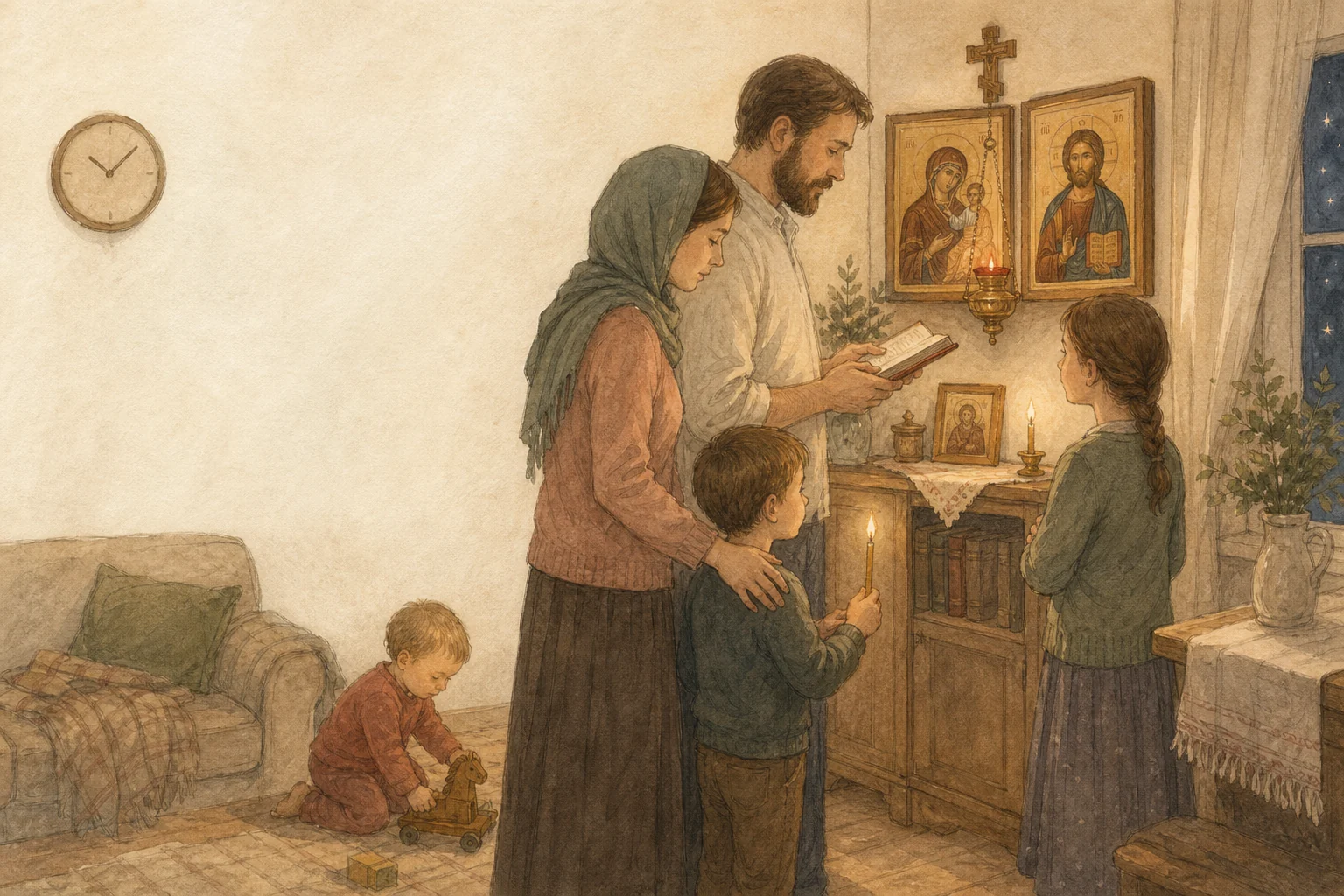
Begin family prayer with three to five peaceful minutes at one predictable time: make the sign of the cross, say the Lord's Prayer, name one thanksgiving and one request, and end by blessing the children. A short prayer the household can actually keep is better than a long rule that becomes a daily struggle.
A child is not required to stand still like an adult. A toddler may sit with a quiet toy, a school-age child read one line, and a teenager choose a petition or sometimes remain present without answering publicly.
Why a family prays together
Common prayer teaches the household to see itself as more than a practical arrangement: these are people who receive life from God and carry responsibility for one another. It creates space for thanksgiving, forgiveness, and hope.
Prayer does not automatically make relationships healthy. It should lead people to admit wrong and perform good rather than cover unresolved violence or coldness with religious language.
How to begin today
Choose a moment when nobody is rushing: after supper, before sleep, or on a weekend morning. Tell the family in advance that the first prayer will take only a few minutes.
Stand or sit near the icons, silence the phone, and begin. Avoid a long introductory lecture; the experience of peaceful prayer explains more.
A five-minute order
Make the sign of the cross, let one adult say, “Glory to you, O God,” pray the Lord's Prayer together, and invite each willing person to name one gratitude and one request. End with a short prayer for the household.
If even this is too much, keep the sign of the cross, the Lord's Prayer, and one sentence of thanks. Expand only after the small pattern has become stable.
Where to pray
A permanent clean corner with an icon of Christ, the Theotokos, a cross, and a prayer book is helpful. Do not turn it into crowded souvenir storage or place open flame where a child can overturn it.
Our guide to arranging a home prayer corner explains the practice without superstition or excessive demands.
When to pray
A repeated connection works better than random inspiration: after brushing teeth, before a bedtime story, or after Saturday dinner. The time must fit the family's real life.
Do not choose the youngest child's point of complete exhaustion and do not wake everyone to preserve a perfect record. The purpose is encounter with God, not schedule control.
Which prayers to choose
Begin with the Lord's Prayer, the Trisagion, a short prayer to the Guardian Angel, or one troparion of the feast. Use a trustworthy Orthodox prayer book.
Do not mix random spells, “prayers for luck,” and Orthodox texts. A formula promising a guaranteed result after an exact number of repetitions requires careful rejection.
May the family use personal words?
Yes. After a church prayer, address God, give thanks for something concrete, and ask for help without demanding control over another person.
Our article on prayer in one's own words shows how personal speech and the prayer of the Church belong together.
Giving children a role
Offer one small, real task: switch on an electric candle, open the book, name a relative, choose the feast icon, or say, “Lord, have mercy.”
The role must not become a test. When a child remains silent, an adult may simply appreciate the child's presence and continue without shame.
When a toddler will not stand still
For a two- or three-year-old, several minutes are already significant. Allow sitting in a parent's arms, looking at an icon, holding a soft toy, or moving quietly nearby.
Do not measure prayer by stillness. Gradually the child will remember gestures, familiar words, and the family's calm atmosphere.
When a school-age child is distracted
Shorten the text, take turns reading, and explain one unfamiliar word after the prayer. Do not make every movement the occasion for correction.
A visual sequence with three simple symbols—cross, prayer, thanksgiving—can show when the gathering will end and reduce uncertainty.
When a teenager refuses
Ask without interrogation what is difficult: coercion, adult hypocrisy, boredom, unfamiliar language, conflict with the Church, or a need for privacy.
Offer silent presence, one shared day each week, or private prayer. Forced recitation rarely creates faith, while an honest conversation protects relationship.
When only one parent prays
Do not recruit the child against the other adult or ridicule an unbelieving spouse. Agree on a peaceful time and respect each person's right not to participate.
One parent may pray openly and briefly with children without building a secret alliance. Respect within the family is itself a witness to faith.
Different church traditions in one family
Discuss which prayers are acceptable and never force someone to violate conscience. Shared gratitude to God may provide a beginning, but real differences should not be concealed.
Questions about children's participation in sacraments require honest agreement between parents and pastoral guidance, not one spouse's victory through pressure.
Prayer after a family argument
Do not immediately assemble everyone and use prayer to force an offended person into reconciliation. First stop shouting, secure safety, acknowledge harm, and allow time to settle.
Later prayer may include, “Lord, help us tell the truth and repair what we have done.” Forgiveness does not cancel boundaries or consequences.
When violence is present
Common prayer must never keep a victim in danger or demand endurance of assault. In a threat, move to safety and contact emergency services and people able to protect.
A priest can offer support, but crime and medical injury require appropriate care. “Pray more” is not a replacement for safety.
Prayer for someone who is ill
Name the person, ask for mercy, wisdom for clinicians, and strength for caregivers. Do not promise children that prayer will certainly produce recovery.
Continue treatment and practical help. A child must know that slow or absent recovery does not mean someone prayed badly.
Candles and fire safety
For a family with small children, an electric candle or enclosed lamp placed out of reach is safer. A real candle requires constant adult supervision.
Keep flame away from curtains, paper decorations, and unstable shelves. Reverence includes care for the home.
Phones and audio recordings
A prayer app is acceptable when notifications do not interrupt. Use airplane mode or open the needed page in advance.
An audio recording can teach a hymn but should not replace every living voice in the family. Do not film a child's prayer for public posting without consent.
After missing several days
Do not compensate with a triple rule or declare the family spiritually defeated. Return at the next normal moment with a brief prayer.
Stability grows through returning rather than a perfect streak. Our beginner's prayer rule helps choose a sustainable measure.
Connecting home and church
At home, look at the Sunday Gospel, name the feast, and check the service schedule. In church, the child will recognize words first heard in safety.
Sunday school may also support the household; learn about the confirmed format at our parish in the guide to parish Sunday school.
A sample beginner week
On weekdays, keep one three-minute evening prayer. On Saturday, read a short Gospel passage; on Sunday, participate in the Liturgy according to the family's capacity.
After two weeks, ask everyone what helps and what remains too difficult. Shortening is not defeat when the direction toward God remains.
Frequently asked questions
Must the whole family pray every day?
A daily rhythm is valuable, but begin with sustainable frequency and never turn a missed day into punishment.
How long should prayer with children last?
Three to five minutes is enough at first; age, fatigue, and health matter more than a formal quota.
May people sit?
Yes, when a child or adult is tired, ill, or better able to attend while seated.
What if a child does not repeat the words?
Allow silent presence and offer one small role without pressure.
May a family pray without a lamp?
Yes. A light may support attention but is never a condition for prayer.
The central message
Family prayer begins not with a large obligation but with a safe, brief, repeatable turning toward God. There is room for an adult, a teenager, an active toddler, thanksgiving, petition, and silence.
Preserve freedom, never hide violence behind prayer, return after missed days, and join words to reconciliation and care. Then the home rule becomes not a scene of control but a school of trust in God and one another.