
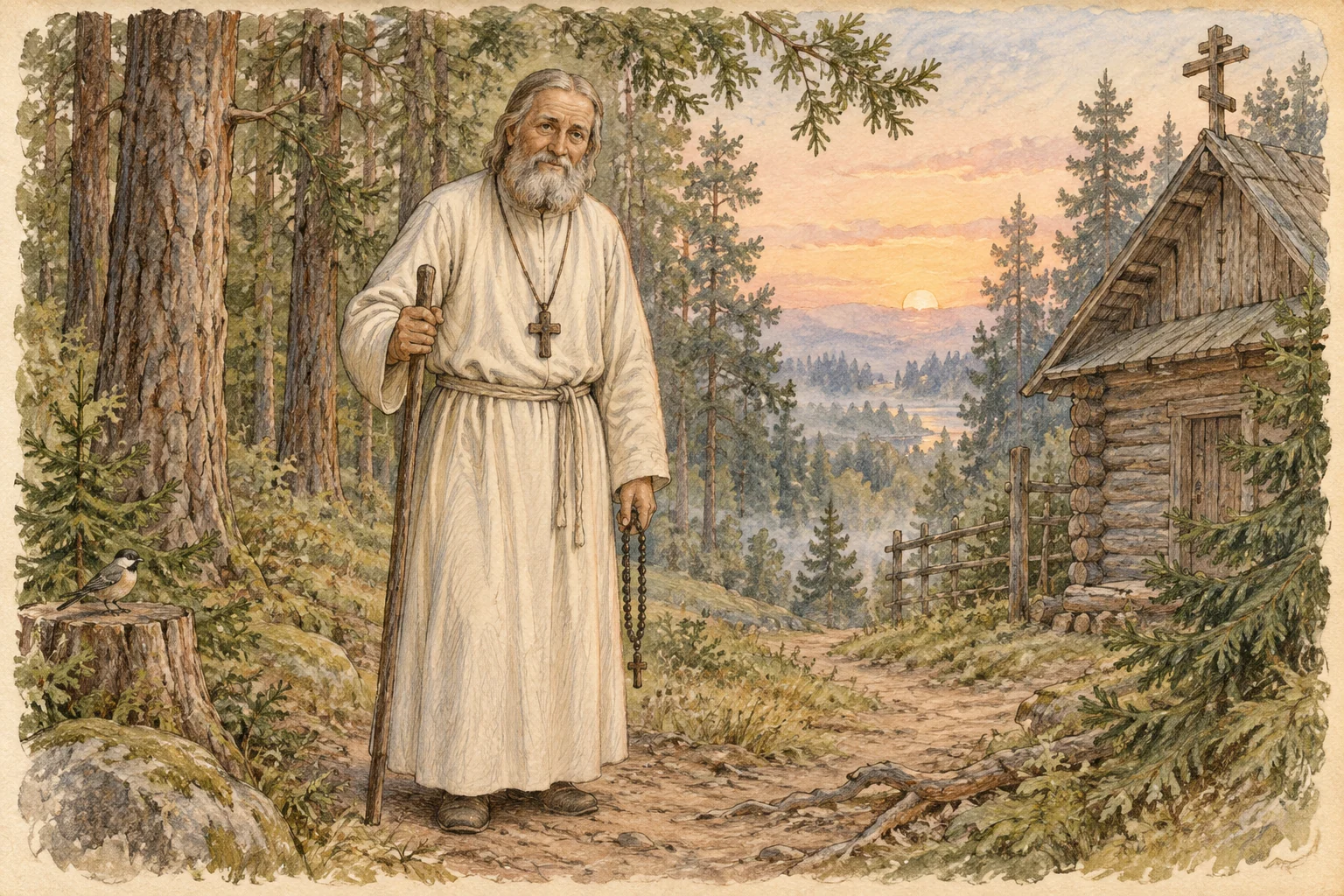
Seraphim of Sarov is often recognized as an elder who received people with peace. That ministry grew out of a long life of prayer, work and monastic obedience. His legacy cannot be reduced to a few encouraging sayings: it belongs to a Christian understanding of salvation, not a promise of permanently pleasant feelings.
From Prokhor to the monk Seraphim
The future saint, born Prokhor Moshnin, came from Kursk. He entered the monastery at Sarov in 1778 and received monastic tonsure in 1786. His early years included ordinary work within the community. He was later ordained a priest and spent periods in solitary prayer.
His Life describes severe trials and prolonged seclusion, followed by a ministry of receiving people seeking spiritual help. Readers should not jump straight from childhood to miracles: his service involved time, patience and faithfulness to a calling. This is not an account of instantly acquiring extraordinary abilities.
Prayer and attention to others
The Church remembers Seraphim for concentrated prayer together with sensitivity to other people's suffering. He is also closely associated with the spiritual life of the Diveyevo community. These aspects should not be opposed: withdrawal from distraction does not mean contempt for people, and care for others is more than practical advice alone.
An ordinary parishioner can make a modest application: set aside a small, sustainable time for prayer and become more attentive to someone nearby. Exceptional physical austerities or prolonged isolation should not be copied without discernment. A saint's life is not a universal instruction manual identical for a monk, a teenager, a sick person and a parent of small children.
Understanding the spiritual legacy
The well-known conversation transmitted by Nikolai Motovilov connects the purpose of Christian life with acquiring the Holy Spirit. This is not the accumulation of unusual sensations but life in God's grace. Prayer, fasting and good works must not become methods for claiming spiritual superiority over others.
Look for a popular saying in a complete text identifying its record and edition. An image captioned “Seraphim of Sarov” does not prove authorship. Even an accurately transmitted saying can be misused as a rebuke to someone in distress: inner peace does not prohibit tears, exhaustion or seeking professional assistance.
Commemorations and reading his Life
Seraphim died in 1833 and was canonized in 1903. In Russian calendar practice, the best-known commemorations are civil January 15 and August 1, corresponding to January 2 and July 19 Old Style. Check the calendar separately when visiting a community following another practice.
Begin with a consecutive account of his life, then read a short passage of teaching in full. Notice not only extraordinary events but the moral questions: how to avoid answering with irritation, how to care for someone vulnerable, and how not to assume the role of a spiritual director yourself. Accounts of healing belong to the Church's remembered testimony; they do not promise the same outcome to every sick person. They must never be used to stop treatment or to blame someone for their illness.
If a teaching is puzzling, formulate a precise question rather than deciding you are incapable of spiritual life. Ask whom the words address and what circumstances they assume. A priest or teacher may help. Respect for a saint is entirely compatible with admitting that the language or context of a text is not yet clear.
The Aim and the Means of Christian Life
The conversation transmitted by Motovilov distinguishes the aim of Christian life from the practices that serve it. A list of completed prayers does not fully describe someone's relationship with God. A prayer rule matters, but completing it must not become a reason to despise someone who knows less or prays differently. The question concerns not just the amount accomplished, but the One for whom it is done.
Consider someone who has set aside time to read and becomes irritated when a relative needs essential help. It is not enough to label every interruption an obstacle to spiritual life. Distinguish an idle distraction from a real need, offer assistance, and return to prayer afterwards. This is an example of reflecting on the conversation, not a new rule attributed to Seraphim. A sustainable prayer practice takes responsibilities and personal strength into account.
Peace Is Not Indifference
When speaking about Seraphim and peace, ask what you mean by calmness. One person restrains a sharp reply to avoid hurting someone; another simply refuses to notice suffering. Both may be silent, but their silence means different things. Seeking peace does not require accepting falsehood. It is possible to disagree without humiliation, acknowledge your own mistake, or postpone a difficult discussion until you can listen more attentively.
For personal reading, choose a short, complete passage and write down one question it raises about your life. A few days later, return to that question instead of assessing unusual sensations. Did you keep a promise, notice a relative's exhaustion, or ask forgiveness? Such reflection does not measure grace or assign a degree of holiness. It helps prevent elevated language from becoming detached from ordinary relationships, where attention and patience are often most difficult.