
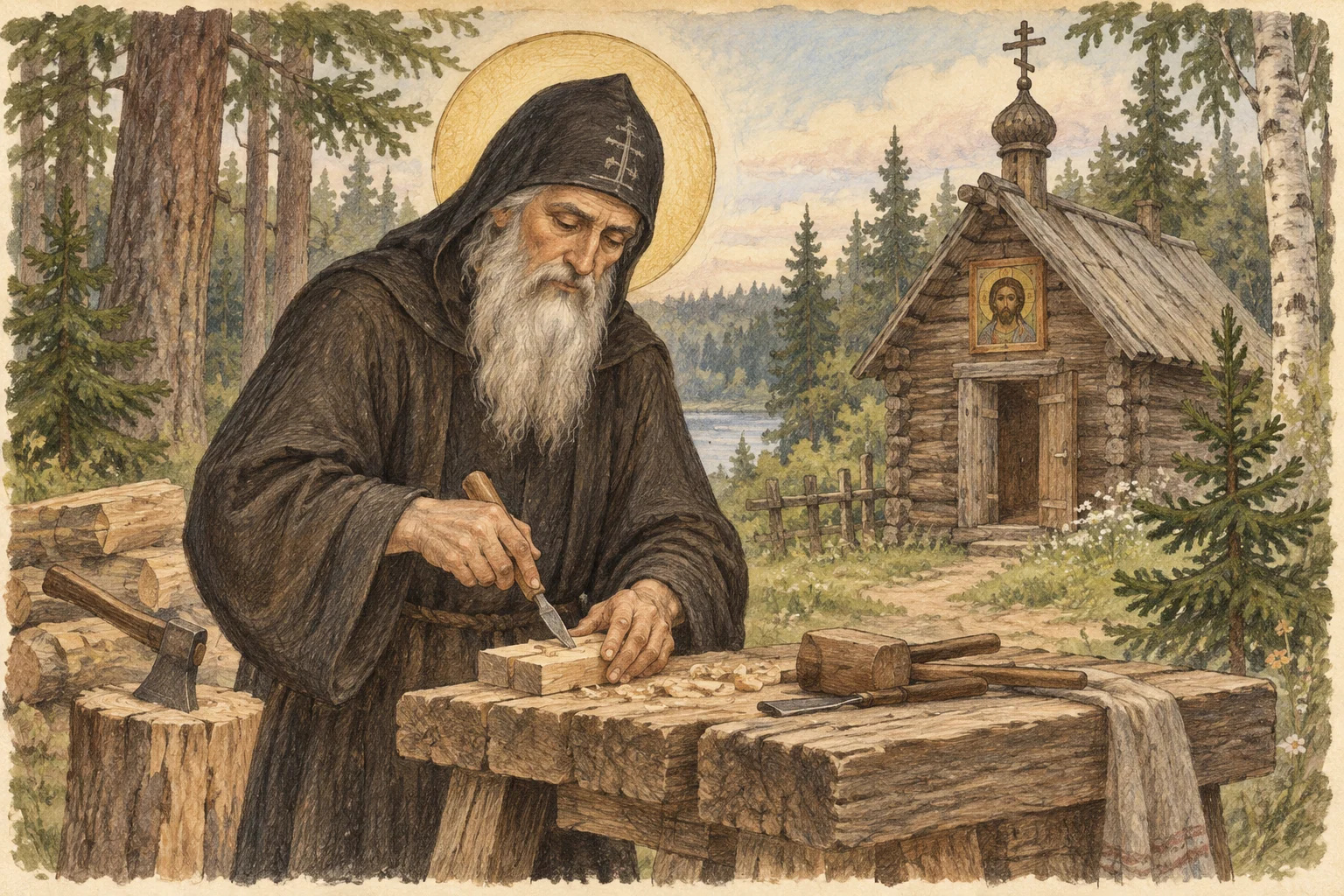
Sergius of Radonezh is known well beyond monastic circles, but his veneration begins with his monastic ministry. He is more than a figure in medieval history. The title Venerable identifies an ascetic whose life was directed towards God through prayer, humility and love for others.
From Bartholomew to the Trinity community
Before his tonsure Sergius was named Bartholomew. His life is associated with the Rostov region and Radonezh; later he and his brother Stephen sought a secluded place for prayer. The community dedicated to the Holy Trinity that developed around him became the foundation of the future Trinity-Sergius Lavra.
His Life describes the abbot's everyday work as well as his prayer. An important movement in the story is from personal solitude to responsibility for other brothers. Gathering people is easier than learning to live together patiently. The monastery is not scenery for an exceptional individual but a place of shared Christian life.
What a community makes visible
Sergius is associated with the strengthening of communal monasticism, joining prayer and work in a common life. His disciples continued monastic ministry in other places. His importance to the Church therefore cannot be measured by one famous historical episode or the number of pilgrims visiting his relics.
A layperson need not turn a family into a monastery to recognize the moral questions involved. How are responsibilities distributed? Who is repeatedly left with the hardest work? Can we ask forgiveness? Shared life tests attractive words against actions: whether a vulnerable person is heard, a promise is kept, or assistance has become a means of domination.
History and hagiographical narrative
A major source for the memory of Sergius belongs to Epiphanius the Wise and the subsequent transmission of the Life. Stories of miraculous help with learning, visions and the blessing of Prince Dmitry Donskoy belong to ecclesiastical tradition and its literary expression. They should not be presented as a transcript in which every conversation is independently documented.
This distinction does not devalue the Life. It respects the genre: the author brings out spiritual meaning, while historians also compare sources and circumstances. Details of military narratives require particular care. A blessing described in a medieval account cannot be converted into automatic church approval for any present-day conflict.
Commemorations and personal reading
Sergius died in 1392. His repose is commemorated on September 25 Old Style, corresponding to civil October 8 in the twentieth and twenty-first centuries. The uncovering of his relics is remembered on July 5/18. Civil dates differ in communities following another calendar, so check the local service schedule.
Read the Life consecutively, choosing one question to consider: how the abbot behaved in ordinary work, how he related to the brothers, or what faithfulness in prayer meant. If your introduction came through a school summary, continue with the ecclesiastical text and commentary. Veneration becomes more substantial when it leads beyond remembering a striking story towards joining faith with patient service to people.
When reading with a child, do not turn Bartholomew's learning difficulties into a promise of excellent marks after prayer. Learning difficulties need attention, patience and appropriate educational support. Asking God's help can accompany effort without replacing it. A child's worth is not measured by reading speed or by how closely their progress matches adults' expectations.
An Abbot Who Works Alongside Others
The account of Sergius's Life includes an episode in which he builds a porch for a brother in return for a few pieces of bread. The narrative does not treat manual work or a meagre payment as beneath an abbot. His position does not remove him from the community's everyday needs. This episode helps readers look beyond the name of a famous monastery to the experience of its early, impoverished brotherhood.
It must not become an excuse for exploitation. A leader who tells everyone to endure hardship while remaining untouched by it has not justified that arrangement by mentioning a saint. In a household or parish project, ask whether the person in charge carries their share and whether others can speak honestly about exhaustion. Shared life becomes visible through a willingness to share the burden, not through everyone repeating the same admirable words.
Solitude and Shared Responsibility
The sequence of the Life prevents us from imagining Sergius simply leaving people behind and never needing them again. Solitude gives way to care for brothers; a personal choice becomes responsibility for a common undertaking. Notice that transition as you read. It explains why a narrative about prayer is also about learning to live together, tolerate differences, and avoid demanding constant convenience.
A modest application concerns shared work. Before a parish event, agree who prepares, who welcomes visitors, and who stays afterwards. Quiet cleaning is as necessary as a visible presentation. Where responsibilities are unfairly distributed, discuss them rather than calling every complaint a failure of humility. This is a contemporary example for reflection, not an attempt to impose a monastic rule on every family. It asks whether a community's declared concern for people is also evident in the work that receives little recognition.