Holy Unction is sometimes surrounded by fear. One person thinks it is only for someone about to die; another expects illness to disappear immediately; another stays away because the service is unfamiliar.
In the Orthodox Church, Holy Unction is a Sacrament of prayer for spiritual and bodily healing. It is neither a prediction of death nor a guaranteed cure. A person brings illness, weakness, repentance and hope into the prayer of the Church.
Holy Unction in simple words
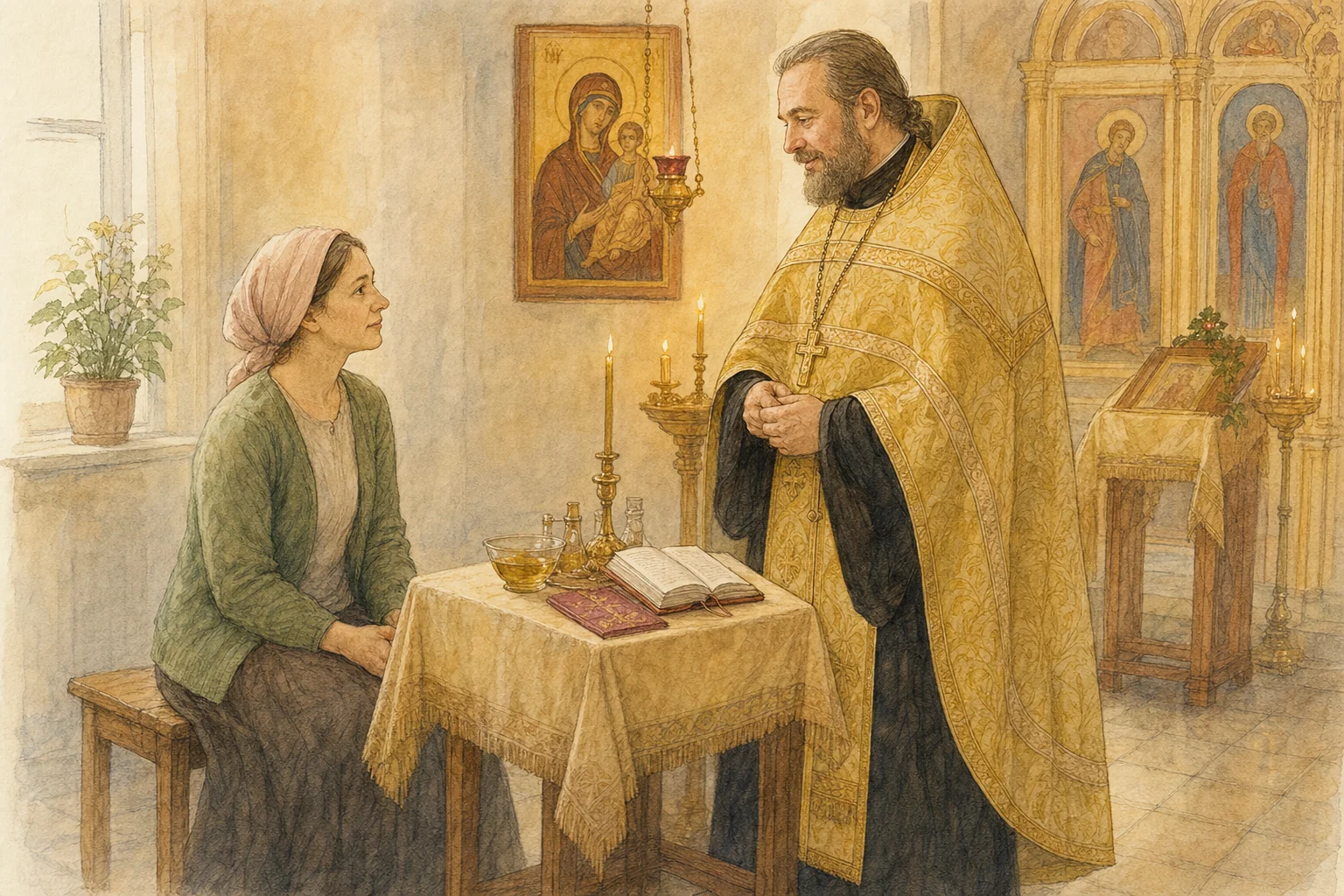
During the Sacrament, passages from Scripture and prayers for healing are read, and the person is anointed with blessed oil.
The Church asks God to forgive sins, strengthen soul and body, give courage in illness and, if it is His will, grant physical recovery.
The oil is a visible sign of the Sacrament. It is not magical or a substitute for medicine.
Why is it called a conciliar service?
The traditional rite is associated with a gathering of priests and contains seven cycles of Scripture readings and prayers. This is why the Russian name Soborovanie refers to a “council” or assembly.
The Sacrament can also be celebrated by one priest, especially in a parish, home or hospital. Its reality does not depend on a participant counting priests or anointings.
It is not only for the dying
The association with death often arose because priests were called to people too ill to come to church. Serious illness is a clear reason for Holy Unction, but the Sacrament itself does not announce that death is near.
Many parishes celebrate a communal service during Great Lent for Orthodox Christians with different illnesses and circumstances.
Do not postpone contacting a priest until a crisis merely because the name sounds frightening.
What kind of healing does the Church seek?
Christian healing is wider than removal of symptoms. A person may need physical recovery, relief from pain, inner peace, courage, reconciliation, patience and freedom from despair.
It is natural to ask honestly for bodily healing. At the same time, we trust God rather than dictate the exact outcome.
Sometimes illness recedes; sometimes it continues; sometimes a person receives strength to live through it in an unexpected way.
Why it does not guarantee a cure
Holy Unction is not a spiritual medical procedure with a predictable result. God is not the executor of a correctly performed ritual.
Promising that everyone must recover after the Sacrament can cause deep pain. No visible improvement does not prove weak faith or make the service meaningless.
Medical care must continue
Do not stop medication, surgery, examinations or professional care because Holy Unction has taken place. Church prayer and medicine are not rivals.
Treatment decisions belong with the treating clinician. A priest offers spiritual care but does not replace a doctor.
Responsible treatment can itself be part of caring for the life God has given.
Forgiveness of sins
The prayers of Unction ask forgiveness for a person's sins. Orthodox teaching particularly speaks of sins forgotten, unrecognised or left outside Confession without a deliberate wish to conceal them.
The Sacrament is not a way to bypass Confession. Deliberately hiding a known sin while expecting Unction to erase it automatically misunderstands repentance.
Holy Unction and Confession
Confession and Holy Unction are different Sacraments. In Confession, a person consciously brings sins before God and receives pastoral guidance and absolution.
Many parishes recommend Confession near a communal Unction service, especially for someone who has been away for a long time. Confirm the timing in advance; a priest may not be able to confess everyone immediately before a large service.
Holy Unction and Communion
Unction belongs within the wider sacramental life of the Church and does not replace the Eucharist. A person may be encouraged to prepare for Communion when health and pastoral guidance allow.
Do not turn the Sacraments into a mechanical checklist. Preparation depends on health, church experience and the priest's advice.
Who may receive Holy Unction?
The Sacrament is celebrated for living, baptised Orthodox Christians. It is not performed for the departed.
Questions about a child's age, another confession, loss of consciousness or other special circumstances require a personal pastoral answer.
Honest information helps the priest offer appropriate care; it is not an examination designed to exclude someone.
Chronic and mental illness
Long illness affects the whole person, bringing fatigue, fear, anger and loneliness. Holy Unction gives space to bring this experience before God with the prayer of the Church.
Depression, anxiety and other mental disorders are not proof of weak faith. Psychiatric care, therapy and prescribed medication should continue.
If there is an immediate risk of harm, seek emergency professional help at once. Spiritual support must not delay urgent care.
What happens during the service?
The rite includes prayers, readings from the Epistles and Gospels, and anointing with blessed oil. In the full order, several cycles are repeated.
Follow the calm instructions given at the parish. You do not need to memorise when to approach or where the anointing takes place.
If standing is difficult, sit down or ask for help. Protecting a sick person's health is not disrespectful.
How long does it take?
Duration depends on the number of participants and priests, and on whether the full rite is celebrated communally or for one person at home.
A communal service can be long. Ask in advance if you require medication, water, seating or rest at particular times.
Spiritual preparation
Come seeking mercy, healing and strength rather than a guarantee. Consider reconciliation where it is possible and look honestly at your life.
If you have not been to Confession for a long time, ask when you may come. You do not need a perfect spiritual report before the first conversation.
A short prayer such as “Lord, help me and teach me to trust You” can be real preparation.
Is fasting required?
There is no single practical rule that fits every patient. The preparation depends on Confession, Communion, health and parish practice.
A sick person should not refuse food, water or medicine when that would harm treatment. Explain medical restrictions to the priest.
Do not copy another person's strict routine. Fasting is a spiritual discipline, not a requirement to become more ill.
What should you bring?
Some parishes ask participants to register their baptismal name or bring a small container of oil or tissues; others prepare everything. Confirm the local order rather than relying on a universal internet list.
Bring necessary medication, water and mobility support. Tell a companion where they are.
Clothing and accessibility
Wear modest, comfortable clothing that does not obstruct the anointing. The parish will explain its practical order.
Inappropriate exposure is not required. Mention a bandage, medical device or mobility limitation in advance.
A person with a disability may ask for a chair, assistance and an accessible way to participate.
Blessed oil is not medicine
Bring oil only if the parish specifically asks. The oil used in the Sacrament is blessed according to the rite; a bottle is not the centre of the service.
Some parishes give participants a little blessed oil afterward. Ask the priest how it should be kept and used.
Do not replace medication with oil, drink it on anonymous advice or treat it as magic.
During and after anointing
Approach without haste and follow instructions. If you feel unwell, say so immediately and sit down.
Missing one anointing or part of a reading is not a dangerous sign. Ask the priest rather than panicking about whether the Sacrament “counted.”
Afterward, thank God without demanding an immediate sensation. Continue treatment and follow any pastoral guidance concerning Confession, Communion and prayer.
Holy Unction at home
If a sick person cannot come to church, relatives may ask a priest about celebrating the Sacrament at home. Do not wait until communication is impossible if the condition is worsening.
Explain the diagnosis, mobility, consciousness and home circumstances. This helps the priest prepare and discuss Confession and Communion as well.
The home does not need to become a perfect ceremonial space. The parish will explain what is actually needed.
Holy Unction in hospital
A hospital visit may be possible when the patient's condition, hospital rules and access for the priest allow it. Coordinate with both the parish and medical staff.
Intensive care and infectious wards may have restrictions. Do not bypass staff or create a safety risk.
If a visit is impossible, ask the priest what prayer and pastoral support are available now.
Serious and palliative illness
For someone gravely ill, Holy Unction may be prayer for healing, peace, forgiveness and a dignified passage through the final stage of life. It is not a declaration that hope has ended.
When the person is conscious, respect their wishes and speak gently. Do not use the Sacrament as a frightening secret ritual performed for the family's anxiety.
Pain relief, palliative care and ordinary human care continue. Spiritual support protects rather than replaces bodily dignity.
How often may one receive it?
Holy Unction is not meant to be repeated frequently from fear that the previous service was insufficient. In many parishes, people take part in a communal service once a year, often during Great Lent.
A new serious illness or special circumstance should be discussed with a priest. Frequency does not make prayer more powerful.
Children and Holy Unction
A child's age and need for the Sacrament should be discussed with the priest. Practice may take account of the child's ability to participate and the medical situation.
Do not frighten a child with talk of punishment or death. Explain simply that the Church will pray, read the Gospel and anoint with blessed oil.
Tell the parish about sensory needs, anxiety, limited stamina or special care.
Donations and online registration
A parish may receive a donation to support worship and parish life. It is not payment for healing or a price for the Sacrament.
If an official online form is available, it may help with registration. A bedridden person, child, unconscious patient or hospital visit still requires direct conversation with the parish.
Common questions
Does Holy Unction mean that death is near?
No. It is a Sacrament of healing for living Orthodox Christians, including those who are not near death.
Must I go to Confession first?
They are different Sacraments. Many parishes recommend Confession nearby in time; confirm the actual order in advance.
Can someone submit my name instead of my presence?
Holy Unction is celebrated over the living person, not remotely by a note. Arrange a home or hospital visit when attendance is impossible.
What if I arrive late?
Quietly ask a parish worker whether you may join. Do not decide alone or panic.
Can Holy Unction be performed for the departed?
No. The Church has memorial prayers for the departed; Unction is for the living.
A calm next step
Check the parish schedule and contact the church. Explain the person's health, ability to stand, medication needs and whether you also wish to discuss Confession and Communion.
Holy Unction is neither a frightening sign nor a promise of a miraculous script. It is the Church's Sacrament of prayer for healing, forgiveness and strength, received with hope while medical care continues and life is entrusted to God.