People often ask about a Sorokoust when someone they love is ill, when a family is anxious, or after a death. The unfamiliar word can bring hope and confusion at the same time: what does forty mean, how is this different from a single note, and does it promise a particular result?
In simple terms, a Sorokoust is continuing commemoration of a person at the Divine Liturgy, traditionally connected with forty Liturgies. It is the prayer of the Church, not a spiritual technique for controlling circumstances.
Who this guide is for
This guide is for newcomers who have seen the term at church, for anyone deciding between a single commemoration note and continuing prayer, and for people worried about writing a name incorrectly.
Parish schedules and practices differ. Use this article as an orientation and confirm practical details with the church where the commemoration will take place.
Sorokoust in simple words
During the Divine Liturgy, the Church prayerfully remembers the living and the departed. A Sorokoust means that a person's name is included in that liturgical commemoration repeatedly over the period established by church practice.
It is not an isolated ritual. It belongs to the prayer of the Liturgy, and every written name represents a real person brought before God.
Why the number forty?
Forty appears throughout Scripture and Church tradition as a period of preparation, testing and spiritual journey. It is not a secret code and does not make prayer automatic.
People sometimes say “forty days,” but the practical meaning may be commemoration at forty Liturgies. Because not every parish celebrates the Liturgy daily, the calendar period may be longer. Ask the parish for the actual order and dates.
What happens during commemoration?
The name is remembered in the prayer connected with the Liturgy and Proskomedia, when the priest prepares bread and wine for the Eucharist and commemorates members of the Church.
Understanding this context helps us avoid treating Sorokoust as a formula separate from the sacramental life of the Church.
For the living
A Sorokoust for the living asks for God's help, strength, peace and salvation. “Health” in church prayer is wider than bodily recovery alone.
One may ask for prayer during illness, a difficult season or an important decision, and also simply out of love. Prayer does not replace medical treatment, responsible choices, reconciliation or practical care.
For the departed
A Sorokoust for the departed joins a family's personal memory and grief with the continuing prayer of the Church.
Church prayer does not require anyone to pretend that loss does not hurt. Grief, tears and the need for support are natural. We remember the departed with love and entrust them to God's mercy.
How it differs from a single note
A single note usually concerns commemoration at a particular service. Sorokoust continues the commemoration across the established number of Liturgies.
Longer does not mean technically “stronger.” The Church does not measure prayer as power. Continuing commemoration preserves loving attention, but it does not guarantee a requested outcome.
Proskomedia, prayer services and memorial services
Proskomedia is a part of each Divine Liturgy; Sorokoust describes repeated liturgical commemoration. A prayer service for the living and a memorial service for the departed are separate services with their own purpose.
If you are unsure what to request, do not search for the “strongest” option. Tell the parish whom you wish to pray for and what is happening.
Whose names are normally written?
Liturgical commemoration notes normally contain the baptismal names of Orthodox Christians. Write names clearly and separate the living from the departed.
If you do not know whether someone was baptised, or a personal circumstance is complicated, ask a priest rather than guessing. You can still remember every person in your private prayer.
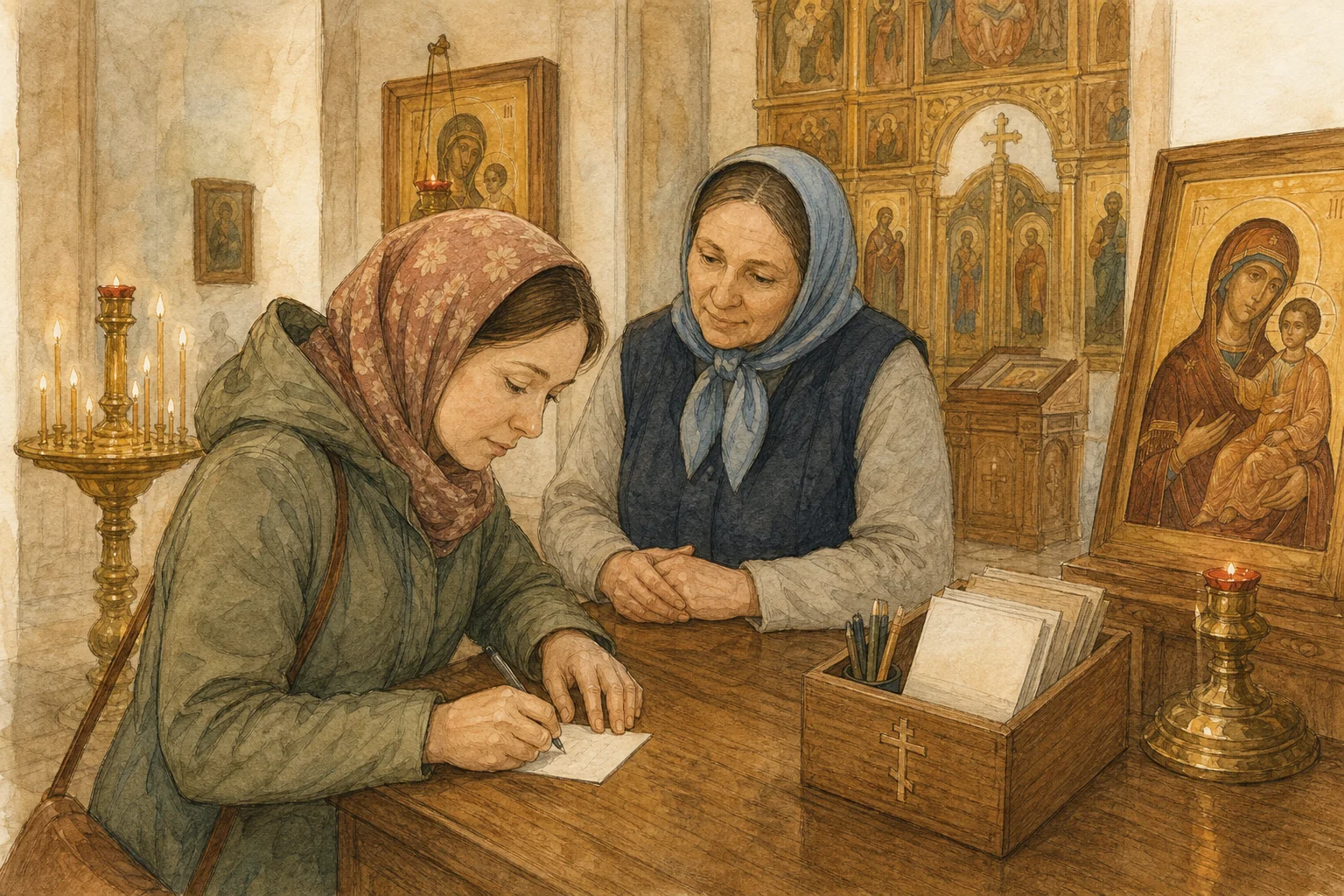
Submitting a Sorokoust
Confirm that the parish receives Sorokoust requests, when the commemoration begins, and how dates are counted. Local practice and the schedule of Liturgies matter.
Check the names carefully before submitting them. A long list is not automatically a deeper prayer; personal attention and acts of love matter.
Should you attend the Liturgy?
If possible, come to the Liturgy and join the parish in prayer. A submitted note can become part of your own participation rather than a task delegated to someone else.
Illness, distance, work and care for relatives can make attendance impossible. Do not turn that into guilt. Pray at home and come when you are able.
Personal prayer and practical love
Remember the person briefly in your daily prayer. You do not need a complicated formula; honest words, gratitude and a request for mercy are a real beginning.
Prayer for the living naturally continues through a phone call, reconciliation, help with treatment or ordinary care. Good works in memory of the departed can also express enduring love.
Why it is not a guarantee
Claims that a Sorokoust must restore a relationship, cure an illness, remove “negative energy,” or change another person's will distort Christian prayer.
God is not the executor of a correctly placed order. We ask for help while admitting that we do not see the whole of another person's life or God's providence.
Prayer may first change the one who prays, teaching patience, mercy, truthfulness and willingness to accept an answer different from the one imagined.
Donations and prayer
A parish may receive a donation with a commemoration note. It supports worship and parish life; it is not a price for God's help.
If money is difficult, speak honestly with the parish. Prayer should not become a financial ordeal.
Common questions
Does it always last forty calendar days?
Not necessarily. The key is commemoration at Liturgies, which may not be celebrated every day. Confirm the dates with the parish.
May I request a Sorokoust in more than one church?
Prayer may be requested in several places, but the number of churches does not turn it into a more reliable technology.
May I submit my own name?
A person can normally request church commemoration for themselves. Ask about local practice if needed.
What if I made a mistake in a name?
Contact the parish and ask for a correction. Do not treat an accidental spelling mistake as a bad sign.
A calm next step
Decide whether you are asking prayer for someone living or departed, check the baptismal name, and contact the parish about its current order.
Sorokoust is not an attempt to force life to follow our preferred script. It is continuing remembrance in prayer, trust in God, and an invitation to become more faithful in love ourselves.