
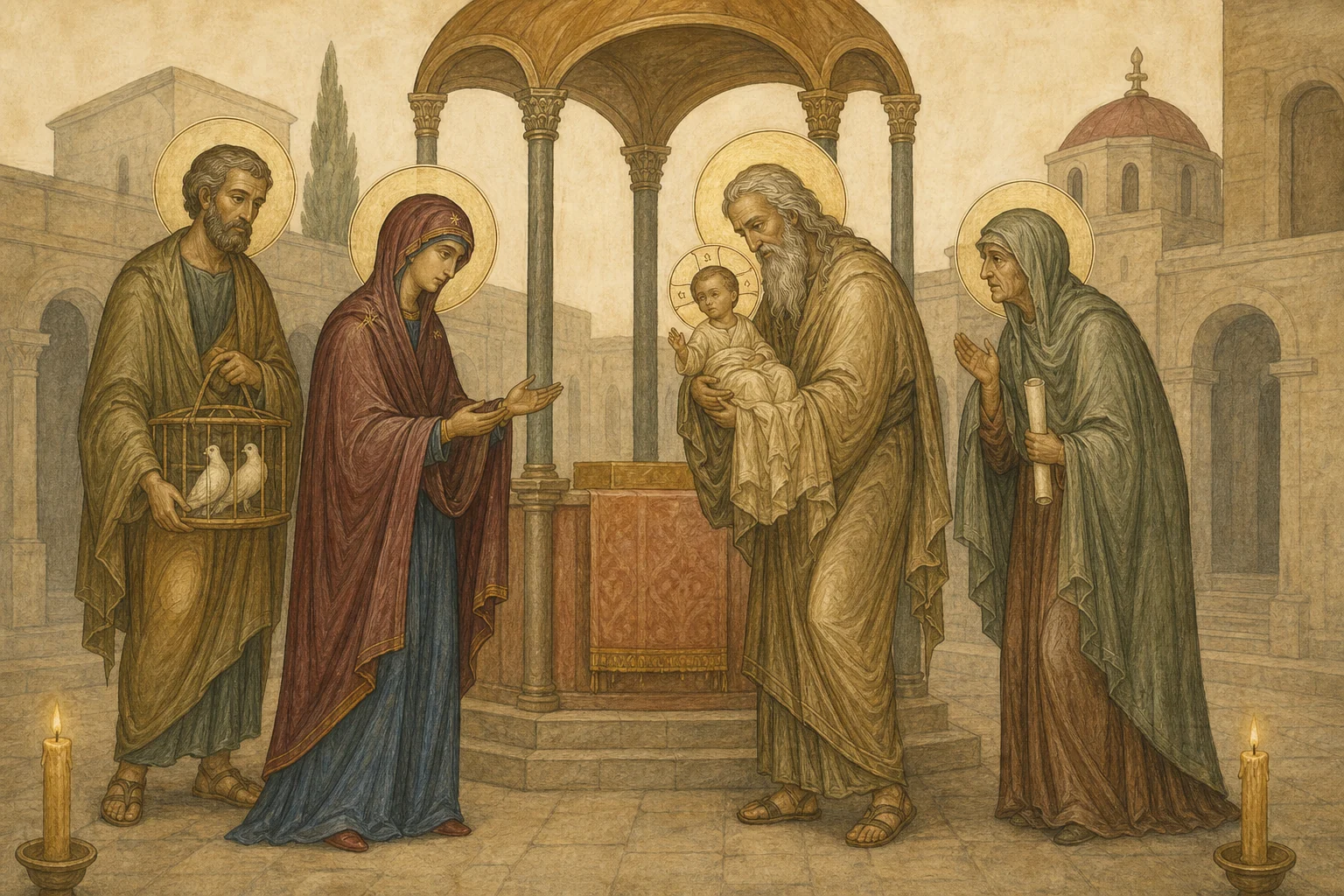
The Meeting of the Lord is the Great Feast celebrated on February 15 in the Russian Orthodox calendar, remembering how Mary and Joseph brought the infant Jesus to the Jerusalem Temple on the fortieth day after Nativity, where the righteous Simeon and the prophetess Anna met Him. The Slavic name of the feast means “meeting.”
The Old and New Covenants, long human expectation and the arriving Savior, Simeon’s old age and Christ’s infancy meet in one event. It is not a feast of fortunate coincidence but the revelation of God whom a person learns to recognize.
What the Gospel narrates
The account appears in Luke chapter two. The parents bring Jesus according to the law concerning a firstborn son and offer a pair of turtledoves or two young pigeons.
Moved by the Spirit, Simeon comes to the Temple, receives the Child, and blesses God. Anna, who had lived many years in prayer at the Temple, also recognizes the Savior and speaks about Him to those awaiting redemption.
Why the fortieth day?
The family fulfills the Mosaic Law after the birth of a firstborn son. Christ, the Lord of the Law, humbly enters human order and receives it.
Forty days carry broad biblical meanings of testing and preparation, but no secret arithmetic is required here. The Gospel reveals the family’s faithfulness and the meeting in the Temple.
What the modest offering reveals
The Law allowed a family of limited means to bring birds instead of a more costly animal. Mary and Joseph’s offering indicates their simple material circumstances.
God enters the world without privilege. Poverty does not make the family less worthy and reminds a parish not to value people by donation size.
Who is Simeon the God-receiver?
Luke calls him righteous and devout, awaiting the consolation of Israel, with the Holy Spirit upon him. He had been promised that he would not see death before meeting the Christ.
The church title means that Simeon received the incarnate Son of God in his arms. It does not imply ownership of God but describes a person who recognized the gift.
The song “Now let Your servant depart”
Simeon says that he may depart in peace because his eyes have seen salvation, a light for the nations and the glory of Israel.
The song is heard every day at Vespers. It teaches Christians to complete the day and finally life itself through peaceful trust in God rather than despair.
Why Christ is light for the nations
Salvation is not enclosed within one people. The infant brought to the Jerusalem Temple is revealed as Light for every nation.
This neither erases Israel’s history nor permits contempt toward Jewish people. The Church receives light through fulfillment of promises given to Israel.
Who is Anna the prophetess?
Anna is an elderly widow, daughter of Phanuel, who served God through fasting and prayer and remained near the Temple. Seeing the Child, she gives thanks and speaks about Him to others.
Her presence shows that the testimony of women and older people matters to the community. Long quiet faithfulness is not useless waiting.
What Simeon tells the Theotokos
He blesses the family and foretells that Christ will be a sign opposed and that a sword will pass through Mary’s soul. Joy already contains the shadow of the Cross.
The words are not a threat to every mother. They reveal the cost of the Theotokos’ love as she will stand at her Son’s Crucifixion.
The meeting of the Old and New Covenants
Simeon and Anna represent Israel’s faithful expectation; Christ is fulfillment of the promise. The New Covenant does not arise from contempt for the old but reveals its purpose.
The feast teaches respect for the path already traveled and readiness to recognize God’s new action without clinging to a form after fulfillment.
The meeting of old age and infancy
A vulnerable Child rests in an elderly man’s arms, yet the Child is Lord of life. The icon overturns the cult of external strength and reveals the dignity of both ages.
A parish that treats children only as disturbances and gives older people no accessible place contradicts this image. Community needs patience with sound and accommodation for limited mobility.
Reading the icon
Simeon receives Christ at the center, Mary extends her hands, Joseph carries the birds, and Anna bears witness. Architecture and an altar canopy indicate the Jerusalem Temple.
The Child may turn toward His Mother, joining Simeon’s reception to the future pain of separation. The icon communicates theology through gestures rather than a domestic handoff.
When the feast is celebrated
The Russian Orthodox Church keeps February 2 in the Julian calendar, corresponding to February 15 in the current civil calendar. The date is fixed.
It may fall during preparation for Great Lent or near its beginning, so food and liturgical rules must be checked for the particular year.
How the services unfold
A vigil is normally served on the eve and the Divine Liturgy in the morning. The Gospel and hymns repeatedly return to light, meeting, and Simeon’s arms.
Consult the parish schedule. When the feast is a workday, the evening vigil may be the most accessible participation.
Are candles blessed?
Some Orthodox parishes have a custom of blessing candles, but it is not an identical mandatory part of the service everywhere. A parish without candle distribution has not celebrated incorrectly.
An ordinary church candle obtained on another day also serves prayer. There is no need to search for the “strongest” Meeting candle.
Using a blessed candle
If a candle was blessed, light it during home prayer with fire safety. It recalls Christ, the Light of the world.
It cannot stop a storm, reveal fate through wax, or guarantee healing. Never leave fire unattended or near children.
The feast and bringing an infant to church
The Gospel presentation influenced church prayers for a mother and child around the fortieth day. A contemporary family arranges the time according to health, the mother’s recovery, and Baptism.
This is not cleansing motherhood as something dirty. Birth is a gift, and prayer asks blessing and restoration to common Eucharistic life.
When the fortieth day was missed
No spiritual catastrophe has occurred. Contact the parish, explain the circumstances, and arrange prayer on an accessible day.
Illness of mother or child, hospitalization, and family difficulty require care rather than accusation.
Holy Communion on the feast
The Liturgy leads to encounter with Christ in the Eucharist. Prepare through prayer, the Eucharistic fast, repentance, and the parish order of Confession.
A festal candle neither replaces the Chalice nor grants admission. Discuss preparation in advance, especially after a long absence.
The Meeting and the end of life
Simeon’s prayer is especially close to someone elderly or gravely ill. It does not seek death through despair but entrusts life to God after encountering the Savior.
Never use the feast to suggest that an ill person has lived too long. Offer presence, the Mysteries if desired, medical treatment, and palliative care.
When waiting has lasted a long time
Simeon and Anna do not dictate a deadline to God. Their expectation is filled with prayer and faithfulness rather than passive inactivity.
A person may seek treatment, search for work, submit applications, and ask for help while trusting God. Faith does not prohibit concrete action.
Orthodox Youth Day
February 15 is also observed as Orthodox Youth Day in the Russian Orthodox Church. The connection emphasizes the meeting of generations and young people’s responsibility in church life.
Youth are not merely an audience for lectures. They need room for questions, real service, safety, and respect.
Folk weather sayings and work
Weather proverbs about winter meeting spring belong to a folk calendar. They are not prophecy and must not govern health or agricultural decisions.
Necessary work is permitted. Do not treat a household action as sinful or fear disaster because a special candle is absent.
Explaining the feast to a child
Say that Simeon waited for the Savior for a very long time and recognized Him in the little Jesus. Find the Child, birds, and Anna in the icon.
Introduce the child to an older parishioner, help carry a bag, or make a card. The meeting of generations becomes living content.
Common questions
What does “Meeting” mean?
Simeon and Anna meet the infant Christ; in Him the Old Covenant and all humanity meet the Savior.
Why forty days after Nativity?
The family fulfills the Law concerning the firstborn and the period after birth by bringing Jesus to the Temple.
Must candles be blessed?
No. The custom does not exist in every parish and is not a condition of the feast.
May Christians work on February 15?
Necessary work may be done. Attend worship when possible and reduce avoidable haste.
What if an infant was not brought on the fortieth day?
Arrange an appropriate time calmly with the parish. Delay is not an irreparable sin.
The essential point
The Meeting shows God arriving as an infant and a person who has learned to wait throughout life. Simeon receives peace not from a private plan fulfilled but from encountering Christ.
Seek that encounter in Liturgy, Gospel, and the person nearby. A candle and date preserve memory of the Light but do not replace trust and love.