
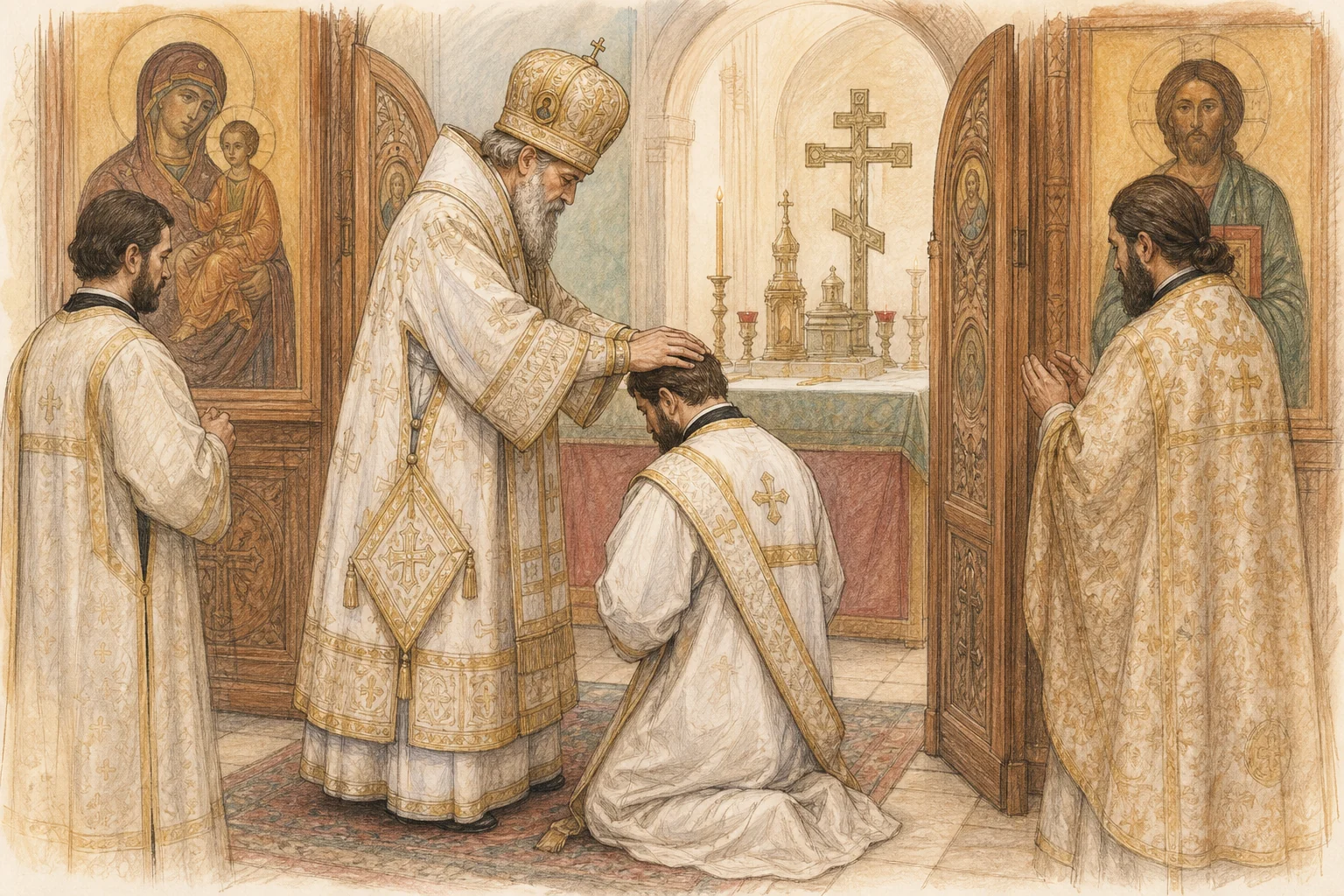
Holy Orders, or ordination, is the sacrament in which a person is appointed to serve as deacon, priest, or bishop through the Church’s prayer and the laying on of a bishop’s hands. It is not a promotion to superior status. It is the acceptance of responsibility to serve Christ and His Church.
An ordained minister does not possess private spiritual power. He receives a ministry within the Church, in unity with the bishop, the community, and apostolic Tradition.
Why Holy Orders is called a sacrament
The prayer of the Church, the laying on of hands, and the liturgical rite are visible. The grace of the Holy Spirit, strengthening the person for the entrusted ministry, is not visible. Ordination therefore cannot be reduced to a diploma, employment contract, or vote.
The sacrament does not make the ordained man’s personality infallible. He remains a human being who needs repentance, discipline, accountability within the Church, and help.
The origin of ordained ministry
Christ called the apostles and entrusted them with proclamation, the Eucharist, and pastoral care. The apostles appointed ministers with prayer and the laying on of hands. The Church recognizes apostolic succession in the continuity of canonical episcopal ordinations.
This is more than a genealogical chain. Succession also includes fidelity to apostolic faith, Eucharistic communion, and canonical unity with the Church.
Three degrees of ordained ministry
Orthodox tradition distinguishes the bishop, the presbyter—usually called a priest—and the deacon. These are not three levels of personal holiness but distinct forms of ecclesial service.
Each degree carries its own duties. No one can confer a rank on himself or advance to another degree merely through seniority.
The bishop
A bishop leads church life in a diocese, guards unity in faith, ordains clergy, and assigns their ministry. He possesses the fullness of ordained ministry. Several bishops together ordain a new bishop.
Administrative work does not exhaust episcopal ministry. A bishop is called to be a teacher, pastor, and visible center of Eucharistic unity in the local Church.
The priest
With the bishop’s blessing, a priest presides at the parish Eucharist, celebrates Baptism, Confession, Crowning, Holy Unction, and other appointed rites, preaches, and cares for people.
He does not act independently of the Church and cannot ordain another person. His parish assignment and permission to serve remain connected to the canonical authority of the bishop.
The deacon
A deacon assists the bishop and priest in worship, leads appointed litanies, proclaims the Gospel in its proper place, and participates in the practical service of the community. His title itself is associated with service.
A deacon does not celebrate the Liturgy or sacraments independently. A parish Liturgy remains possible without a deacon; the priest says the necessary petitions and exclamations.
What happens during ordination
Ordination occurs during the Divine Liturgy at the altar. The candidate is brought into the proper liturgical place, the bishop lays hands upon his head, and the prayer invoking divine grace is read. The people prayerfully witness the ecclesial event.
The act cannot be reproduced as theater outside worship. The precise order differs according to the degree being conferred.
Who may ordain?
A canonical Orthodox bishop ordains deacons and priests. The ordination of a bishop is performed by a council of bishops. A priest, deacon, or layperson cannot confer Holy Orders.
The origin of an ordination and canonical communion therefore matter. Vestments and an outward imitation of a rite are not sufficient.
Can ordination be repeated?
A person is not ordained twice to the same degree. Like Baptism, ordination is a unique ecclesial appointment. Movement from diaconate to priesthood or from priesthood to episcopacy is ordination to another degree, not repetition of the former one.
Suspension or removal from clerical ministry belongs to church discipline and judgment. A person cannot resolve it privately by changing parishes.
Ordination and appointment to minor orders
Similar Greek-derived terms can describe different acts. Ordination in the strict sense appoints a bishop, priest, or deacon. Another form of laying on of hands appoints or blesses certain minor ministries, such as reader or subdeacon, according to their rite.
A reader, altar server, singer, catechist, or parish social worker may have no ordained rank. The work remains important without becoming priesthood.
Holy Orders is not a church career
A desire to help people does not automatically constitute a call to ordination, and love for beautiful services reveals little about the full burden. A pastor carries responsibility for worship, the seal of Confession, family crises, the sick and dying, and the life of a community.
A healthy decision matures in sustained parish life and is tested by the Church. The declaration “I am called, therefore you must ordain me” contradicts the ecclesial nature of vocation.
How candidates are prepared
Spiritual education, recommendations, experience of church obedience, and examination of faith, moral life, health, and family circumstances are normally required. The bishop, not only the rector or candidate, makes the decision.
Exceptional educational provisions follow a separate church process and do not mean that formation is unnecessary. Clergy continue to study throughout life.
May an Orthodox priest be married?
An Orthodox deacon or priest may be married when the canonical marriage took place before ordination. Marriage after ordination is not permitted. A future clergyman must settle his path of family life before receiving Holy Orders.
In contemporary Orthodox practice, bishops are chosen from monastics or celibate clergy according to church norms. A priest’s family is not an accessory to an office and must be protected from unrealistic demands imposed by parishioners.
Why does the Orthodox Church ordain men?
The Orthodox Church maintains the apostolic practice of ordaining men to the episcopate, priesthood, and diaconate. This does not claim that women are less holy, less intelligent, or less capable of serving God.
Women carry many indispensable ministries in theology, education, mission, social care, music, administration, and monastic life. Baptismal dignity is shared by women and men, while ministries are not identical.
What does calling a priest “Father” mean?
The form of address honors pastoral service; it does not declare the priest an infallible owner of another person’s life. A pastor helps a Christian mature before God but does not replace conscience or gain a right to humiliation and total control.
Advice involving medicine, law, mental health, or immediate safety also requires the appropriate professional competence.
Why ask a blessing and kiss the priest’s hand?
A believer asks Christ’s blessing through the ordained minister. Kissing the hand honors the ministry and is not worship of the individual. Approach peacefully with the customary gesture; when uncertain, it is acceptable simply to ask.
A priest may be unable to pause during a particular liturgical action or hurried practical task. This is not necessarily personal rejection.
When a clergyman commits sin
A clergyman’s personal sin is serious and requires repentance. Crime or abuse must not be hidden to protect the honor of an office. Care for a harmed person takes precedence over institutional reputation, and danger should be reported to the competent church and civil authorities.
At the same time, the sacraments do not depend on a priest’s flawless temperament or mood. Canonical questions about ministry are decided by the Church, not by social-media rumors.
The participation of laypeople
The common priesthood of believers received in Baptism appears in prayer, witness, mercy, and participation in the Eucharist. It is not identical to ordained ministry, but neither is it passive spectatorship.
A parish needs people who visit the lonely, teach, sing, clean, serve children, and support those in need. Learn about community life through the parish contact page and service schedule.
Discerning a vocation
Begin not with a fantasy about rank but with stable prayer, the Liturgy, honest work, and a concrete parish responsibility. Speak with a spiritual father and family, learn the seminary requirements, and observe whether you can serve without attention or reward.
Awareness of one’s inadequacy is natural; romantic certainty also needs testing. The individual and the Church discern vocation together.
Common questions
Can a priest ordain another priest?
No. A bishop ordains deacons and priests; a council of bishops ordains a new bishop.
Are all monks priests?
No. Monastic vows and ordained rank are distinct. A monk may remain unordained, become a deacon, or become a priest.
May a widowed priest marry again?
The general canonical rule does not permit marriage after ordination. A painful personal situation cannot be settled by an internet answer; it belongs to competent church authority.
Does graduation from seminary guarantee ordination?
No. Education prepares a candidate, but the bishop makes the final decision after ecclesial examination.
Can someone resign from Holy Orders?
A person may cease active ministry, but canonical status is handled by a church decision. It is not changed by a private announcement.
The essential point
Holy Orders appoints a person not over the Church but to service within it. Bishop, priest, and deacon have different responsibilities joined by prayer, the Eucharist, and apostolic succession.
Understanding this helps parishioners avoid both idolizing a clergyman and treating him as a hired performer of rituals. Healthy church relationships require faith, responsibility, appropriate boundaries, and shared life in Christ.