
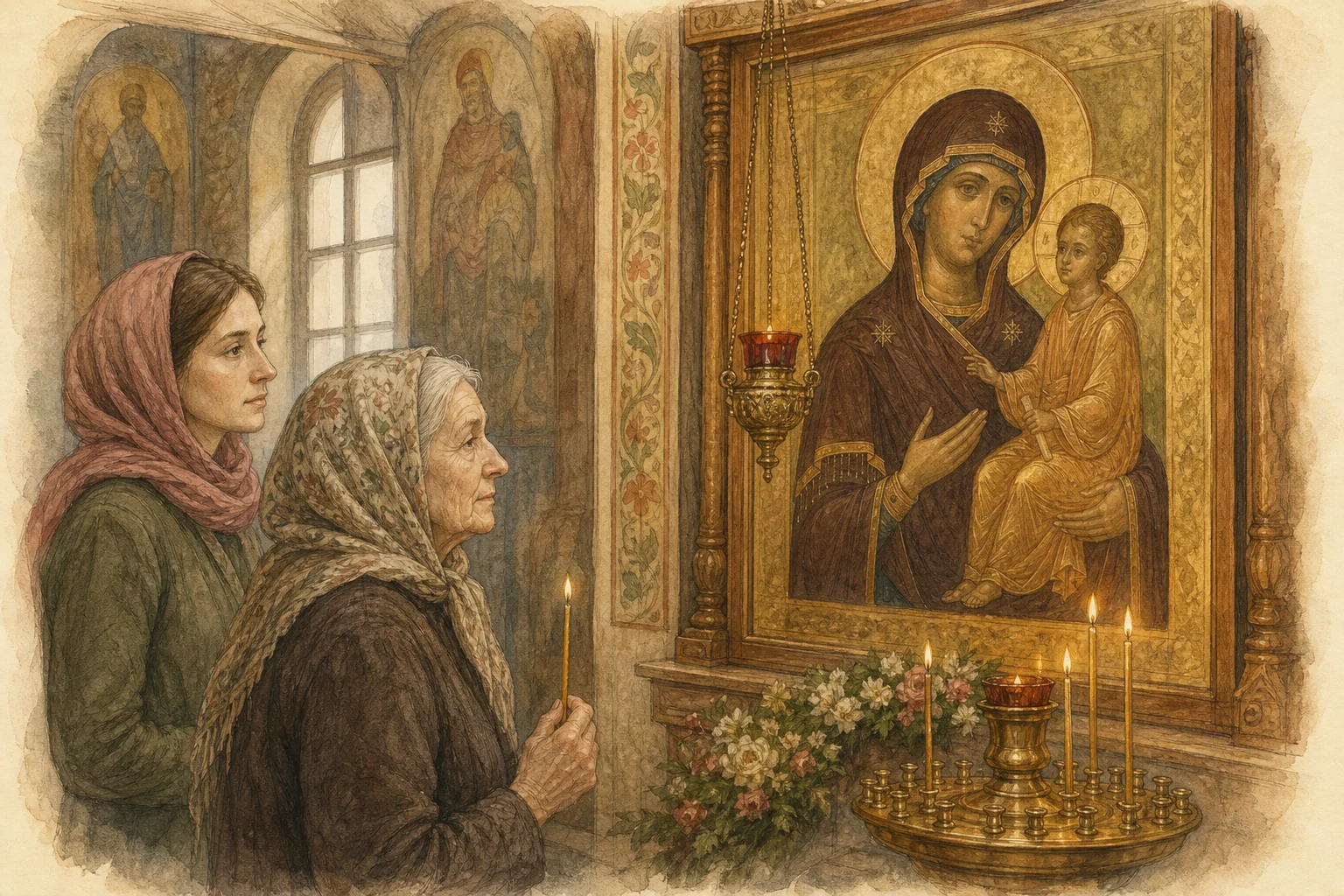
The Tikhvin Icon of the Mother of God is a revered Hodegetria image, a “She Who Shows the Way”: the Theotokos points toward Christ as the way of salvation. Its story joins ancient church tradition, an appearance near Tikhvin in 1383, decades of safekeeping outside Russia, and the return to the restored monastery in 2004.
The principal feast is July 9 in the civil calendar. A Christian praying before the icon does not address wood, paint, or an independent “power of the image,” but asks the Mother of God to intercede before her Son.
What the Tikhvin icon looks like
The Mother of God is shown half-length with the Christ Child on her left arm. Her right hand gestures toward him, while Christ blesses with his right hand and holds a scroll in his left. The Child's feet are visible, with one sole characteristically turned toward the viewer.
This composition belongs to the Hodegetria type. Its central point is not an unusual artistic detail: the Theotokos does not keep attention on herself but directs it toward the incarnate Son of God.
Why the icon is called Tikhvin
The name comes from the place of its appearance and long residence near the town of Tikhvin. It does not mean that the Mother of God helps only people from one locality.
A geographical title preserves the concrete memory of a community and its shrine. Copies of the Tikhvin icon stand in many churches, and prayer before them does not depend on distance from the historic original.
The tradition concerning Saint Luke
Church tradition connects the original image with the Apostle and Evangelist Luke and says that it was transferred from Jerusalem to Constantinople in the fifth century, where it was kept in the Blachernae church.
This is a tradition, not the result of modern laboratory analysis of the surviving panel and pigments. Saying “according to tradition” faithfully preserves ecclesial memory without claiming a scientific date that the evidence cannot establish.
The appearance near Lake Ladoga in 1383
The Holy Synod's account of the icon's return says that in 1383 the image appeared above the waters of Lake Ladoga and on June 26 in the old calendar—July 9 today—was found near Tikhvin.
The narrative describes several appearances before the final location. A modern pilgrim need not reconstruct every movement to the meter; the essential fact is how prayerful memory gathered a church and community around the image.
The church and the Tikhvin monastery
A wooden church dedicated to the Dormition of the Mother of God was built at the site. In 1560 the Tikhvin Dormition Monastery was founded to keep the icon and became an important spiritual center of northwestern Russia.
A monastery is not a museum display case for a famous object. Worship, monastic life, Confession, works of mercy, and hospitality reveal why the Church keeps a shrine at all.
What happened after the revolution
The monastery was closed in 1924, and the wonderworking icon was moved to a church in Tikhvin. The destruction of the monastery belonged to the wider tragedy suffered by church communities in the twentieth century.
The story reminds us that particular people protected the shrine, often in dangerous circumstances. Their memory should be honored without adding political legends unsupported by sources.
The icon's journey during the war
During the Second World War the image was taken to Pskov and then Riga. The Orthodox community there was led by Archbishop John Garklavs, who later carried the shrine west.
Popular summaries sometimes shorten or alter the route. The church documents provide the responsible outline: Tikhvin, Pskov, Riga, then Europe and the United States.
Safekeeping in America
Archbishop John brought the icon to the United States in 1949. After his death, his adopted son, Archpriest Sergius Garklavs, became its guardian.
The icon was held on the condition that it would return to Tikhvin after the monastery was revived. This was not private ownership of a celebrated relic but stewardship on behalf of an ecclesial community.
The return to Russia in 2004
After discussions between the Russian Orthodox Church and the Orthodox Church in America, an agreement was reached. In 2004, after roughly six decades away, the icon returned to the restored Tikhvin monastery.
Return does not imply that prayer offered in America had been less real. On the contrary, the journey became a story of keeping a sacred trust and fulfilling a promise.
When the Tikhvin icon is celebrated
The principal feast falls on July 9, corresponding to June 26 in the old calendar. The Divine Liturgy is celebrated in churches, with especially solemn worship at the Tikhvin monastery.
Always check the schedule of a particular parish. The presence of an icon does not guarantee a separate molieben at a time convenient to a visitor.
What people pray for before the icon
Christians ask the Mother of God for perseverance in faith, peace in the family, help for children, consolation in illness and grief, wisdom in travel, and protection from evil. These themes grew from generations of living prayer.
They must not become a menu of guaranteed specialties. The Theotokos prays to God for a person; the icon is not a machine that produces an event after a prescribed number of bows.
The Tikhvin icon and children
The image is often associated with prayer for children and family life. Parents may ask for health, faith, wise teachers, and protection while continuing to fulfill their own responsibilities.
Prayer does not replace a physician, practical safety, respectful conversation, or protection from abuse. A child should never be threatened that the Mother of God will punish ordinary disobedience.
Original, painted copy, and reproduction
The original normally means the historic wonderworking image kept in the Tikhvin monastery. A painted copy follows the revered composition and may acquire its own history and local veneration.
A printed reproduction can also support prayer at home. Spiritual value cannot be measured by age, price, a jeweled cover, or physical proximity to the original panel.
The Tikhvin copy in our church
A copy of the wonderworking Tikhvin Icon of the Mother of God is among the sacred objects venerated at Saint George Church in Krasavitsa. This does not mean that the original was moved from Tikhvin; the words “copy” and “original” must remain distinct.
Learn about the parish and its sacred objects on our church history page. Check the current schedule before making a special journey.
How to pray before the icon
Stand quietly, make the sign of the cross, name your need before God, and ask the Mother of God for intercession. You may use a prayer received from the Church or speak a few honest words of your own.
Do not wait for a special sensation, warmth, or sign. Prayer remains real in dryness when a person turns to God attentively and is willing to live consistently with the request.
How to venerate the icon
According to customary practice, make the sign of the cross, bow, pray briefly, and kiss the edge or a depicted hand rather than the face. When a line has formed, move peacefully and do not delay others.
Illness, limited mobility, or sensible concern about infection may make a simple bow preferable. Our detailed guide explains how to venerate icons in church without anxiety.
May the Tikhvin icon be kept at home?
Yes. Place it in a clean and respectful location, normally within the home prayer corner near an icon of Christ. An icon of the Theotokos is not ranked “above Christ” according to a family's preferred specialty.
The corner need not face an exact compass direction when the home cannot accommodate it. See our guide to arranging icons at home.
What to do with a damaged reproduction
Do not throw a blessed or prayerfully used image into ordinary household rubbish. Bring it to the parish and ask what to do; the material, condition, and local practice can differ.
Accidental damage does not place a curse on the family. Repair what can reasonably be repaired, and never pay someone who offers to “remove consequences” through fear.
Veneration versus magic
Veneration leads toward Christ, thanksgiving, repentance, and love. Magical thinking searches for a secret combination, compares the “strength” of icons, demands a particular dream or sign, and guarantees results for payment.
A miracle remains a free act of God, not a service. Even after receiving what was requested, a Christian thanks God and continues medical care, work, and personal responsibility.
How to tell a child about the icon
Begin with the Theotokos's hand: she points toward Christ. Then tell the brief story of Lake Ladoga, Tikhvin, the difficult journey, faithful guardians, and the return home.
Do not overload a child with disputed miraculous details or force a kiss on the glass. Let the child ask questions, notice the colors, and choose a short prayer.
Pilgrimage to Tikhvin
Before traveling, consult the monastery's official opening information, service schedule, photography rules, and accessibility. Pilgrimage begins with participation in prayer, not with hunting for a rare photograph.
If travel is impossible, that does not limit divine help. One may pray in the local parish, before a home icon, and through participation in the Liturgy.
Frequently asked questions
Where is the original Tikhvin icon?
The historic wonderworking image is kept at the Tikhvin Dormition Monastery.
When is the Tikhvin icon's feast?
The principal celebration falls on July 9 in the civil calendar.
Did Saint Luke paint the icon?
Church tradition says so. It should be presented as tradition rather than substituted for modern scientific dating of the panel.
May one pray before a copy?
Yes. Prayer is addressed to the Mother of God and ultimately to God; it does not depend on physical closeness to the original wood.
Does the icon help only children?
No. A person may pray about every good need without reducing the image to a narrow specialty.
The central message
The Tikhvin icon points to Christ and carries the memory of the 1383 appearance, the monastery, exile, faithful stewardship, and the 2004 return. Its long journey is not a tale about possessing a rarity but a history of fidelity and responsibility.
Approach the image without magical expectation: pray, participate in the Liturgy, care for your family, and perform the good for which you ask. The Mother of God never obscures Christ; she leads us toward him.