
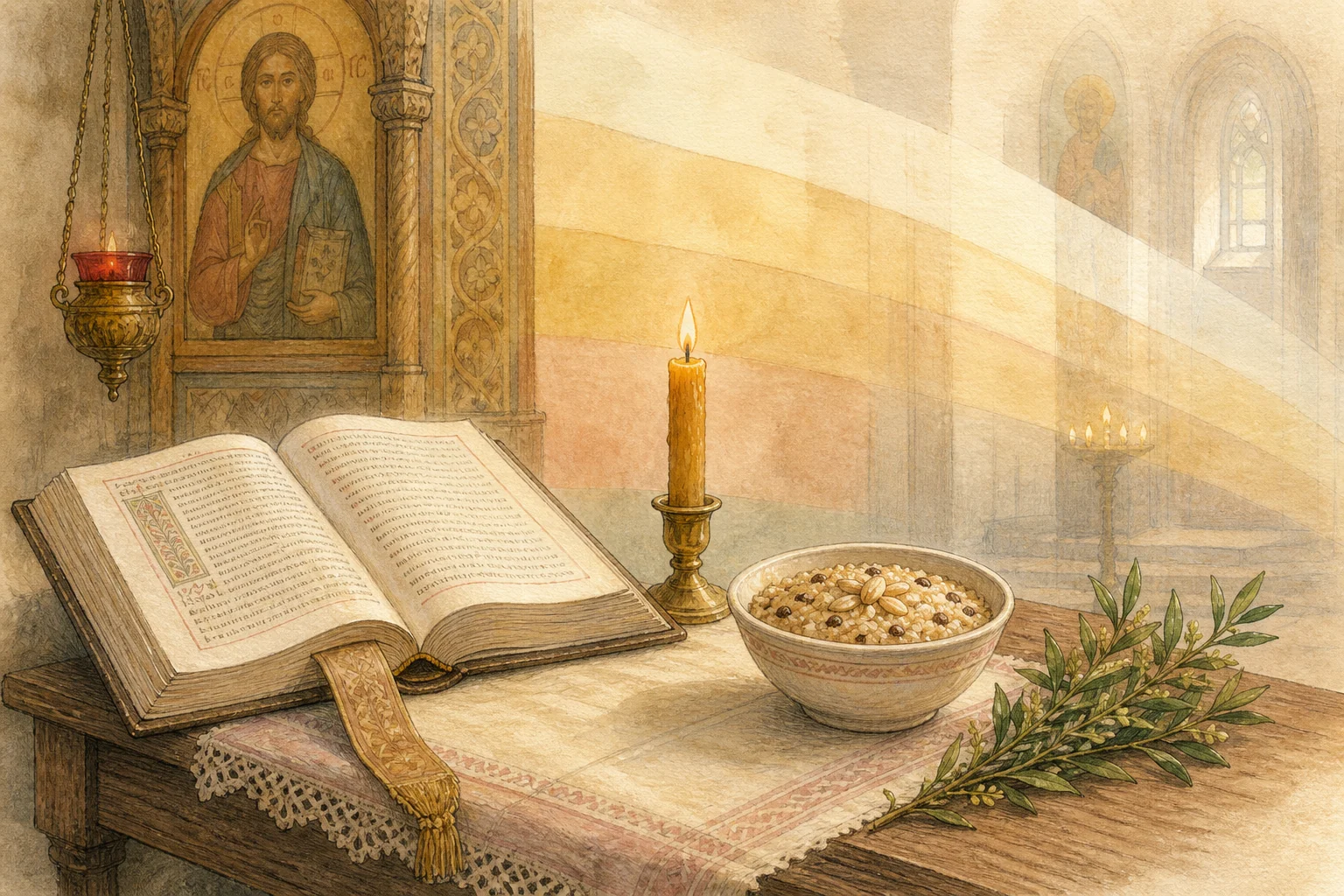
The third, ninth, and fortieth days after a death are traditional days of intensified Orthodox prayer for the departed. The date of death is counted as day one. If a person dies on the first day of a month, the third day is the third, the ninth is the ninth, and the fortieth is found by inclusive calendar counting.
These dates are not checkpoints that require a magically exact ritual. The Church asks for God's mercy, forgiveness, and rest for the person; it does not claim to calculate the invisible condition of the soul hour by hour.
Why the Church marks these days
Christian remembrance continues throughout life, but the first forty days are often experienced with particular intensity. Specific dates bring family and parish together in prayer when grief can otherwise become chaos and isolation.
The essential practices are the Divine Liturgy, a memorial service, prayer at home, and works of mercy. A particular menu, number of candles, or amount of spending does not determine the destiny of the departed.
How to count the dates
The day of death is treated as the first day regardless of the hour. The following calendar day is the second and the next is the third. The ninth and fortieth days are counted in the same inclusive way.
Do not count forty periods of twenty-four hours from the time of death and do not begin with the funeral date. Tell the parish the date of death, and staff can help confirm the calendar dates.
The meaning of the third day
The third day is associated above all with the three-day Resurrection of Christ and with faith in the Holy Trinity. The Church asks that the departed be received in the light of the Resurrection.
This does not prove that the soul must remain inside the home until a particular hour or watch every action of the family. Familiar stories of that kind should not be presented as binding doctrine.
The meaning of the ninth day
The ninth day is traditionally related to the nine orders of angels, with prayer that the person may be numbered among the heavenly assembly. The symbolism directs the heart toward divine mercy.
It does not authorize the family to describe with certainty where the soul is located or what it sees at that moment. The invisible remains a mystery held by God.
Why the fortieth day receives special attention
The number forty appears repeatedly in Scripture as a period of testing, preparation, and the fullness of a journey. Christ's Ascension takes place on the fortieth day after the Resurrection.
Orthodox tradition joins the fortieth day to earnest prayer concerning the person's life beyond death. Yet prayer is not an attempt to bribe God or reverse a decision through ceremony; it entrusts a loved one to God's justice and mercy.
Can anyone map the soul's journey day by day?
Patristic and hagiographic texts contain several images of trial after death. They should not be turned into a detailed travel map, a timetable, or a device for frightening relatives.
The Church confesses death, personal responsibility, prayer for the departed, the resurrection of the dead, and the coming Judgment. Curiosity about invisible mechanics must yield to repentance and hope.
What “newly departed” means
In prayer lists this description is commonly used during the first forty days after death. It simply marks how recent the transition from earthly life is.
After the fortieth day the name continues to be offered without the description. Prayer does not end and does not become less meaningful.
What to request at the parish
If the person was baptized Orthodox, the family may submit the name for commemoration at the Divine Liturgy and arrange a panikhida memorial service. Liturgical remembrance is united to the Eucharistic offering and has the central place.
A panikhida is a separate service of prayer for the departed. Contact the parish in advance through the parish contact page, especially when the family wishes to be present.
Liturgy, panikhida, and litiya are different
At the Liturgy the name is commemorated during the preparation of the Gifts and in the prayer of the Church. A panikhida is a fuller memorial office that may be celebrated repeatedly.
A litiya is shorter and may be served at the grave or another suitable place. The difference is explored in our article on the funeral service and the panikhida.
When to submit a name
It is best to arrive before the Divine Liturgy begins and give the baptismal name in the form used by the parish. A prayer list does not need a surname, age, cause of death, or a long explanation.
If the baptismal name is unknown or you are uncertain whether the person was baptized, say so honestly to the parish worker or priest.
When the date falls on a working day
You may submit the name beforehand, pray personally on the date, and attend a memorial service or Liturgy at the nearest realistic time. God does not measure love by an employment timetable.
Do not create conflict at work or accuse relatives who cannot travel. Shared family prayer in the evening also carries real meaning.
When no panikhida is scheduled on the exact date
The liturgical calendar and parish schedule may require a separate memorial to be moved. Arrange the nearest available service and pray at home on the commemorative day itself.
Special rules apply during Holy Week and Bright Week, when ordinary panikhidas may not be celebrated. This is not a refusal to pray for the departed but the ordering of worship around the Paschal mystery.
How to pray at home
You may use prayers for the departed from an Orthodox prayer book, read a section of the Psalter, or simply ask God to grant rest and mercy. Attention and honesty matter more than length.
If a long rule is exhausting during acute grief, a few comprehensible prayers are enough. Prayer at home complements the Divine Liturgy; it does not compete with it.
Must the Psalter be read for forty days?
This is a venerable custom, not a condition without which the person cannot be saved. Relatives may divide sections among themselves or read as much as can be sustained faithfully.
Do not promise what you cannot carry and do not hire unknown people out of fear that continuous reading is required to prevent disaster. Stable prayer without panic is better.
Almsgiving in memory of the departed
Helping someone in need, supporting a worthy ministry, delivering food to an isolated person, or serving through the parish can become an act of remembrance. The good is offered in love, not as payment for a favorable verdict.
Do not give away resources the immediate family genuinely needs, and do not donate under pressure. The size of a gift does not measure the depth of grief.
Is a memorial meal required?
A family meal is permitted and can help people remain together. It is not a sacrament and may be very simple or omitted entirely.
Begin with prayer, speak respectfully about the person, and avoid turning hospitality into a competition in expense. Alcohol does not assist prayer and can be especially dangerous during acute bereavement.
What koliva means
Boiled grain sweetened with honey or other ingredients symbolizes the seed that dies and bears new life, together with the sweetness of hope in the Resurrection. It may be blessed during a memorial service.
Recipes differ according to local custom. The absence of koliva does not invalidate prayer, and the dish should never be left as food for the deceased.
Is a cemetery visit necessary?
Visiting the grave is appropriate when health, distance, and weather permit. At the cemetery a family may pray a short litiya, care for the site, and stand quietly.
Do not leave vodka, bread, cigarettes, or other supposed gifts. The departed need prayer, while food should be given to a living person.
Mirrors, water, clocks, and household signs
Covering mirrors, stopping clocks, placing a glass of water beside a photograph, and prohibiting removal of rubbish are not part of Orthodox remembrance. Keeping or breaking these customs has no power over the soul.
If an older relative is attached to a custom, a funeral day may not be the right moment for a quarrel. Calmly distinguish a family habit from Christian teaching and refuse to nourish fear.
Dreams and a sense of presence
Grief can produce vivid dreams, involuntary memories, the expectation of familiar footsteps, and a powerful sense that the person is near. These experiences do not provide reliable knowledge of the afterlife.
Do not make major decisions from dreams. If the experiences cause terror, prevent sleep, or lead toward dangerous behavior, contact a physician or mental health professional and also speak with a priest.
When death was sudden or traumatic
Shock, guilt, and recurring thoughts may be especially severe after an accident, violence, or suicide. Do not force a simple explanation and do not place all responsibility upon one relative.
If you are thinking about your own death or cannot remain safe, seek immediate emergency help and the presence of a trusted person. Pastoral care supports but does not replace crisis medical care.
May the unbaptized be commemorated?
Personal prayer and works of mercy remain possible, but names submitted for the Eucharistic preparation are normally those of baptized Orthodox Christians. Pastoral distinctions apply to the unbaptized and non-Orthodox.
Do not conceal the circumstances or invent a baptismal name. Our separate guide explains prayer lists for the unbaptized.
How to speak with a child
Use simple truthful words: the person died, we still love that person, and we pray to God. Do not say the dead person is merely asleep or is certainly watching every action of the child.
Invite the child to light a candle safely, draw a memory, or name one quality for which the family is grateful. Never force a frightened child to approach a coffin or visit a cemetery.
What happens after the fortieth day?
Prayer continues on the anniversary of death, memorial Saturdays, birthdays and name days, and whenever the heart remembers. There is no point after which it is “too late” to submit a name.
Gradually returning to work, joy, and relationships is not betrayal. Memory can become quiet gratitude instead of permanent self-punishment.
A short practical sequence
Find the dates by inclusive counting, contact the parish, ask about the Divine Liturgy and panikhida, prepare the baptismal name, and choose a sustainable prayer at home. Tell relatives the time without pressuring them.
On the day, pray, perform an act of kindness, and stay near those who are struggling most. This is enough; an expensive meal and exact reproduction of every custom are not required.
Frequently asked questions
From which date are the third, ninth, and fortieth days counted?
The date of death is day one regardless of the hour of death.
May a panikhida be held a day earlier or later?
Yes, when the schedule or circumstances make the exact date impossible; the family can still pray at home on the day.
Is a memorial meal mandatory?
No. It is a family custom, not a condition of the Church's prayer.
Should food be left at the grave?
No. Give food to someone living and offer prayer at the grave.
Does remembrance end on the fortieth day?
No. The Church continues to pray for the departed afterward.
The central message
The third, ninth, and fortieth days give form to the first season of grief. Their strength lies not in precise household ceremony but in the prayer of the Church, hope in the Resurrection, and faithful love.
Count the dates calmly, refuse frightening maps of the invisible world, and do not measure remembrance by expense. Bring the name to the Divine Liturgy, pray at home, do good, and care for the living.